Knee flexion during leg curls
How your knee moves determines whether lying and seated leg curls actually train your hamstrings or turn into an exercise in compensating with your hips, lower back and ankles. Here, we look at why this happens and how to adjust the machine for a cleaner movement.
Why knee movement matters during leg curls
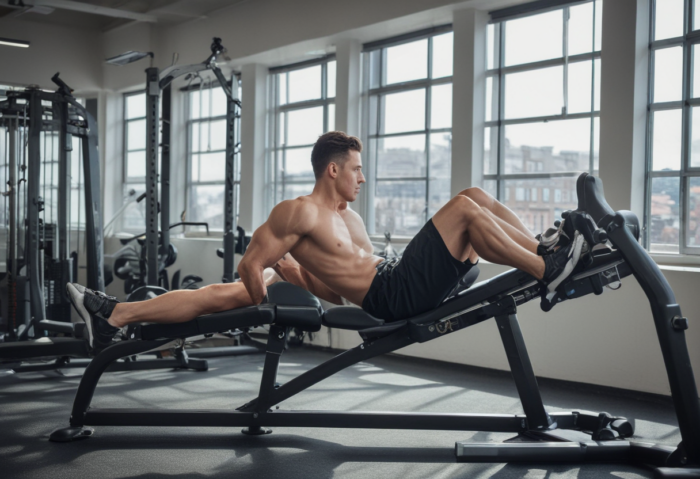
Lying and seated leg curls are very common gym exercises. They look simple: you lie on a bench or sit in a machine, position the roller behind your lower leg and curl your leg. In reality, there is a little more to the movement.
The hamstring muscle group includes the semimembranosus, semitendinosus and biceps femoris. They are all two-joint muscles. This means they contribute to both hip extension and knee flexion. The biceps femoris is the only one of these with a portion that crosses the knee joint.
The gastrocnemius also assists during leg curls. This is another two-joint muscle: it helps with knee flexion and is also the main plantar flexor of the ankle. This is why your ankle position can noticeably change how the exercise feels.
The basic principle is simple: a leg curl machine should primarily train knee flexion. But if your hips lift, your pelvis shifts, your lower back arches or your toes start contributing, the training load shifts elsewhere. You see this in the gym all the time.
How knee flexion works
Both seated and lying leg curls are intended to be single-joint movements. In other words, only your knee should move. In practice, the rest of your body does not always stay still. Your hips, lumbar spine, pelvis and ankles can all become involved in the movement.
This does not automatically mean you are performing the exercise poorly. The cause is often your own mobility or the machine’s design. If a muscle is too tight, your body looks for an easier way to move. The same problem arises if the machine does not suit your height or hip angle.
Tightness at the front of your thighs limits movement
If your quadriceps are tight, they can reach passive insufficiency during knee flexion. This particularly affects the rectus femoris. As a result, your knee may resist bending fully, even though you seem to have the strength.
Two things can help here: stretching exercises and more precise machine adjustments. Greater hip flexibility gives the rectus femoris more room to move and reduces the likelihood of reaching that limit too early.
Hamstring tightness affects your lower back
If your hamstrings are tight, the problem may appear at the other end of the movement. Trying to reach full knee extension at the end can lead to passive insufficiency. Your pelvis may then shift position, placing unnecessary strain on your lower back.
Frankly, this is where many people chase too much range of motion. Full extension is not worth it if your lower back pays the price. Keep your body position under control and choose a range that allows clean movement at the knee.
Ankle position changes how the exercise feels
If you actively use your ankle during knee flexion, the gastrocnemius can contribute more. Dorsiflexion, the position in which your toes point toward your head, improves this muscle’s length–tension relationship. This often makes leg curls feel easier.
If you want to increase the intensity of the hamstring exercise without adding weight, try keeping your ankle in plantar flexion throughout the entire movement. This takes away some of the calf muscle’s advantage and forces your hamstrings to work harder.
Knee position and machine setup
A well-executed leg curl starts with your position. Your legs should not rotate sharply inward or outward during the movement. If this happens consistently, the inner and outer portions of your hamstrings may be unevenly developed.
Try performing the exercise with your feet in a neutral position. This means maintaining steady control without holding yourself rigid. Your knees should move in the same direction your feet point, and your hips should not twist with every repetition.
Balance between your quadriceps and hamstrings also matters. Your knee joint is healthier when both muscle groups do their job. Strengthening only your hamstrings will not solve every problem if your quadriceps are tight or dominant.
If the machine allows you to adjust your hip angle, choose a position that puts your hips into greater extension. This may reduce the problem of passive insufficiency. If the machine does not allow this, you will need to pay more attention to stretching your quadriceps and hamstrings.
On a machine with a flat bench, do not let anyone forcibly press your hips down against the bench. Lifting your hips may be your body’s natural way of putting your hamstrings in a better working position for a stronger contraction. There is, however, one major caveat: this position can place considerable stress on your vertebrae.
So what actually helps? Choose a weight that lets you complete a repetition without a sudden jerk. Keep your pelvis as stable as possible, control your ankle position and make sure the movement starts at your knee, rather than your lower back.
FAQ: questions about the knee joint and leg curls
Are lying or seated leg curls better?
Both have their place. The hip angle in the seated version may suit some people better, while others feel their hamstrings working more clearly when lying down. Choose the variation that lets you control your knee movement without your lower back taking over.
Why do your hips lift off the bench during leg curls?
Your hips may lift because your body is seeking a better length–tension relationship for your hamstrings. This can increase strength, but it can also put strain on your lower back. If your hips lift substantially and you lose control, reduce the weight or adjust the setup.
Should you pull your toes toward you?
When you pull your toes toward your head, the gastrocnemius contributes more to knee flexion, which can make the exercise feel easier. If you want to feel your hamstrings working more, try keeping your ankle in plantar flexion.
Source: www.ifbb.com
Professor Mauricio de Arruda Campos
IFBB Educational Commission
Translated by Jupp, written by Professor Mauricio de Arruda Campos
Come work out! ArtGym