
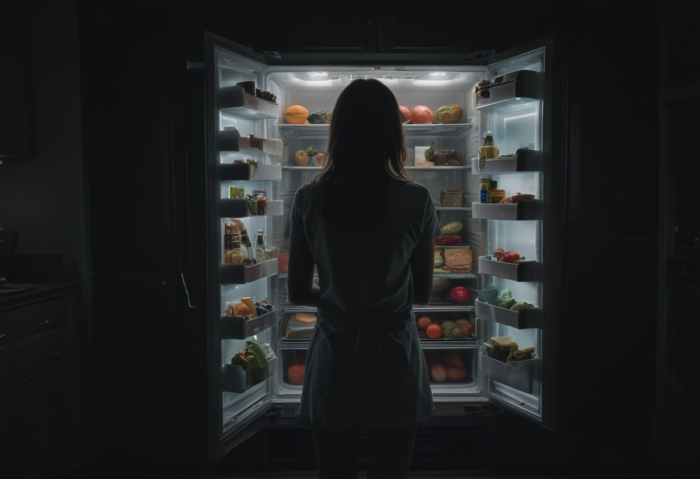
Does eating at night make you fat?
Eating at night is one of the fitness world’s most enduring debates. The popular belief is simple: eat late and you’ll get fat. Yet science shows that the reality is much more complex — and sometimes the exact opposite of what people assume.
Why do people think eating at night makes you fat?
The traditional explanation seems intuitive: nighttime is for rest, your body becomes less active and your metabolism slows down — so food eaten late turns to fat. It also seems logical that food eaten just before bed won’t be burned off.
In reality, things are more complicated. Many studies show that obesity is linked less to when you eat than to the total calories you consume over a week. Your body doesn’t synthesize fat immediately — the process takes time. The simple truth is that if your daily energy balance is negative, meaning you burn more than you consume, no meal timing will make you fat. Equally, if you consume too many calories every day, eating in the morning won’t help you keep your weight under control.
So what actually happens when you eat late in the evening? Hormones come into play.
Hormones and eating at night — a complex picture
From a biochemical perspective, eating in the evening can have both benefits and drawbacks — it depends on exactly what you eat and when.
Growth hormone secretion peaks approximately 90 minutes after you fall asleep. A key detail: the lower your blood sugar level at that point, the stronger the growth hormone surge. Growth hormone has an anabolic effect, meaning it promotes muscle growth, while also mobilizing fat stores. This means that going to bed overly full — especially after a carbohydrate-rich meal — may suppress growth hormone secretion.
On the other hand, cortisol — a hormone associated with stress — is more active in the evening than in the early morning. Cortisol has a catabolic effect: it breaks down muscle. Studies show that both protein and blood sugar suppress cortisol’s catabolic effect. So a small, protein-rich evening meal isn’t necessarily a bad thing — it may actually reduce muscle loss rather than increase it. Going to bed on a completely empty stomach isn’t always beneficial.
What has the research found?
Let’s look at the data. A study in the Journal of Nutrition (119:333-43, 1989) found that people who consumed most of their daily calories at breakfast lost more weight than those who consumed most of their calories at lunch. Research in the American Journal of Clinical Nutrition (57:476-80, 1993) confirmed that the thermogenic, or heat-producing, effect is significantly greater in the morning than at lunchtime and in the afternoon — meaning that breakfast burns slightly more calories through digestion alone.
Yet the findings are far from clear-cut: in 1995, researchers examined the eating habits of 1802 women and found no link between obesity and evening eating (Journal of the American College of Nutrition, 14:358-63). Later long-term studies included 2580 men and 4567 women. The results confirmed that people who consumed most of their calories after five in the evening showed no greater levels of obesity than those who ate more in the morning.
Frankly, that finding surprises many people — but the numbers speak for themselves.
Athletes and eating at night: a special case
All the studies mentioned above involved members of the general population, not bodybuilders or elite athletes. Strength athletes and athletes who train intensely need to account for an additional factor: intense training significantly increases the secretion of both cortisol and growth hormone. Nutrition can actively influence both.
For an athlete, a carefully planned evening meal — particularly one containing fast- and slow-digesting proteins — may be essential for recovery rather than harmful. The timing isn’t the problem; what matters is exactly what you eat.
FAQ: eating at night and weight
Does eating late slow down your metabolism?
Your metabolism naturally slows at night, but that doesn’t automatically mean fat will be stored. Your total daily calorie intake is far more important than the timing of any individual meal.
Is it better to go to bed on an empty stomach?
Not necessarily. Having a completely empty stomach before bed may amplify cortisol’s catabolic effect. A small, protein-rich snack — such as cottage cheese — is often a better choice than fasting completely, especially if you’ve trained intensely during the day.
Does an evening meal affect growth hormone?
Yes. A larger meal before bed, particularly one containing fast-digesting carbohydrates, raises blood sugar and may blunt the peak in growth hormone secretion — which occurs about 90 minutes after you fall asleep. A light meal or fasting before bed keeps blood sugar low and supports growth hormone’s natural effects.
Find fat burners here: https://turg.fitness.ee/et
Translated by Mikk-Alvar Olle. Flex
Source: WHO – healthy eating.
Come work out! ArtGym




