
In short:
- About 80% of people experience lower back pain at least once in their lifetime.
- Most cases are non-specific and resolve on their own within 4–6 weeks.
- Regular core and glute exercises are the most effective relief measures according to the science.
- Prolonged bed rest slows recovery — light movement is the better choice.
What causes lower back pain?
Lower back pain is one of the most common health complaints worldwide — according to the World Health Organization (WHO), more than 600 million people suffer from it every year. More than 80% of people experience at least one episode of lower back pain in their lifetime (Maher et al., 2017). Back pain is divided into non-specific (about 95% of cases), where no single specific pathology lies behind it, and specific, caused by a disc herniation, spinal stenosis, osteoporosis or another diagnosable condition.
The main risk factors are prolonged sitting, weak core and gluteal muscle tone, poor lifting technique, excess weight and chronic stress. Muscle cramps are often an accompanying symptom of lower back pain — tired lumbar and back muscles go into spasm, which intensifies the pain even further.
When should you see a doctor for lower back pain?
Most episodes of lower back pain resolve on their own within 4–6 weeks (Foster et al., 2018). However, there are symptoms for which a doctor’s visit is essential:
- Pain radiates into the leg or causes numbness and tingling (possible sciatica or disc herniation)
- Bladder or bowel problems together with back pain
- Pain wakes you at night and does not ease when you change position
- Fever, unexplained weight loss or a recent trauma
According to the recommendations of the Estonian Health Board, serious symptoms should always be discussed with a doctor before starting self-directed exercise therapy.
Which exercises relieve lower back pain most effectively?
Research clearly shows that movement is more effective than prolonged bed rest in treating lower back pain (Hayden et al., 2005). The best exercises based on EMG studies activate the back muscles optimally without putting excessive training load on the spine.
Cat-cow stretch
Start on all fours, with your hands under your shoulders and your knees under your hips. As you inhale, let your belly sink (cow position); as you exhale, round your back upward (cat position). Do 10–15 repetitions, 2–3 sets. The exercise increases lumbar mobility and reduces muscle spasms.
Bird-dog
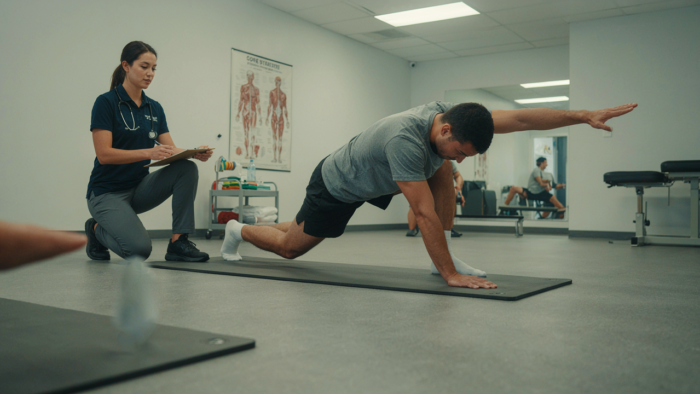
Start on all fours; extend the opposite arm and leg horizontally at the same time, hold for 3–5 seconds, then switch sides. Do 8–12 repetitions on each side, 2–3 sets. A meta-analysis by Searle et al. (2015) confirmed that stabilization exercises such as the bird-dog significantly reduce the intensity of chronic lower back pain.
Glute bridge
Lie on your back with your knees bent and your feet hip-width apart. Lift your hips off the floor, squeeze your glutes, hold for 2–3 seconds, then lower slowly. Do 12–15 repetitions, 3 sets. Glute weakness is one of the main risk factors for lower back pain — the bridge improves pelvic stability by strengthening the gluteal muscles.
Knee-to-chest stretch
Lie on your back; pull one knee toward your chest with both hands and hold for 20–30 seconds, then switch legs. It stretches the piriformis muscle and relieves tension in the lumbar region.
Pelvic tilt
Lie on your back with your knees bent; press your lower back into the floor by tightening your abdominal muscles. Hold for 5 seconds, then relax. Do 15–20 repetitions. It activates the transversus abdominis muscle, which supports spinal stability.
Training with Pilates exercises is ideal for people with chronic lower back pain — controlled movements and deep core activation help restore muscle balance without added risk.
How can you prevent lower back pain?
A preventive approach is always more effective than treatment. Even athletes in dynamic sports benefit from specialized core training — the article how to jump higher — exercises basketball players could do confirms that a strong core and glutes are the foundation of both athleticism and back health.
Practical prevention measures:
- Stand up every 30–45 minutes and move around for 2–3 minutes
- Add core stabilization exercises to your training program at least 2–3 times a week
- When lifting, keep your spine in a neutral position and lift with your legs, not with your spinal erectors
- Check your desk ergonomics: chair support, screen distance and height
- Pay attention to sleep quality — your mattress should support the natural curve of your spine
References
- Maher C, Underwood M, Buchbinder R. (2017). Non-specific low back pain. The Lancet. PMID: 27745712
- Foster NE, Anema JR, Cherkin D, et al. (2018). Prevention and treatment of low back pain: evidence, challenges, and promising directions. The Lancet. PMID: 29573872
- Hayden JA, van Tulder MW, Malmivaara AV, Koes BW. (2005). Meta-analysis: exercise therapy for nonspecific low back pain. Annals of Internal Medicine. PMID: 15867409
- Searle A, Spink M, Ho A, Chuter V. (2015). Exercise interventions for the treatment of chronic low back pain: a systematic review and meta-analysis of randomised controlled trials. Clinical Rehabilitation. PMID: 25681408
Frequently asked questions
Is it better to rest or stay active with lower back pain?
Gentle movement and stretching are generally a better choice than bed rest — research shows that an active approach speeds up recovery (Hayden et al., 2005). Complete rest is recommended only during the first 24–48 hours in case of acute pain.
How long does recovery from lower back pain take?
Most non-specific episodes of lower back pain resolve within 4–6 weeks. Chronic lower back pain lasting more than 12 weeks needs a more structured treatment program and medical supervision.
Can I do lower back pain exercises without a doctor’s approval?
Gentle stretching and stabilization exercises are generally safe. If the pain radiates into the leg, numbness occurs, there has been a trauma or you have bladder problems, see a doctor before training.
Which exercises should you avoid with lower back pain?
During the acute pain phase, avoid strength training with a high training load, prolonged forward bending while sitting, and spinal rotations under full training load. Low-intensity stabilization exercises are better suited to people with back pain.
Can lower back pain be a sign of a more serious condition?
Rarely, but it can. See a doctor if the pain is accompanied by fever, unexplained weight loss, bladder problems, numbness radiating into the leg or night pain — these may point to an infection, a tumor or nerve root damage.
Come and train! ArtGym




