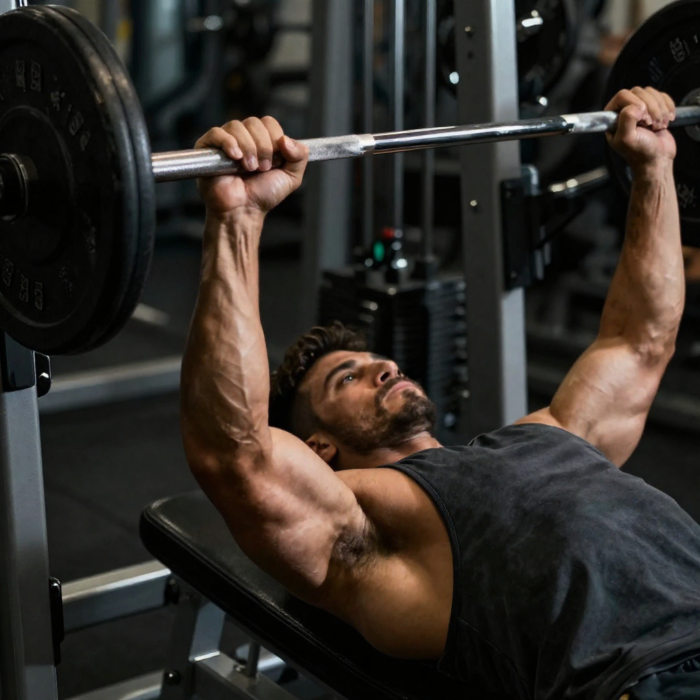
Mass and strength training for big gains
Mass and strength training starts with a simple idea: first construct a strong body, then sharpen the definition. Without muscle mass, even the leanest physique looks skinny rather than powerful. This old story by C.S. Sloan, from the April/1997 issue of Musclemag, pp. 216-222, is about exactly that.
Why does mass and strength training work?
One thing is certain: a lean, defined body looks good. But without mass, there isn’t much to define. Just as a sculptor first needs a block of raw material, a lifter needs muscle to shape later.
Jaan, or Jean-Pierre Fux, was once a small boy who got teased. He wanted to get big. Not just a bit bigger, but gigantic. He had already been training for a whole year, but in a fairly typical way: 20–30 sets for chest and arms, a few sets for shoulders and back, and even fewer for legs.
This sounds familiar even today. Many young people start with the muscles they can see in the mirror. Chest. Biceps. A bit of shoulders. Legs come last, if at all. The result is often fatigue, not growth.
The author noticed Jaan in the gym while training legs himself. He offered to help and made a small bet: if Jaan trained his way for a while and also watched his nutrition, he would start to grow. Jaan accepted. A couple of months later the picture was different. Fewer sets, more thought, more rest and heavier work did the trick.
A simple truth: muscle doesn’t grow just because you exhaust it endlessly. It grows when you give it a strong reason to adapt and then enough time to recover.
Mass and strength training: 4 methods
Below are 4 old-school methods built on the same idea: heavier weights, limited sets and a clear focus. These aren’t comfortable workouts. They are short, heavy and demand honesty about technique.
Strength-style supersets
Strength-style supersets suit anyone who wants to build quality mass and improve strength at the same time. The principle is to train opposing muscles together: chest and back, biceps and triceps, quadriceps and hamstrings.
Take an arm day, for example. Choose 2 exercises for biceps and 2 for triceps. Standing barbell curls and Scott bench curls work well for biceps. Lying extensions and cable pushdowns work well for triceps.
The first pair is standing curls and lying extensions. The second pair is Scott bench curls and cable pushdowns. Set up your equipment so you can move quickly from one exercise to the other. Start with a weight you can lift for 10–12 repetitions. Do the biceps exercise, go straight to triceps and keep the repetition range the same.
Then add weight. The next round could use a weight that allows 8 repetitions. Continue at the same pace, without resting in between, until you reach the range of 2 or 3 repetitions. After the 5th or 6th superset you should have reached your maximum for the day.
Now rest 3–5 minutes and do a second strength superset following the same scheme. The whole routine is very intense and shouldn’t take longer than 12–15 minutes, rest excluded. The pump is strong, but the weights are quite serious too.
Don’t let a short workout fool you. A short workout doesn’t mean shorter recovery.
The heavy-weight method
Shorter, more intense workouts are not a new fad. Mike Mentzer was already talking about them in the late 70s and early 80s. At the time, Arnold, Franco Columbu and Serge Nubret dominated, and they favored more sets and repetitions. Mentzer’s ideas faded into the background for a while.
Later, Dorian Yates, Dave Fisher, Aaron Baker and David Dearth picked up parts of this approach again. They didn’t train exactly like Mentzer, but the message stayed the same: less can be better if the work is hard enough.
Take a chest workout, for example. At the start, do one or two warm-up exercises to get blood flowing into the chest and shoulders and to have your elbow joints ready. Then choose the incline barbell press.
Start with the heaviest weight you can press for 6–8 repetitions. You need a training partner here. When you reach failure, your partner helps you do 2–3 more forced repetitions. After that come 2–3 negative repetitions. Rest 2 minutes, or until you feel ready for a new set.
With this method, a couple of exercises and 4–5 sets are enough. If you’re used to doing a lot of volume, such a sharp switch can give you a fresh push. According to old bodybuilding lore, Dorian’s progress between Mr. Olympia 92 and 93 is a good example of what harder, more focused work can do.
Short-range partial reps
Partial reps are also an old technique. Larry Scott and Dave Draper were already using it in the fifties. Later, the book Power Factor: The Science of Bodybuilding brought it back into the conversation.
The idea is simple: the muscle feels tension, not necessarily a beautiful full range of motion. Short-range partial reps let you use heavier weights and put a different training load on the muscle. For example, if you press 100kg for 6 repetitions through a full range of motion, you might do partial reps with 120kg for about 8–12 repetitions.
That doesn’t mean you should load a barbell heavily on cold muscle right away. The risk is real. Heavy weights can lead to injury if your warm-up is poor or your ego is driving your technique.
The method seems to work better for the chest, shoulders, triceps and legs. For calves, back and biceps the effect is less convincing. A shoulder workout example looks like this:
- Dumbbell lateral raises 3 x 12 15
- Behind-the-neck press 2 x 6 8, partial reps
- Military press (from the chest) 2 x 6 8, partial reps
Do the isolation exercise through a full range of motion so the shoulder warms up and your feel for the muscle improves. Rest 30 45 seconds between dumbbell raises. Rest 2 3 minutes between sets with partial reps.
One and a half
Honestly, even the original author has no idea who invented this technique. But the method is clear: do one full rep and immediately follow it with a half rep. This keeps the muscle under tension longer and gives you a strong pump.
Vince Gironda used it a lot. For him, the one-and-a-half method helped improve the feel for the muscle and the pump effect he had previously struggled with. For the chest, deltoids and triceps it may work especially well.
Here you need to reduce the weight. If you can normally do 8 reps, with the one-and-a-half method you may only get 5 reps with the same weight. That isn’t failure. The tension is simply longer and the work denser than in a regular set of 8 reps.
How do you put training, food and recovery together?
These methods only work if the rest of your life supports them. Training is one half. Nutrition, sleep, rest and mental readiness are the other half. If you eat too little and sleep badly, no clever superset will save you.
In your nutrition, put protein first and carbohydrates second. The original text uses the word “proteins”, but the idea is the same. Many people who train hard don’t grow because they get too little protein and too few calories. If you’re very thin, you don’t need to be afraid of foods like eggs, whole milk and red meat. Your daily intake can be at least 3500 calories a day, sometimes even up to 6000.
If you’re overweight, the approach is different. Then your intake may stay between 1700 and 2400 calories, and you need to monitor your fat intake more carefully. If regular food doesn’t provide enough protein, you can use supplements such as protein powders or amino acids.
Recovery is the next big place where progress stalls. Workouts should be short and sharp, lasting no more than 90 minutes. Even better would be 45 60 minutes. If you’re a natural athlete, it makes no sense to train more than 2 days in a row without a rest day.
One simple split might look like this:
- Day 1 chest and back
- Day 2 legs
- Day 3 off
- Day 4 arms and shoulders
- Day 5 off
- Day 6 start the cycle over
It doesn’t look impressive on paper, but that’s exactly where its strength lies. Big exercises, proper effort and enough rest. If you go into every workout half-focused, you’ll get half the result.
Practical tips for mass and strength training
Pick one method at a time. Don’t try strength supersets, the heavy-weight method, partial reps and the one-and-a-half technique on every muscle in the same week. That would be more confusion than system.
Write your weights down. If you do 6 8 reps or work in the range of 2 or 3 reps, you need to know clearly what happened last time. Memory lies. A training log doesn’t lie as easily.
Warm up your joints, not just your ego. Especially with partial reps and forced reps, your body needs to know what’s coming. Do the first sets with clean technique and don’t rush to the heaviest barbell.
A training partner is essential for some of these methods. On the incline bench, 2 3 forced reps and 2 3 negative reps are not the place to count on luck. A good partner helps only as much as needed and doesn’t pull the barbell up for you.
And finally: believe in the method long enough for it to work. Not blindly, but honestly. If you change your plan every week, you can’t know whether the problem was the training, the eating, the sleep or your impatience.
FAQ: mass and strength training
Are these methods suitable for beginners?
A true beginner should first learn the technique of the basic exercises. Once your movements are clean and your body tolerates the training load, you can use these methods in moderation.
How long should you use one method?
Give a method at least several weeks, not one random workout. If your strength, body weight or measurements are going up and your recovery stays good, there’s no reason to switch right away.
What is the biggest mistake when building mass?
The biggest mistake is thinking that more sets always means more muscle. Without food, sleep and recovery, high volume just becomes wasted energy.
Author: Fitness.ee
Source: WHO – physical activity.
Come and train! ArtGym