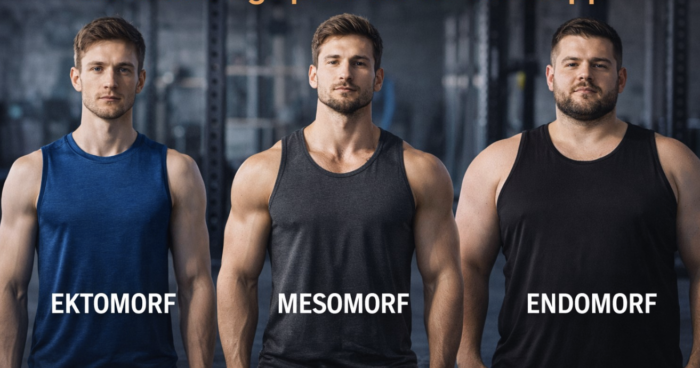
Mesomorph and other body types in the gym
The mesomorph is a body type that often gets visible results quickly from gym work. But knowing the name of your body type won’t make anyone strong or fit. What matters is understanding how your body responds to training, food and recovery.
Why does the mesomorph matter at all?
The best-known researcher of morphology in the 20th century was Dr. William H. Sheldon of Harvard University. He divided body types into three groups: ectomorph, endomorph and mesomorph. Today these labels shouldn’t be treated as a final verdict, but in the gym they still offer a simple framework to start from.
The simple truth is that people don’t all respond to the same program in the same way. One person adds muscle even when training modestly. Another eats a lot and trains hard, yet the scale stays put. A third builds strength well but has to work harder on body fat percentage.
This is exactly where body types become practical. They don’t tell you who you are; they help you spot a pattern. When you know your strengths and weak spots, it’s easier to choose your training volume, your weights and the pace of your recovery.
How does a mesomorph respond to training?
In Sheldon’s classification, the mesomorph sits between the two extremes. In the bodybuilding world it is often considered the most rewarding body type, because a mesomorph generally finds it easier to build quality muscle mass and keep an athletic look.
The original text put it quite bluntly: a mesomorph who only occasionally “lifts iron” can look better than a strong but fat endomorph or a lean but slight ectomorph. That sounds harsh, but the point is clear. The mesomorph’s body responds well to strength training.
Mesomorphs often have a predominance of fast-twitch muscle fibers. These tolerate high intensity and help build muscle mass. The downside is that endurance may not be as good. It can still be improved with well-thought-out training, for example by varying the length of your sets and the number of repetitions.
None of this means a mesomorph can train carelessly. If training load, sleep and food are out of balance, progress stalls even for someone with a good starting point. The advantage shows when training is consistent and heavy enough, but not endlessly exhausting.
What do ectomorphs and endomorphs need differently?
An ectomorph typically has long, slender limbs and a very low body fat percentage. These are the people who are often asked what they do to stay so skinny. Honestly, the answer may be: nothing special. The ectomorph is the classic “hard gainer”.
In the gym, an ectomorph’s capacity may be small at first. Running or other aerobic sports often suit them better, but that doesn’t mean muscle training is pointless. Volume and recovery simply have to be chosen wisely.
The endomorph is the opposite of the ectomorph. An endomorph’s build may resemble a pear, yet the muscles can respond well to training. At the same time, lowering body fat percentage is often the first big goal. At the start it can help to do 15 minutes of aerobic work two to three times a week. Once your body adapts, you can extend both the length of the aerobic work and the number of training sessions.
To describe a body type more precisely, Sheldon used a 7-point scale. In each category a person falls somewhere between 1 and 7. Many male bodybuilders may land in the range from 1-6-3 to 3-5-1, where the order is endo, meso, ecto. An ectomorphic 2-3-6 build, however, can quickly overreach on pro bodybuilding programs.
There’s an important difference here. If an ectomorph copies the program of Ronnie Coleman or Chris Cormier, they won’t automatically get the same physique. Not everyone has the same skeleton, metabolism, muscle tissue type or recovery capacity. The claim that an ectomorph could simply will their way up to a competition weight of 130 kilos is highly questionable.
The mesomorph and choosing your training in practice
So what actually works? The best approach is to look at how your body really responds to training load. If muscle grows well but endurance lags behind, a mesomorph needs more moderate work in addition to heavy sets. If body fat percentage tends to creep up, you need to keep a closer eye on nutrition and aerobic activity.
Ectomorphs often have a predominance of slow-twitch muscle fibers. These give good endurance, but muscle growth is slower. The original text recommended using 80-90 percent weights in heavy workouts, where 100% = your maximum capacity, and 60-70% on lighter days. The idea is to alternate the training load rather than squeeze yourself dry every time.
A beginner ectomorph can start with lighter weights and longer sets. As they progress, the sets get shorter. You can also take a week-long break every four weeks to reduce the risk of overtraining and injury.
Alternating heavy and light days actually suits the other body types too. On heavy days you can build strength. On lighter days you can maintain technique, range of motion and blood flow without completely shutting down recovery.
Don’t use your body type as an excuse. Use it as a tool. If you know you lean mesomorph, take advantage of your good response to training, but don’t leave recovery to chance. If you lean ectomorph or endomorph, choose a program that takes your body into account, not a magazine cover star’s.
FAQ: mesomorph and body types
Does a mesomorph gain muscle more easily?
Yes, often. A mesomorph’s body usually responds well to strength training, but progress still depends on training, food and recovery.
Is a person only one specific body type?
Usually not. Many people are a mix of different traits. The whole point of Sheldon’s 7-point scale was to show that a body type can sit between several characteristics.
Should an ectomorph avoid heavy strength training?
No. They simply need to manage their training load more carefully. Alternating heavy and lighter days helps build strength without excessive overtraining.
Author: Marek Morozov
Source: WHO – physical activity.
Come and train! ArtGym