
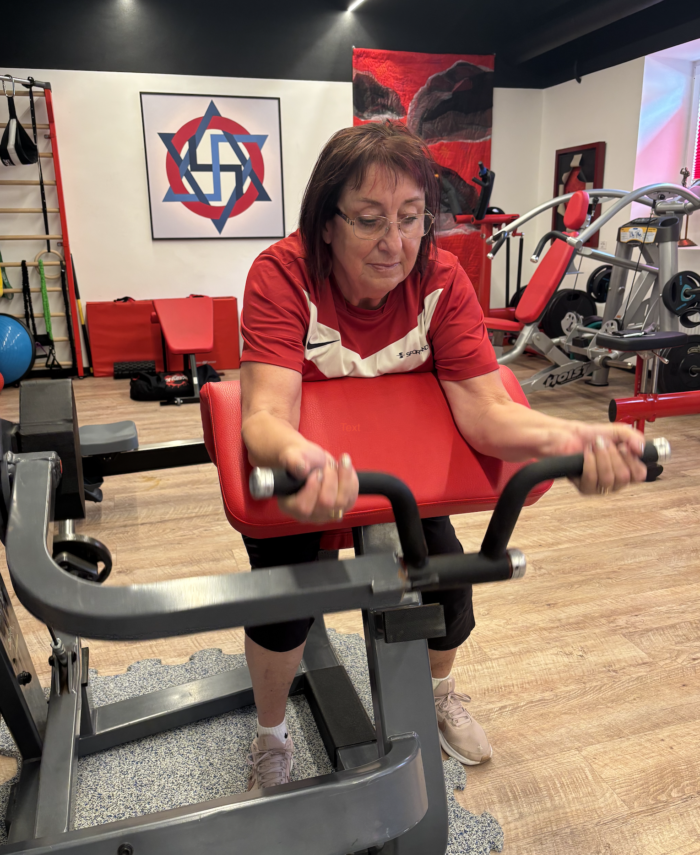
At a glance:
- Muscle loss becomes significant when it is accompanied by declines in strength, movement speed and the ability to manage everyday tasks.
- The most practical initial measure is grip strength or repeated chair rises, because EWGSOP2 identifies low muscle strength as the primary feature of sarcopenia.
- The main way to slow the decline is through consistent strength training, adequate energy intake and a protein-rich diet, rather than a single supplement or an occasional block of training.
Introduction
Muscle loss is an age-related change, but that does not mean you have to accept a rapid decline in strength, balance and independence. An evidence-based approach distinguishes a simple change in body composition from sarcopenia: what matters is whether declining muscle mass is accompanied by a measurable deterioration in strength and physical performance. The WHO framework for healthy aging emphasizes functional ability, rather than simply the absence of diagnoses: WHO Healthy Ageing.
How does muscle loss develop with age?
Muscle loss develops slowly through a combination of factors: signals from the nervous system to the muscles weaken, fast-twitch muscle fibers decline in both proportion and size, inflammatory and hormonal changes can affect recovery, and physical inactivity accelerates the decline. A quantitative review reports that after about age 50, muscle mass may decline by approximately 1–2% per year, but strength can fall faster than muscle mass itself (Mitchell, 2012). This is why the mirror, body weight and even measurements of muscle mass alone do not give you the full picture.
The modern approach to sarcopenia starts with muscle strength. The EWGSOP2 consensus states that low muscle strength indicates probable sarcopenia, low muscle quantity or quality confirms the diagnosis, and poor physical performance indicates severe sarcopenia (Cruz-Jentoft, 2019). In practical terms, the question is not just how much muscle you have, but whether you can rise from a chair, walk steadily, carry a shopping bag and use stairs.
If your goal is to build or preserve muscle, it is worth avoiding the same pitfalls described in the Fitness.ee article When people try to build muscle mass, what are the mistakes that: an inadequately defined training load, impatience and underestimating nutrition. The principle stays the same as you get older, but the margin for error is smaller.
How can you measure muscle loss at home and in a clinic?
Assessment at home should start with function. Record how many times you can rise from a chair with control, whether using stairs is becoming harder and whether your walking pace is slowing. If you have access to a dynamometer, grip strength provides a simple, repeatable measure. EWGSOP2 defines low grip strength as below 27 kg for men and below 16 kg for women, and slow walking speed as 0.8 m/s or less (Cruz-Jentoft, 2019). These figures are not a basis for self-diagnosis, but a signal that a more detailed assessment is worthwhile.
In clinics or research, muscle quantity is measured more precisely using DXA, bioelectrical impedance, computed tomography or magnetic resonance imaging. Each method has limitations: bioelectrical impedance depends on hydration status, DXA shows fat-free mass but does not capture all aspects of muscle quality, and more expensive imaging methods are not needed routinely. The Health ABC study showed that strength declined markedly in older adults even when changes in muscle mass were smaller, and that muscle quality mattered for function (Goodpaster, 2006). The best assessment therefore combines three elements: strength, muscle quantity and mobility.
It is important to measure the same thing in the same way. If you are testing chair rises, use the same chair and the same technique. If you are tracking body composition, do not compare ad hoc measurements taken on different devices. Record the exercise, weight, reps and how you feel in your training log, because subjective impressions are useful but imprecise on their own; this idea also ties in with How you feel is hard to measure….
How can you stop muscle loss through training?
The most effective practical tool is progressive strength training. ACSM recommends that older adults engage in regular physical activity that includes exercises to develop muscle strength on at least 2 days per week, alongside aerobic, mobility and balance training (Chodzko-Zajko, 2009). The word “progressive” is key here: over time, your muscles need a slightly greater or more deliberately managed training load.
A good program does not have to be complicated. Start with basic movement patterns: a squat or chair rise, a hip thrust or a light deadlift variation, presses, pulls, carries and calf raises. If joint issues or balance limit you, use machines, resistance bands or supported variations. The aim is not to push to your maximum in every workout, but to keep the exercises challenging enough, maintain consistent technique and allow for recovery.
If you have not trained for a long time, it makes sense to start with a lower volume and gradually increase your training load. Peterson’s meta-analysis found that resistance training improves muscle strength in older adults, with benefits seen across different decades of later adulthood (Peterson, 2010). In plain language: you do not need an “athletic background” to get started. Consistency matters more than a perfect program.
For motivation, it helps to ask why this matters to you in the first place. For some, the answer is athletic fitness; for others, it is lifting a grandchild, moving independently or being able to work. Why I do all this explores that personal motivation well. Stories of experiences in bodybuilding and strength training, such as Oh, that Ott, also remind us that muscle is not just about appearance: it is the result of sustained work and habits.
What role do protein and recovery play?
Protein intake is important for preserving muscle mass, but it should not be considered in isolation. If your overall energy intake is too low, you have no training load or your sleep is consistently poor, one protein-rich meal will not solve the problem. A practical goal is to spread high-quality protein sources throughout the day and combine them with strength training, because your muscles need both building material and a signal to preserve it.
Managing recovery also becomes important as you get older. The same workout that suited you when you were younger may require a longer warm-up, more rest between sets or smaller increases in weight. If muscle loss is accompanied by rapid weight loss, falls, loss of appetite or a new illness, it is worth involving your family doctor, a physiotherapist or a clinical nutrition specialist. This is no place for sales promises: the goal is to reduce risks and improve measurable function.
When should you be concerned about muscle loss?
Rather than worrying, look for a pattern. If you are losing strength, avoiding stairs, walking more slowly, falling more often or can no longer manage everyday tasks you used to do, you have a clear reason to act. EWGSOP2 recommends identifying possible cases through simple checks and measurements, then confirming the condition by assessing muscle mass or quality (Cruz-Jentoft, 2019).
A good action plan is simple: establish your baseline, do strength training consistently, eat enough, monitor your body weight and physical function, and adjust your training load. Muscle loss is a biological process that cannot be prevented entirely, but its rate and impact can often be significantly influenced. The best indicator is not one impressive measurement, but whether you move more confidently, get up more easily and maintain your independence.
References
- Cruz-Jentoft AJ, Bahat G, Bauer J, Boirie Y, Bruyère O, Cederholm T, Cooper C, Landi F, Rolland Y, Sayer AA, Schneider SM, Sieber CC, Topinkova E, Vandewoude M, Visser M, Zamboni M (2019). Sarcopenia: revised European consensus on definition and diagnosis. Age and Ageing. PMID: 30312372. DOI: 10.1093/ageing/afy169
- Chodzko-Zajko WJ, Proctor DN, Fiatarone Singh MA, Minson CT, Nigg CR, Salem GJ, Skinner JS (2009). American College of Sports Medicine position stand. Exercise and physical activity for older adults. Medicine & Science in Sports & Exercise. PMID: 19516148. DOI: 10.1249/MSS.0b013e3181a0c95c
- Mitchell WK, Williams J, Atherton P, Larvin M, Lund J, Narici M (2012). Sarcopenia, dynapenia, and the impact of advancing age on human skeletal muscle size and strength; a quantitative review. Frontiers in Physiology. PMID: 22934016. DOI: 10.3389/fphys.2012.00260
- Goodpaster BH, Park SW, Harris TB, Kritchevsky SB, Nevitt M, Schwartz AV, Simonsick EM, Tylavsky FA, Visser M, Newman AB (2006). The loss of skeletal muscle strength, mass, and quality in older adults: the Health, Aging and Body Composition Study. The Journals of Gerontology Series A. PMID: 17077199. DOI: 10.1093/gerona/61.10.1059
- Peterson MD, Rhea MR, Sen A, Gordon PM (2010). Resistance exercise for muscular strength in older adults: a meta-analysis. Ageing Research Reviews. DOI: 10.1016/j.arr.2010.03.004
Frequently asked questions
Is muscle loss the same as sarcopenia?
Not quite. A decline in muscle mass is one part of the problem, but assessing sarcopenia focuses first on muscle strength, followed by muscle quantity and physical performance.
What is the simplest way to assess your risk?
Monitor your grip strength, ability to rise from a chair, walking speed and ability to use stairs. If these decline, a more detailed assessment is worthwhile.
Does walking stop muscle loss?
Walking supports health and endurance, but maintaining muscle usually also requires resistance training, which gives your muscles a clear stimulus to develop strength.
Is protein powder necessary?
Not necessarily. Your overall daily diet and strength training come first; a protein supplement can be a convenient way to top up your protein intake if you are not getting enough from regular food.
Come and work out! ArtGym




