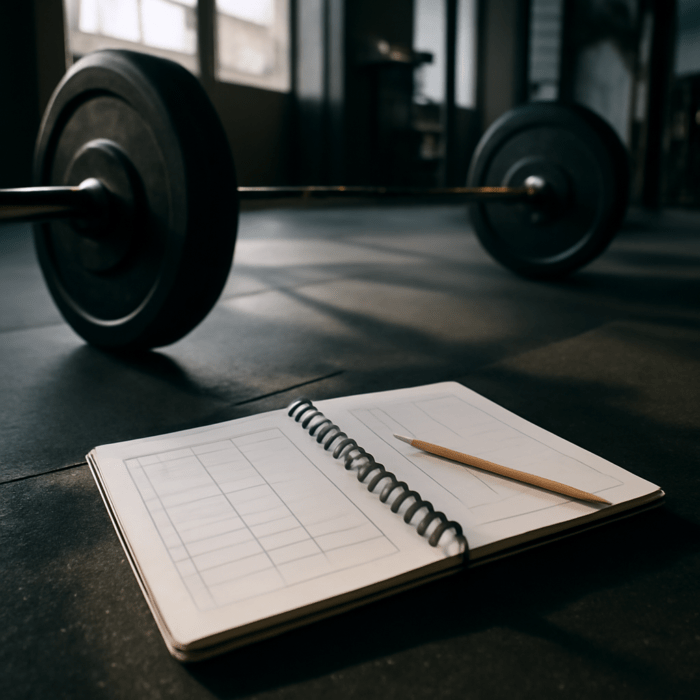
How you feel in the gym is hard to measure
How you feel is hard to measure, even though everyone who goes to the gym knows how satisfying it is when you feel a muscle working and your workout “hits the spot”. But a good pump alone cannot sustain progress. If you want to get stronger or build muscle mass, you need to look at your weights, sets and reps as well as how you feel.
Why can’t you rely on feel alone?
There is plenty of talk about the mind-muscle connection, especially in bodybuilding. And rightly so. When you do lateral raises for your shoulders, cable rows for your back or biceps curls, it helps to know which muscle is actually working. This helps you improve your technique and keeps the purpose of the exercise clear.
But there is a catch. How you feel varies from day to day. Some days, the bar moves easily even though you slept poorly. On others, even your warm-up set feels heavy, despite the strength being there. Sometimes, how you feel and what the numbers show tell completely different stories.
“I worked hard in today’s workout, focused well on the muscles working and got a good pump” may be an honest assessment of one workout. Over the longer term, it is not enough. If you do not know what weight you used, how many sets you did or whether your reps increased, it is hard to tell whether you made progress or simply had a good day.
To be fair, listening to your body matters. Pain, fatigue and poor recovery deserve attention. But if every slight increase in perceived difficulty automatically leads to an easier workout, you will miss out on much of the effort you need to put in.
Numbers support how you feel, not the other way around
In strength training, you need some way to manage your training load. The simplest approach is to keep a record: exercise, weight, sets and reps. These are things you can write down and compare later. You can describe how you feel, but you cannot measure it precisely.
Think about muscle tension. It matters for progress, but you do not measure it directly during a typical workout. You do not write down that today there was “a lot of tension” and next week “a little more tension”. That does not give you enough information. The weight on the barbell or dumbbell does.
If the weight you use for a ten-rep set of squats increases by 10-15 kg every 2-3 months, it is hard to argue that nothing is changing. A year later, your legs will probably be stronger and bigger. Not because everything always felt perfect, but because your body had to adapt to doing more work.
This does not mean chasing a one-rep max. If your goal is muscle mass, it makes sense to track whether the weights you use for working sets of 8-15 reps increase over time. If your goals are more focused on strength and speed, progress in sets of 1-8 reps matters more.
How can you actually track your training?
Getting started can be very simple. After your workout, record the basics: exercise, sets, reps, weight and a brief note on how you felt. The note can be one sentence. For example: “good technique”, “last set was hard”, “shoulder was bothering me”.
This gives you two perspectives. The numbers show whether your training volume and weights are changing. How you feel helps you judge whether you are making that progress with sound technique or simply pushing through at any cost.
The simple truth is that if you want to progress, you need to know what you did last time. Otherwise, your workouts are more likely to follow your mood than your plan.
Feel is hard to measure, but you can still use it
Feel is not the enemy. It is a tool. A good mind-muscle connection helps you keep an exercise under control, avoid sloppy use of momentum and target the muscle the exercise is in your program to train. This is especially important for isolation exercises and bodybuilding goals.
The problem starts when feel becomes your only yardstick. “I got a good pump today” does not tell you whether your bench press, squat or row has improved over the past month. Nor does it tell you whether the training load was sufficient or simply felt good.
The best approach is to combine the two. Train so that the muscle works properly, but also track whether your weights and reps are increasing. If both improve, you are on the right track.
Practical tips for your training log
- Record at least your main exercises and the weights you use for their working sets.
- Keep your technique consistent for each exercise; otherwise, the numbers are not comparable.
- Do not judge a workout solely by your pump. Look at your reps and sets too.
- If a weight feels heavy one day, do not immediately assume you have become weaker.
- If the same weight feels easier over several weeks, that is progress too.
So what actually happens? You take some of the control away from a vague feeling and give it to your plan. This does not turn training into dry mathematics. On the contrary, it helps you understand when to push and when to hold back.
FAQ: feel and progress in the gym
Does the mind-muscle connection matter at all?
Yes, it does. It helps you maintain your technique and get the right muscle working. You just should not judge progress by that alone.
Do I need to increase the weights every workout?
No. Progress is about the longer-term trend, not setting a record every workout. Look at weeks and months, not just one day.
What should I do if I feel bad but my numbers are improving?
Honestly assess your technique and how you feel. If there is no pain and your movement remains sound, the workout can still be worthwhile. If your body gives you a clear warning sign, reduce your training load.
Author: Janar Rückenberg
Come and train! ArtGym