
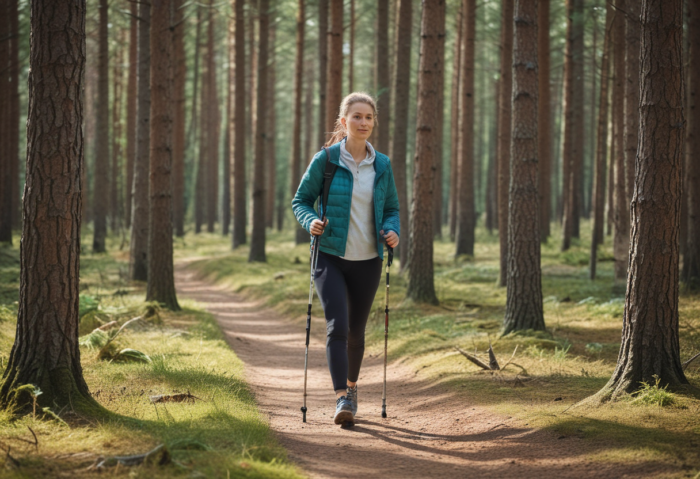
Nordic walking: technique, pole length and health benefits
Nordic walking is one of the simplest ways to get far more out of ordinary walking. The poles also put your upper-body muscles to work, push your heart rate up without you noticing, and suit beginners and experienced movers alike. Below I explain what Nordic walking is, how to choose poles of the right length, what the correct technique looks like and why it is better for your health than plain walking.
What Nordic walking is and where it comes from
Moving with poles is nothing new — shepherds and mountain hikers have done it for centuries. In its modern form, Nordic walking was born in Finland. The first attempt to popularize it as a health sport did not catch on, but a second attempt in the autumn of 1997 succeeded. Today hundreds of thousands of people practice it, and the sport is especially strong in Finland, where Helsinki hosts instructor-led group training sessions on trails 5 or 10 kilometers long.
In Estonia, Nordic walking has become part of enthusiasts’ daily routine as well as of group training sessions at companies, associations and clubs. The idea is simple: get out into the fresh air and nature, but move in a way that loads the body more than ordinary walking does.
Nordic walking vs regular walking
In ordinary walking, mainly the lower body works. With poles, the muscles of the shoulder girdle, upper body and lower back join in. It is exactly this extra training load that helps many people ease neck and lower-back pain and symptoms of radiculitis.
Walking with poles raises your heart rate higher than ordinary walking, and you barely notice it. Energy expenditure is greater, oxygen consumption increases and endurance develops faster. If you plan to keep your heart rate in a low zone, it is worth checking it with a heart rate monitor — otherwise the training load can end up higher than you expected.
The right pole length
Walking poles are about twenty centimeters shorter than ski poles. A simple rule: when you hold the pole and your elbow is bent at a right angle, the pole tip should reach straight down to the ground. Below is the recommended length according to the walker’s height.
- 150 cm — 110 cm
- 160 cm — 115 cm
- 170 cm — 120 cm
- 175 cm — 125 cm
- 180 cm — 130 cm
The pole basket is smaller than on a ski pole. For walking on asphalt and other hard surfaces, a rubber pad is fitted to the pole tip, which reduces impact and protects the tip. An adjustable wrist strap keeps the pole comfortably attached to your hand, so you don’t have to grip it tightly all the time.
How to use the poles correctly
The most common mistake is carrying over technique from skiing. A short walking pole is never brought forward of the body — that loads the shoulder joint and can cause pain. The correct movement is as follows:
- The poles move from your sides backward.
- The pole tip lands level with the opposite foot (right pole — left foot and vice versa).
- The push comes from straightening the arm, not just from the shoulder.
- The wrist strap takes the weight, while the palm stays relaxed.
You can pick up the technique after just a few hundred meters of trying. If you don’t want to spend money on sports equipment, an ordinary ski pole also works to start with — cut it down considerably and remove the snow basket.
Gymnastic exercises with poles
One of the conveniences of Nordic walking is that the pole is itself a good gymnastics tool. Before and after training — and why not in the middle of it too — you can stretch and extend with the poles. Here are some exercises worth repeating:
- Chest press with the pole
- Squats with the pole held at chest level
- Lunges with the pole across the back of the shoulders
- Hand raises
- Lateral trunk flexions with the pole overhead
- Rows from an inclined position
- Behind-the-neck press with the pole
- Trunk rotations with the pole across the shoulders
- Stretch for the muscles at the front of the thigh
- Stretch for the muscles at the back of the thigh
Why Nordic walking works
Nordic walking is a year-round activity — you can walk with poles in the forest, in the park, on city streets, on country roads, on the beach and in the bog. You don’t need a hall or expensive equipment. It suits untrained people who are just starting out, but also those who want to train with a high training load.
Perhaps the best part is that the effect sneaks up on you. You simply walk in the fresh air, yet your heart beats faster, your upper body works along and your endurance grows. And all of this happens without feeling like you’re pushing yourself the way you would in the gym.
Nordic walking FAQ
Is Nordic walking suitable for beginners?
Yes. The movements are simple and natural, and you’ll pick up the basic technique within a few hundred meters. Start with a short loop and add kilometers gradually.
Can I use regular ski poles?
At first, yes, if you cut them shorter and remove the snow baskets. But proper walking poles are lighter and the wrist strap is more comfortable, so in the long run it’s worth getting a dedicated pair.
How often should you do Nordic walking?
Several times a week is a good start. You can increase the length and pace of your walks according to how you feel — your heart and legs will let you know when it’s time to add more.
Start right away! https://www.kepikond.ee/
Author: Mo
Source: WHO – physical activity.
Come and train! ArtGym




