
In short:
- With osteoporosis, walking alone is not enough: the best starting point is a combination of strength training and balance training (Giangregorio, 2014).
- Progressive resistance training can improve lower-limb strength and hip or femur bone density in older adults (O’Bryan, 2022).
- If you have had a spinal fracture, severe pain or a very high risk of falling, start training under the guidance of a healthcare professional or a qualified coach.
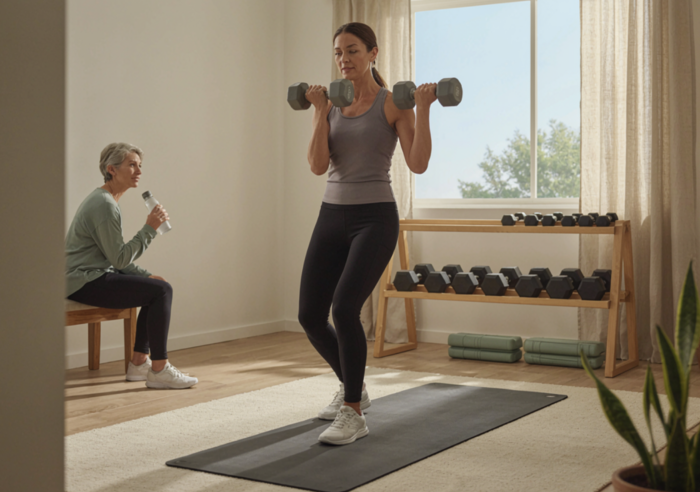
Osteoporosis training does not mean inactivity when your bones are fragile, but a smartly dosed training load. Bone tissue needs a mechanical stimulus, muscles need strength, and the nervous system needs a balance challenge in order to practically reduce the risk of falls and fragility fractures. This guide treats training as a complementary tool, not a replacement for treatment prescribed by a doctor.
How does osteoporosis training strengthen bones?
Bone adapts to load slowly. The most important stimulus is mechanical tension: muscle pulls on bone, the body bears weight, and the exercise sends a signal that bone structure needs to be maintained or strengthened. The ACSM stresses that both weight-bearing activity and resistance training matter for bone health, because they load the skeleton in different ways (Kohrt, 2004).
In practice, this means osteoporosis training should include exercises that work large muscle groups: squat variations, hip thrusts, lighter deadlift versions, rows, presses, calf raises and core stability exercises. At first the load can come from your own body weight, a resistance band or a machine; later you can use dumbbells, a barbell or cable systems. What matters is not heroic weight but gradual progression.
In the context of osteoporosis, strength training has an added benefit: a stronger muscle helps you rise from a chair, carry shopping bags, climb stairs and catch yourself after a stumble. This is directly linked to sarcopenia. The EWGSOP2 consensus highlights muscle strength, not just muscle mass, in assessing sarcopenia, because strength is a better predictor of practical health outcomes (Cruz-Jentoft, 2019). The same logic applies to protecting bones: a stronger person moves with more confidence.
What kind of strength training suits osteoporosis?
A good training program starts with exercises you can do in a controlled way without provoking pain. Too Fit To Fracture recommends a multicomponent program for people with osteoporosis or an osteoporotic vertebral fracture, including progressive resistance training and balance training; as a minimum for resistance training, it lists training at least two times a week, covering the larger muscle groups and an intensity that matches your tolerance (Giangregorio, 2014).
A simple model for getting started: choose exercises for the lower body, upper body and core that you can do with clean technique. Do fewer sets at first and leave repetitions in reserve. Once the movement stays stable, increase the load bit by bit. Bone responds well not only to effort but also to consistency.
In a meta-analysis by O’Bryan and colleagues, progressive resistance training increased both lower-limb muscle strength and femur or hip bone density in older adults; the change in lumbar spine bone density was less certain (O’Bryan, 2022). This is an important nuance: training is a powerful tool, but not a quick or uniform solution for every region of bone.
If you are new to strength training, it may help to go over the basics. An earlier Fitness.ee article, Strength training and children, explains the principles of strength training for a different age group, but the logic of progression and technique is universal. The link between women’s bone health and strength training is also put in broader context in Women and strength training: part I.
Is walking enough if you have osteoporosis?
Walking is good for general health, the habit of moving and aerobic endurance, but with osteoporosis it should not be your only training. Giangregorio and colleagues stress that aerobic training should not replace strength and balance training, because for fall prevention and bone health you need several types of stimulus (Giangregorio, 2014).
The WHO recommends that older adults do regular physical activity, muscle-strengthening activities and multicomponent training that supports functional balance; you can find the general recommendation on the WHO physical activity page. The WHO guidelines are a public health framework, not an individual treatment plan, so with a high fracture risk, a recent trauma or severe pain the training load has to be chosen individually.
A good week can therefore include walking, strength exercises and balance work. For example, sit-to-stand from a chair, a low step-up, a light deadlift from a raised surface, pressing against a wall, band rows and the tandem stance already make a well-rounded start. Fat burning does not need to be the focus, but if body weight and metabolism are also on your agenda, the background is covered in Fat burning and training.
Which exercises should you avoid with osteoporosis?
What to avoid depends on your risk. General caution applies to uncontrolled deep forward bending, sudden twisting, jumping with a high risk of falling, and any exercise where technique breaks down. Particularly if you have a history of vertebral fragility fracture, be careful with movements that combine flexion and rotation under load. Too Fit To Fracture stresses slow, controlled movement, posture and, where needed, supervision (Giangregorio, 2014).
This does not mean you should keep your body under glass. Rather, choose exercises so that the bone gets a useful load while the risk of falling and of painful compensation stays low. Machines may be safe for some people, but for others they require a position where the back rounds or twists. Free weights can be very good once the technique has been learned and the load is realistic.
Hormones, muscle strength and recovery also influence the response to training. The article Testosterone and training provides broader background, but with osteoporosis you should not treat hormonal issues yourself or use training to judge whether you need medication.
How to get started if you already have a diagnosis
Start by mapping out your situation: have you had a fragility fracture, do you have back pain, do you fall often, and which medications and coexisting conditions affect your balance or load tolerance? If your risk is high, it makes sense to start with a physiotherapist or coach who understands the specifics of osteoporosis training.
The goal of training is not to change bone density in one month. The first practical goals are better technique, a stronger grip, a steadier gait, better hip and knee control, and better posture. When these improve, everyday movement also becomes more confident. From a longevity perspective, this is central: bones and muscles work together, not separately.
Vitamin D and calcium are background factors in bone metabolism, but a supplement does not replace mechanical loading. If you suspect a deficiency or you take osteoporosis medication, discuss test results and doses with your doctor. Training, nutrition and medical treatment should all support the same goal: fewer falls, more strength and better mobility.
References
- Kohrt, Bloomfield, Little, Nelson and Yingling (2004). American College of Sports Medicine Position Stand: physical activity and bone health. Medicine and Science in Sports and Exercise. PMID: 15514517. DOI: 10.1249/01.mss.0000142662.21767.58
- Giangregorio, Papaioannou, Macintyre, Ashe, Heinonen, Shipp, Wark, McGill, Keller, Jain, Laprade and Cheung (2014). Too Fit To Fracture: exercise recommendations for individuals with osteoporosis or osteoporotic vertebral fracture. Osteoporosis International. PMID: 24281053. DOI: 10.1007/s00198-013-2523-2
- O’Bryan, Giuliano, Woessner, Vogrin, Smith, Duque and Levinger (2022). Progressive Resistance Training for Concomitant Increases in Muscle Strength and Bone Mineral Density in Older Adults: A Systematic Review and Meta-Analysis. Sports Medicine. PMID: 35608815. DOI: 10.1007/s40279-022-01675-2
- Cruz-Jentoft, Bahat, Bauer, Boirie, Bruyere, Cederholm, Cooper, Landi, Rolland, Sayer, Schneider, Sieber, Topinkova, Vandewoude, Visser and Zamboni (2019). Sarcopenia: revised European consensus on definition and diagnosis. Age and Ageing. PMID: 30312372. DOI: 10.1093/ageing/afy169
Frequently asked questions
Can you do strength training if you have osteoporosis?
Yes, but the training load needs to be progressive, technically controlled and matched to your risk. If you have a high fracture risk or have had a vertebral fracture, start with supervision.
Is walking enough to strengthen your bones?
Walking is beneficial, but it usually does not replace strength and balance training. With osteoporosis, it makes sense to combine different types of loading.
When should you talk to your doctor before training?
If you have a recent fracture, severe or worsening pain, repeated falls, dizziness or very low bone density, it is worth having your training plan reviewed first.
Is vitamin D enough to strengthen your bones?
No. Vitamin D can be important if you are deficient, but bone tissue also needs mechanical loading, adequate nutrition and, when necessary, treatment prescribed by a doctor.
Come and train! ArtGym




