Powerlifting in Tartu: 2016 European Championship medals
In March 2016, powerlifting brought Europe’s strongest youth lifters and juniors to Tartu. For the Estonian athletes the competition got off to a good start: the first days produced several medals, records and one very bold attempt.
This wasn’t just another competition in some big arena. The classic powerlifting European Championships took place in the center of Tartu, in the Dorpat Conference Center at the Tasku center. That meant even people who don’t normally set foot in a powerlifting gym could follow along.
Why powerlifting in Tartu was a success
For Estonian powerlifting, the European Championships in Tartu were a special moment. The competition ran from March 5-12, with more than 360 athletes from across Europe. That meant young Estonians weren’t measuring themselves only against the home level. They lifted on the same platform as Europe’s best.
The first three days went well for the Estonians. Among the youth lifters (up to 18 years old) and women juniors (up to 23 years old), they won three total medals and 11 single-lift medals. That’s a solid haul, especially considering that in classic powerlifting, equipment gives the lifter little extra support.
A simple truth: technique, nerve and raw strength are what count here. If a squat, bench press or deadlift goes wrong technically, even a heavy weight counts for nothing.
How powerlifting turned into medals at the European Championships
Tartu schoolboy Mihkel Ruut competed in the youth -120 kg class and won bronze in the squat, bench press, deadlift and total. The 205 kg squat and 552.5 kg total were new Estonian youth records. Making a mark on the opening days with four medals is no small thing.
Andri Eric Külaviir, who competed in the -83 kg class, came very close to the age-group world record in the squat. 230.5 kg narrowly stayed out of reach this time, but a 225 kg squat brought silver and a new Estonian junior record. Külaviir also won bronze with a 135 kg bench press and bronze in the total with 575 kg. The bench press and the total were new Estonian youth records.
In the women’s junior 84+ kg class, Tartu County high school student Kristel Loorits put in a strong performance. Loorits won bronze in every single lift and in the total. The results were 115 kg in the squat, 75 kg in the bench press, 170 kg in the deadlift and 360 kg in the total. All of these results were logged as Estonian records, and the bench press, deadlift and total were even outright Estonian records.
An interesting detail is that Loorits’s main sport was actually the shot put. That explains a lot. The shot put builds a strong base in the legs, hips and upper body, which powerlifting makes good use of. Honestly, it’s a pretty good example of how strength training in different sports supports each other.
Young Estonian lifters and records
In the women’s junior -63 kg class, Laura-Lisett Lepp won silver in the bench press with 87.5 kilograms. It was the heaviest weight Estonian women had pressed so far, and naturally an Estonian record too. In the total, Lepp took fourth place in very strong competition, setting Estonian records in every lift.
Kermo Pärn and Paula Helena Kuklane also won medals. Pärn lifted 92.5 kg in the bench press in the -66 kg class and took a medal. Kuklane earned a medal in the -52 kg class with a 115 kilogram deadlift. Both finished fourth in the total.
Fourth places like these tend to get lost in the news, but for the athlete they are often very impressive results. Especially when records are being set at the same competition and the field is international.
On the later days of the competition, Estonia’s hopes also rested on Alex-Edvard Raus and Siim Rast. Raus was a former junior world champion and the 2013 open-class world champion in classic powerlifting. Raus held a 330 kg world record in the squat. Rast was an athlete weighing over 180 kg, with lifts that were exceptional by Estonian standards.
What classic powerlifting means
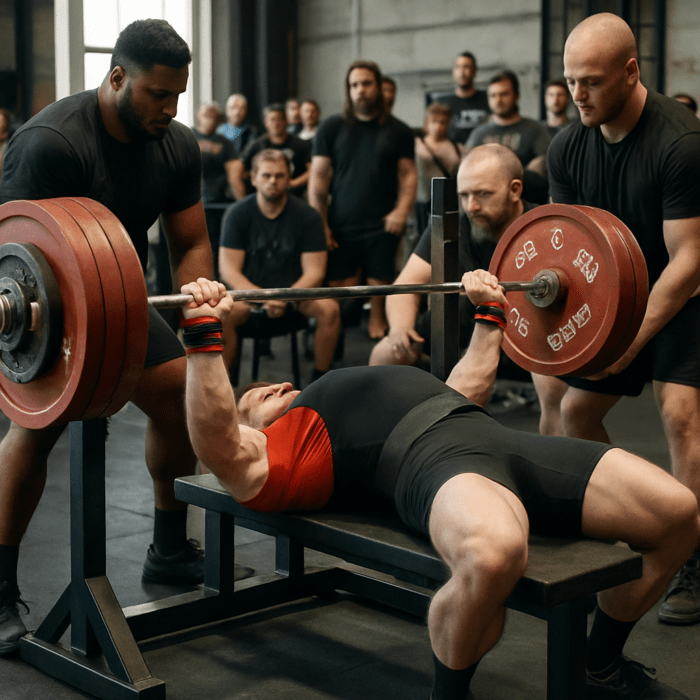
Powerlifting consists of three lifts: the squat, the bench press and the deadlift. In each lift, the athlete has to make a valid attempt with as much weight as possible. The winner is decided by the total of the three lifts.
Classic powerlifting differs from equipped powerlifting in that the lifter may use only limited aids. A lifting belt, wrist wraps and knee sleeves are allowed. Other equipment that could add a lot to a lift is banned.
So what actually happens? The athlete has to be strong, but also calm. Squat depth has to be right. In the bench press, the bar must stay under control. In the deadlift, it isn’t enough for the bar to somehow move up. All three lifts demand a clean execution.
Besides the winners of the weight categories, the best overall lifters are also determined. This uses the Wilks coefficient, which takes into account the relationship between the weight lifted and the athlete’s body weight. This makes it possible to compare athletes of different body weights more fairly.
FAQ: powerlifting and the Tartu European Championships
When did the classic powerlifting European Championships take place in Tartu?
The competition took place in Tartu from March 5-12, 2016. The venue was the Tasku center, more precisely the Dorpat Conference Center.
Which lifts are part of a powerlifting competition?
Powerlifting is contested in three lifts: the squat, the bench press and the deadlift. The total gives the athlete’s final result.
Why is it called classic powerlifting?
Because lifters don’t use special lifting equipment that would add significantly to the weight lifted. Only basic aids such as a belt, wrist wraps and knee sleeves are allowed.
Author: EJTL
Come and train! ArtGym