
Richard Jones back workout: 5 exercises
The back workout in Richard Jones’s plan is simple, heavy and direct: lots of rows, two deadlift variations and an emphasis on control. This is not a comfortable beginner circuit but an old-school bodybuilding back day, where every set has to accomplish something.
Why does a back workout matter?
A good back doesn’t only show on stage. You feel it in every compound exercise where the body has to hold, pull or stabilize a load. Richard Jones’s approach comes from an era when building the back relied mainly on pull-ups, deadlifts and heavy barbell rows.
The original names Flex as the source, and the idea behind the plan is clear: first a wide grip, then a heavy pull, then rows that build thickness, and finally more work for the lower back. This order fatigues the whole posterior chain, not just the lats.
Frankly, this plan is quite demanding. If the pull-up takes your strength right at the start, you have to leave your ego at the door. The weight has to be heavy, but not so heavy that your back drops out of the movement, your hips start jerking and the rep becomes nothing more than moving the bar.
How does Richard Jones’s back workout work?
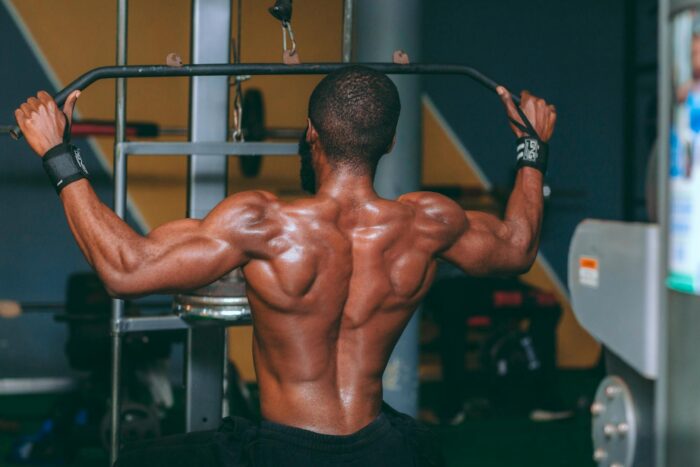
The plan starts with a wide-grip pull-up, which Jones describes as the exercise used by every bodybuilder with a good back. The movement begins from a dead hang, you pull up so that the chest moves toward the bar, and you squeeze the back muscles at the top. When not every rep comes out clean, a little leg drive is used to finish the planned volume.
- Wide-grip pull-up 4×8-12
- Deadlift (first round) 3×8
- Bent-over barbell rows to the stomach 4×8-12
- Seated cable or dumbbell rows 4×8-12
- Deadlift (second round) 3x 8
The deadlift appears twice in this back workout. Jones says outright to love deadlifts and uses them both after the pull-up and at the end of the session. In the description, the safety bars in the power rack are set slightly below knee height. This allows partial-range movements and directs the focus to the lumbar area, glutes and hamstrings.
Before competitions, the work gets even sharper. With two weeks left until a contest, the deadlift becomes a superset to work the lower-back details more intensively. This comes with an important limitation: it isn’t recommended for everyone, only for advanced bodybuilders.
Barbell rows and cable rows
In bent-over barbell rows, Jones varies the hand position. Both overhand and underhand grips are used, but the overhand grip usually allows more strength to go into the exercise. The idea is to build mass, so the weight is heavy. At the same time, control is stressed: if the body starts to join in too much, the isolation of the back is lost.
Sometimes a T-bar takes the place of a regular barbell. It allows the weight to be lifted slightly higher and hits more of the middle back. The seated cable row is more of a stretch-and-feel exercise. Having admired Arnold’s lower back muscles, which seem to begin at the hips, Jones looks for the exercises that affect this area best.
Back workout: practical tips
A simple truth: this kind of back workout works only when the rep is honest. In a pull-up, it isn’t enough for your chin to get up there somehow. Your back has to start the movement, your shoulders must not rise toward your ears, and there should be a moment of squeeze at the top.
In the deadlift, keep the tempo steady. If you use safety bars below the knees, think of it as work for the lower back, glutes and back of the thigh, not just an ego pull with a shorter range of motion. Your back has to stay strong. If your position breaks down, the weight is too heavy or fatigue has gone too far.
In dumbbell rows, Jones kneels on a bench or leans on something. The dumbbell starts on the floor and travels straight up as high as possible, without momentum. In the bottom phase, the aim is a stretch. It’s a good reminder: back muscles grow better when you feel both the stretch and the contraction.
If you’re a beginner, don’t copy the entire volume right away. Take the idea from the plan, not just the numbers. For example, do a pull-up, one deadlift variation and one controlled row with a barbell or cable. An advanced trainee can use the whole sequence, but recovery has to be genuinely in place.
FAQ
Is this back workout suitable for a beginner?
Not in full volume. A beginner can use the same exercises but with lower volume and simpler technique. Be especially careful with the second round of deadlifts.
Why is the deadlift in the plan twice?
Jones uses the deadlift both as a heavy compound exercise and at the end of the session to emphasize the lower back. This gives the plan a strong old-school bodybuilding character.
Is the T-bar better than a regular barbell?
Not necessarily. Jones sometimes uses the T-bar to lift the weight slightly higher and work the middle back more. Choose the option where you feel your back better and can control the movement.
Author: joker
Source: WHO – physical activity.
Come and train! ArtGym




