Better body awareness with sports massage
Sports massage can sometimes get your body to start listening again. When a muscle has been tense for a long time, you may no longer notice it, until a movement turns clumsy or pain hits out of nowhere.
This article explains why your sense of your muscles can fade under training, work posture and tension, and how sports massage helps bring that tension back into clearer focus.
Why does sports massage improve body awareness?
If you listen to loud music for a long time, you may gradually keep turning the volume up. At first everything seems normal. Only when someone else walks into the room do they say right away: it’s too loud. Your body has simply adapted.
Something similar can happen with your muscles. When the number of workouts and the training load increase bit by bit, the nervous system gets used to the pressure. A muscle may be stiff, yet you no longer clearly feel it. That doesn’t mean the tension has gone away.
Pain is the body’s warning signal. When there’s no pain, everything seems fine. But that’s exactly where the risk lies: training load builds up in the tissues unnoticed. The muscle becomes stiffer, elasticity drops and movement quality declines.
Honestly, this is familiar to many people who train consistently. Today your shoulder is a little stiff. Tomorrow your lower back feels slightly tired. A couple of weeks later the feeling is so ordinary that you no longer see it as a sign. Then one bad row or twist is enough.
How can sports massage help you feel your muscles again?
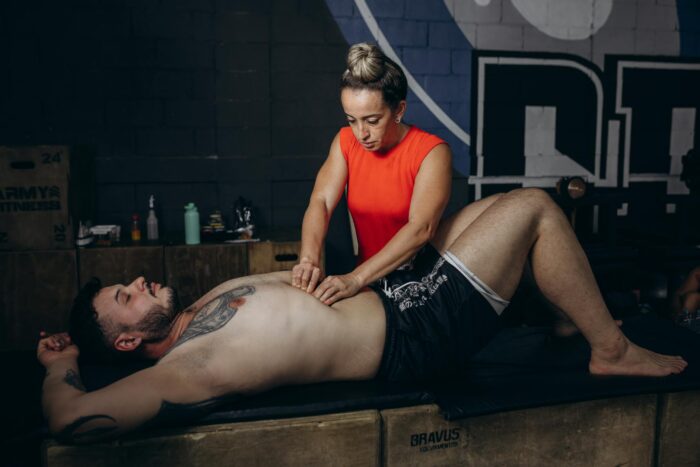
The point of sports massage isn’t just to “knead a muscle soft”. Good treatment gives the nervous system new information. Manual techniques act on muscles, tendons and mechanoreceptors, the receptors that help the brain understand what is happening in the body.
It’s a simple truth: if the information coming from a muscle is imprecise, the movement is less precise too. Coordination can weaken even though you believe you’re training the same way as always. This raises the risk of strains, tears, deformations and stress fractures.
Many athletes notice tension especially after a break. For example, after a competition period you may stay away from massage for a while. When sessions start again, only then do you feel which muscle is actually tense. Some spots may even be sore, although you hadn’t noticed them before the session.
You could describe this as reactivating the nervous system through sports massage. The body doesn’t gain a new muscle or a new joint. It gets a better picture of what’s already there.
So what actually happens?
Tension doesn’t always disappear in a single moment. But after a session you may understand more clearly where your body is holding on. That matters, because awareness comes before change. If you can’t sense the tension, you can’t take it into account in your training either.
For example, you might notice that one hip moves worse during a squat, that your shoulder girdle doesn’t relax during a press, or that your calves feel heavier than usual after a run. These are practical signs, not mysticism.
Sports massage helps with desk work too
The same pattern doesn’t affect only athletes. It very often shows up in people who sit at a computer a lot. The muscles of the nape and shoulder girdle are tense day after day. A static working posture and mental stress keep the muscles working even when you think you’re just sitting.
There may be no pain at first. Sometimes dizziness or headaches appear instead. In some cases, referred pain can make itself felt in the ear, eye or tooth. Then the cause is sought elsewhere, tests are run and the results may come back normal.
If the real cause is muscle tension, after 2-3 massage sessions you often start to sense the state of your nape and shoulder girdle better. You realize when your shoulders creep up, when your chin juts forward and when your breathing becomes shallow.
That knowledge is valuable. Not because massage replaces movement, sleep or a sensible training load, but because it helps you listen to your body at the right time.
Practical signs to watch for
You don’t have to judge whether you need sports massage by pain alone. Sometimes how your body moves and recovers matters more than pain. If movement turns wooden, your warm-up drags on or your usual workout suddenly feels harder, it’s worth paying attention.
- A muscle still feels stiff after warming up.
- One side of the body moves noticeably worse than the other.
- Stiffness after training doesn’t go away in the usual time.
- Your neck, upper back or lower back is constantly tense.
- Headaches or referred pain appear with no clear cause.
- Coordination and movement precision have worsened.
For an athlete, body awareness is part of the toolkit. When you train close to your limits almost every day, you need to know when your body is ready and when it is just “putting up with it”. The same goes for a coach who often shares the training load in aerobics, the gym, ball games or other group training.
Muscle stiffness reduces performance and elasticity. That is why sports massage shouldn’t be seen as a luxury. Done at the right time, it is one way to keep the nervous system, muscles and movement in better contact with each other.
FAQ: questions about sports massage
Does sports massage have to hurt?
No. A strong sensation can be normal, especially in a tense area, but pain is not the goal. A good massage helps you notice and influence tension, rather than just gritting your teeth and getting through it.
When should an athlete consider massage?
If your muscles are constantly stiff, your movement becomes imprecise or your recovery drags on, it’s worth taking a closer look at the condition of your body. This is especially important during periods of heavy training load and during the competition season.
Can people with desk jobs benefit too?
Yes. Tension in the upper back, neck and shoulder girdle is very common with sedentary work. Massage can help you sense this tension better and support more conscious posture.
Come in for a massage! https://ondi.ee/
Author: Üllari Ots
Source: WHO – physical activity.
Come to training! ArtGym