
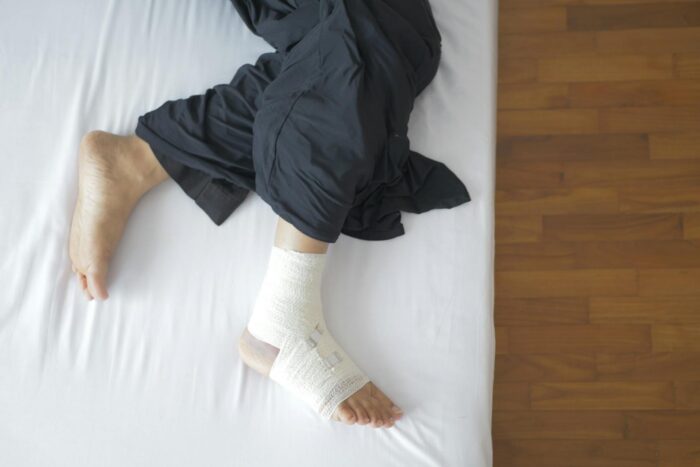
Ankle: ligament injury and treatment
The ankle is a small joint, but it does a lot of work with every step: body weight passes through it to the foot, and it keeps your balance in place. When your foot rolls over on stairs, on a slippery street or when landing from a jump, the ligaments supporting the ankle can stretch or tear. Here you’ll get a clear overview of how the injury happens, what to do in the first minutes and when to see a doctor.
Why is the ankle so easily injured?
The ligaments of the ankle hold the joint in the right position. They work like strong support straps that stop the foot from rolling too far inward or outward. The ligaments sit on both the inner and outer sides of the joint, but it is the outer ligaments that suffer more often.
The typical situation is familiar: you step off a curb wrong, land on someone’s foot in basketball or volleyball, slip on a wet leaf or take too much momentum on the stairs. The foot twists out from under you and the pain comes at once. Sometimes at first it seems like “it’ll pass”, but swelling and bruising often tell a different story.
The injury can be partial, where only some of the ligament fibers tear, or complete, where the ligament loses its ability to support the joint. The most severe variant is a fracture together with a ligament tear. You shouldn’t try to guess that at home. If you can’t put weight on the foot or swelling appears quickly, you need to have it checked.
The ankle and the first symptoms
The first sign is usually pain. It can be sharp and immediate, or get worse when you try to walk again. Within a few minutes to an hour, swelling and bruising may appear around the injury. The faster it appears, the more seriously you should take the situation.
With a milder ligament tear you can put weight on the foot, although it hurts. With a more severe injury, the pain doesn’t let you put any weight on the foot at all. The truth here is simple: if you limp badly, the foot swells up quickly or the pain stops you from walking, don’t push on.
Diagnosis usually begins with an examination and palpation. The doctor assesses the swelling, the spot that hurts and the mobility of the joint. An X-ray is often taken to rule out a bone injury. If needed, a stress X-ray is also used, which helps assess the extent of the ligament injury.
What to do right after the injury?
In the first minutes, the goal is to keep swelling and pain under control. Put an ice pack on the injured spot for about 30 minutes. The cold shouldn’t be directly against the skin; a thin towel in between is better. Rest the foot and raise the limb higher, especially when sitting or lying down.
If bruising appears within minutes, the pain is severe or you can’t put weight on the foot, see a doctor. The same applies if the foot feels numb, hot, very tight or is in an unnatural position. Frankly, with the ankle it’s better to have one check too many than to return to training too early.
Milder ankle ligament tears are often treated with a support, or orthosis. In a more severe case, the foot is put in a plaster splint or a more complex orthosis is used, such as a walking boot. In the first days, crutches or forearm crutches can help so you don’t overload the injured foot.
If it’s only a ligament tear, cast treatment lasts 2-3 weeks. To ease pain and swelling, the doctor may recommend anti-inflammatory tablets. You shouldn’t take them just “in case”, especially if you have stomach, kidney or blood pressure problems. If needed, double-check with a pharmacist or doctor.
Recovery: when can the ankle handle training load?
After the cast comes off, the foot is often stiff. That doesn’t mean anything is wrong; the joint has had limited movement for a while. This is where physiotherapy exercises come in. The exercises help restore mobility, strength and balance so that the injury doesn’t recur.
You must not remove the cast yourself earlier than prescribed. With a hinged walking boot, joint stiffness is usually less of a problem, but even then you can’t skip the exercises. Ligament healing needs time, not just for the pain to disappear.
After treatment ends, depending on the severity of the injury, the ankle must not be put under heavy training load for 8-12 weeks. That doesn’t mean sitting completely still. Swimming and cycling are often good choices, because they keep you moving but don’t twist the ankle the way running, jumping or ball games do.
How to prevent an ankle injury?
In everyday life, prevention starts with footwear. The heel shouldn’t be very high and the sole should suit the surface. The Estonian winter and wet autumn are a harsh combination for the ankle: slippery sidewalks, rushing and fatigue do their work quickly.
In training, the warm-up counts. Before running, the gym or a ball game, calmly warm up your joints and add light jumps, calf raises and balance exercises. Stretching can be part of the routine, but stretching alone isn’t enough. The ankle also needs strength and reaction speed.
If you’ve injured your ankle before, don’t ignore a feeling of instability. A supportive orthosis, taping and a gradual return to training can be sensible. The worst plan is to go straight back to the same training load and hope you get lucky this time.
FAQ: ankle and ligament tear
Do ankle ligament injuries heal on their own?
A milder sprain can heal with rest, ice and support. If there is major swelling or bruising, or you can’t put weight on the foot, have the injury checked.
When can you train after an ankle injury?
The return depends on the severity of the injury. Heavy training load should be avoided for 8-12 weeks, but lighter activity, such as swimming or cycling, may be suitable earlier.
Can you take the cast off earlier yourself?
No. A cast or walking boot is part of the treatment, and removing it too early can prolong healing or make the joint unstable later.
Author: Marek Morozov
Come and train! ArtGym




