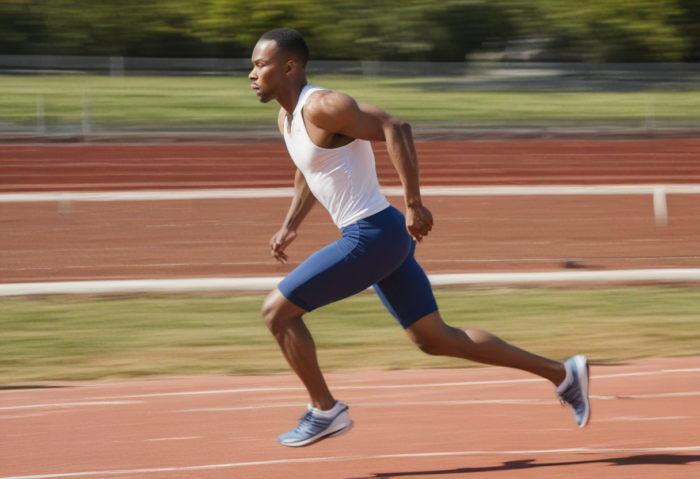
How can you maintain or improve your sprinting technique? Various running drills and exercises can help. To assess your technique, you need to analyze videos of your runs. Getting your biomechanics right is crucial in sprinting.
Technical and neurological improvements in sprinting come down to two factors: intermuscular coordination and intramuscular coordination. Intermuscular coordination describes how your muscles work together during sprinting, coordinating their efforts to perform the activity. Intramuscular coordination describes the coordinated activity of structures within a muscle. The better both types of coordination are, the more force a muscle can produce during a given movement.
When you first learn a new movement or the technique for a sport, improvements in technique come mainly from better intermuscular coordination. For example, when a young child learns to crawl or walk, they fall very often and very easily because they lose their balance. The more they learn to control the muscles involved, the more successfully they can perform the movement. Once the basic movement pattern is established, they begin to perform it with greater speed, power and strength. Intramuscular coordination and its development play an increasingly important role here: muscle fibers learn to activate together, firing frequency improves and additional motor units are recruited.
In training, these improvements in coordination mean that when you are learning a new technique or movement, or refining something you have had little practice with, your initial focus should be on improving intermuscular coordination through more frequent workouts. The same applies to strength training: beginners make the best and fastest progress by practicing the same exercise as often as three times a week, with this progress coming almost entirely from more efficient intermuscular coordination mechanisms—learning to use only the muscles needed for the movement and to switch off those that are unnecessary. As you become more proficient in the technical elements or the new movement and motor connections become established, high training frequency becomes less critical. As the scope for further improvements in intermuscular coordination diminishes, continued progress increasingly depends on the strength and power of the specific muscles involved in the movement. In other words, development becomes more dependent on intramuscular coordination mechanisms. Training intensity and increasing it now become more important than increasing the number of workouts. This is also why intermediate and elite athletes can achieve good results with two workouts a week, while beginners train at least three times a week.
Speed training…less is more
Sprinting is a high-intensity activity that differs considerably from distance running. Quality matters more than quantity. If you are a sprinter, every time you sprint, your goal should be to run faster than you did last time. Sprinting is a high-intensity activity—or at least it should be—and you need to recover fully between sets. Sprinting when tired will improve your fitness, mainly your endurance, but it will no longer make you faster. “As soon as your speed on a repetition starts to drop compared with previous repetitions, you should end the sprint session (Baggett, p. 9). Remember that when training speed, the aim should be to keep the athlete fresh, capable of an all-out effort and able to maintain technique without fatigue compromising it.
General recommendations
The best advice is to sprint, and to sprint enough to maintain your technique and continually improve it through numerous repetitions. A sprinter’s main concern should be how to transfer increasingly more power from their legs to the track relative to their body weight. This means putting a more powerful engine in your “car.” In other words, your body fat percentage should be low, while you aim to use your existing strength as efficiently as possible when running and continue to build lower-body strength.
Sample training plan
Based on both experience and science, I have concluded that unless you are an elite athlete, you can achieve good results by combining training cycles focused on strength with cycles focused on explosiveness. During a strength cycle, you focus on increasing your strength; during an explosiveness cycle, you train to produce that high level of force quickly while sprinting. Each cycle also accounts for the need to maintain the gains made in the previous cycle, rather than letting them decline. For example, sprint repetitions and plyometrics are included during the strength cycle to prevent technique and speed from suffering.
For both cycles, I recommend training only twice a week. Experience has shown that this produces the best results in terms of injuries and overtraining. Do not make the cycles too long: for example, do one cycle for 1 month and the other for 1 month as well.
A sample training program for the strength phase could look like this:
Monday
* Light warm-up
* Plyometric exercises (jumps), 2–3 sets of 5–10 reps; choose your own exercises
* Sprint starts, 5–10 reps
* Deadlift, 4–5 sets of 3–5 reps (try to add weight each week)
* Underhand or overhand pull-ups: 3 x 5–10 reps
* Exercise for the biceps femoris: 4–5 sets of 5–10 reps
Friday
* Light warm-up
* Sprint repetitions at top speed, 30 – 60 m (stop if your times start to deteriorate)
* Light deadlift
* Underhand or overhand pull-ups: 3 x 5–10 reps
* Split squat, 3–5 sets of 6–8 reps per leg
* Hamstring exercise: 4–5 sets of 5–10 reps
A sample training program for developing explosive power could look like this:
Monday
* Warm-up
* Sprint starts, 5–10 reps
* Timed sprints over 20–30 m (stop when your times start to deteriorate)
* Jump squat variation at 30%, 3 sets of 5 reps
* Jump squat variation at 15%, 3 sets of 5 reps
* Hamstring exercise: 2-3 sets of 5–8 reps
*Percentages are based on your maximum squat or deadlift.
Thursday
* Warm-ups
* Sprint starts, 5–10 reps
* Timed sprints over 30 – 40 m (stop when your times start to deteriorate)
* Depth jumps, 4 sets of 3 reps
* Deadlift, 3 x 3 at 85–90% of your personal best
After completing both cycles, you can start again from the beginning, making small changes to your exercise selection. For example, you could replace the deadlift with the squat, or keep the deadlift but use a wide snatch grip in the next cycle. These are just a few examples, and you can substitute exercises to suit your needs. Exercises are important, but the methods you use and the principles that guide your training are even more important. A seemingly simple training program like this can take you a long way over time, provided, of course, that you train consistently, strive to improve and keep track of your progress.
In any case, I hope you found this article helpful and that it gave you some ideas about speed and how to develop it.
References
Baggett Kelly. The Simple Guide to Speed Training. Accessed at: http://www.higher-faster-sports.com On: October 13, 2008.
Dintiman George and Ward Bob (2003) Sports Speed. Third Edition. United States of America: Human Kinetics.
Author: Janar Rückenberg (translation)
Come and train! ArtGym