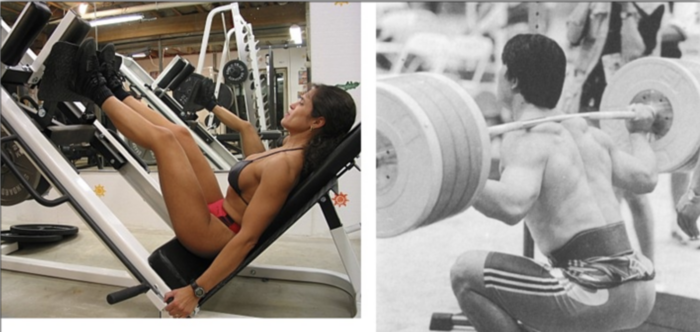
Squats and leg press for big legs
Squats are the classic for building legs, but they aren’t an equally good tool for everyone. If your goal is bigger thighs, it’s worth taking an honest look at the leg press, your body proportions and where the training load actually lands.
Why are squats and the leg press pitted against each other at all?
This debate will probably never leave the gym. Some people fear the squat like fire. Others believe that if the barbell squat isn’t in the program, you haven’t really done a proper leg workout.
I’d look at it more simply. Exercises are like tools. Some tools suit one body and goal better, others suit a different one. If the goal is to build big, strong legs, not everyone has to take the same path.
The squat is a very natural lower-body movement. After walking, squatting is one of the oldest and most common ways people use their bodies. But “natural” doesn’t mean every body gets the same muscle growth from it.
When the barbell is on your back and you move down and up, the quadriceps, hamstrings, glutes and core muscles do the work. The training load doesn’t stay only in the legs. Force has to travel through your midsection to the barbell. That’s where part of the problem begins.
How do squats work for different body types?
During a squat, your body has to lean forward to some degree. Without that, you can’t keep your balance. The longer your legs, and especially your femurs, the more you often have to lean forward. That instantly changes how the exercise feels.
For a lifter with long legs, the squat can go more into the glutes and lower back than into the front of the thighs. Then something familiar happens: your backside and lower back get tired, but the quadriceps don’t get the hit you expected for building mass. So what is actually happening? Leg training turns into a test of your hip extensors and core.
If you have shorter femurs, you can usually keep a more upright position while squatting. The training load then shifts more easily to the front of the thighs. With that build, the squat can truly be a very strong mass-building exercise.
A good comparison is Arnold Schwarzenegger and Franco Columbu. Arnold Schwarzenegger was 188 cm tall, had long legs and leaned forward more when squatting. Franco Columbu had shorter legs and stayed more upright during the squat. That doesn’t make one man better or the other worse. It shows that body structure changes how the exercise affects you.
A board or other raised surface under your heels can help your knees travel further forward and keep your torso more upright. Weightlifting shoes follow the same idea. But be careful here: if the heel is too high, the knee can end up under an uncomfortable load.
When is the leg press the better choice?
The simple truth: the leg press can be a great exercise for people whose squat doesn’t hit the quadriceps hard enough. Especially when your lower back or your breathing gives out before your legs do.
The leg press takes away part of the demand for balance and trunk stability. You can focus on making your thighs do the work. A leg press with a proper range of motion loads the front of the thighs, the hamstrings and the glutes very hard.
Does that mean the leg press is always better than the squat? No. The squat does more for whole-body control and the stabilizing muscles. But when we’re talking strictly about leg mass, the leg press can give some people a better result.
Nor does it mean that someone with long legs shouldn’t squat. They absolutely can. The squat can stay in the program for strength, skill and overall lower-body work. Just don’t be surprised if growth in the front of the thighs doesn’t keep pace with your glutes and lower back.
A practical choice: squats or leg press?
- If the squat feels strong in the front of your thighs and your technique holds up, keep it in the program.
- If the squat tires your lower back before your thighs, add the leg press or favor it.
- If you have long femurs, test the leg press seriously, not as a “simple machine”.
- If you want better overall body control, don’t drop the squat from the program.
- If your knees send warning signals, lower your ego and check your depth and foot position.
Single-leg squats are a topic of their own. In terms of stabilizer-muscle load they can be very demanding, and in that sense they beat both the leg press and the regular squat. But when it comes to building mass, what ultimately counts is whether you get enough repeated load on the target muscle.
Don’t blindly believe the claim that the squat automatically equals big legs. Just as the bench press doesn’t guarantee everyone powerful chest muscles, the squat doesn’t guarantee everyone big thighs. You have to find what works for you.
FAQ
Are squats mandatory for building legs?
They aren’t mandatory, but they’re a very worthwhile exercise. If the squat suits your body and your technique holds up, use it. If not, the leg press may be a better route to building thigh mass.
Does the leg press build legs as well as the squat?
With the right person and the right execution, yes. For many people, the leg press lets the thighs get closer to true fatigue without the lower back becoming the limit first.
Should I do both?
For many people, using both is the best fit. The squat gives you overall strength and control, while the leg press helps deliver a large volume and a stable load to the thigh muscles.
Original article: Leg Press Vs. Squat. What’s Better For Scary Big Legs?
Author: Rusi”;i:48;s:27:” Janar Rückenberg (translation)
Come and train! ArtGym