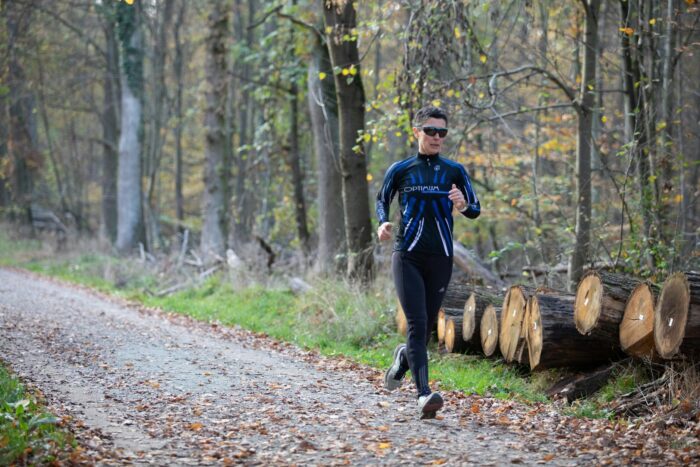
Trail running: how to prepare
Trail running offers something asphalt can’t – real nature, the surprises of a winding path and fresh air. But trail running also requires specific preparation, or you’ll pay for it with an ankle or a knee.
Why trail running differs from regular running
Two years ago, while preparing for a Half Ironman triathlon, I decided to do my running workout on a nearby forest trail. I left the CD player in the car, took my hound Dharma along and started my watch. 15 minutes later I looked at my watch for the first time – on the road I would have done that at least 20 times. The narrow, winding trail led me over hills and through streams, and 25 minutes flew by.
Then I decided to pick up the pace. I rushed through rocky stretches – and twisted my ankle. The lesson was harsh: on a forest trail, speed equals caution. An hour later I reached the car with a badly swollen ankle. A week of exercises and two weeks of running went down the drain.
Honestly, though – Dharma got a great hike. And I realized that a clay forest trail completely trumps the sidewalk, both for your joints and mentally.
The gym is the best preparation for trail running
“Strength training is important,” says Jason Simon, a certified personal trainer with the American Council of Personal Trainers, from Pacific Palisades, who runs 10 miles a day in the Santa Monica Mountains. “It increases endurance, balance and strength on the trail and protects you from injury.”
Your quadriceps, hamstrings and glutes are the main drivers in running. Squats are among the most effective exercises – vary them: use your body weight, light dumbbells, lean against a wall or stand on a balance board. Single-leg squats on a Smith machine – with your heel on a knee-high bench – prepare your legs for steep slopes.
Lunges are important too. “When you lunge, push straight through your heels and glutes,” Simon instructs. Leg press exercises and single-leg hamstring curls complement the program well.
Don’t forget your ankles. Calf raises – toes forward, in, out – and standing on a Bosu Balance ball strengthen tendons and ligaments. Another way: tie a weight around your ankle and draw the alphabet in the air with the tip of your big toe. It sounds funny, but it works.
In the upper body, your back needs attention. Pull-ups and lat pulldowns work the latissimus dorsi, which maintains good posture on inclines. “If it isn’t strong enough, you’ll be weak and put your stride length at risk,” Simon warns. Be sure to add triceps and shoulder exercises to your program too.
Treadmill as a complement to trail running
If the weather won’t let you go outside, a treadmill with an incline is a good alternative. Start with a warm-up walk – put your whole foot down and push through your heels. “You use the muscles at the back of your thighs and your glutes, not just the front of your thighs – it’s a much more effective way to run,” recommends Cathy Sassin, a former elite cyclist who works with Intrafit’s fitness and nutrition program in Bend, Oregon.
Some treadmills also have a decline setting, which helps prepare your quadriceps for downhill running – it’s worth asking whether your gym has one.
After your run, be sure to stretch. Nearly 90% of minor knee problems stem from tight quadriceps. “They aren’t stretched, so they’re shortened and pull on the knee tendons,” says Simon. To increase flexibility, do yoga at least once a week.
Practical tips for trail running
Trail running pace is at least 10% slower than on the road, warns Stan Swartz, co-author of the book “Trail Running: From Beginner to Master” (2002). “And it can be even slower.” Nancy Hobbs, executive director of the All-America Trail Running Association, therefore recommends running by time, not by speed.
Keep your eyes on the terrain. “If you want to look around, walk or stop,” says Hobbs. Be especially attentive toward the end of the trail, when fatigue builds – an extra quarter inch in the wrong direction can mean three weeks sitting at home instead of running again tomorrow.
Don’t be too bold on hill slopes. “It feels great to fly down a hill, but your quads will pay for it later,” says Swartz. The road is for chasing personal records. In the forest, you enjoy the process.
FAQ: trail running
Is trail running better for your joints than asphalt?
Yes, soft ground absorbs impact better than hard asphalt. A clay trail is noticeably easier on the joints.
How much slower should you run on a trail?
Allow for a pace at least 10% slower than on the road. On hilly terrain the difference can be even greater – that’s normal.
How do you strengthen your ankles for trail running?
Calf raises, standing on a Bosu Balance ball and “drawing the alphabet” with a weight around your ankle are all effective. Do them regularly before your first trail runs.
–Dimity McDowell–
Muscle & Fitness