
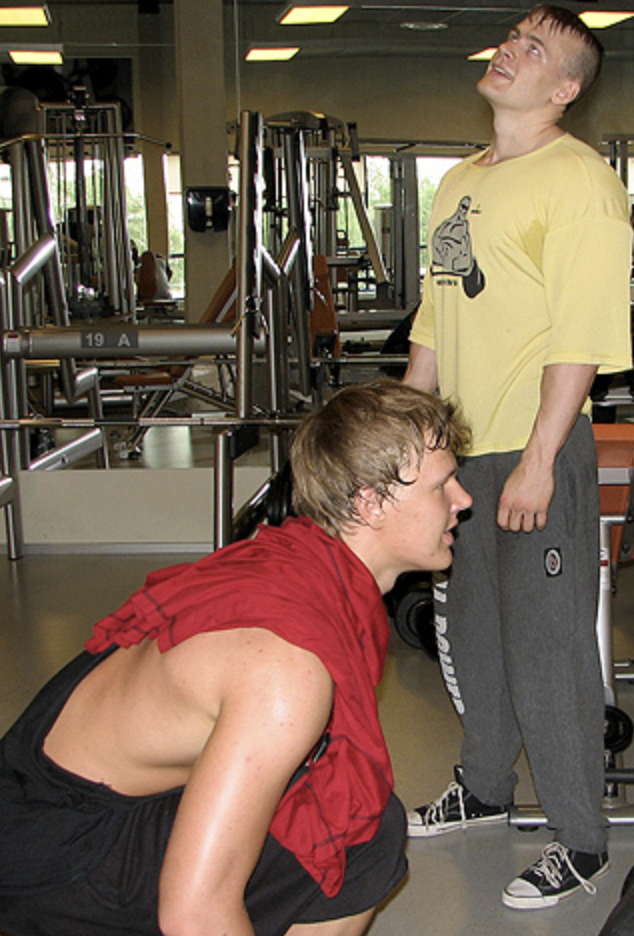
Upper body workout: Robert Nool’s strength program
I visited Arctic Sport to see how Robert Nool trains — Fitness.ee readers know him as Muci. Robert is an Estonian champion and cup winner in the youth and junior categories, and in spring 2006 he placed second overall. An accomplished competitor, to say the least. Could his upper body training be the secret? During his strength cycle, his program is split into two: one day for the upper body, the other for the lower body. Today, we’re taking a closer look at his upper body workout.
Why a strength cycle works for upper body training
The idea behind a strength cycle is simple: keep reps in the 1–6 range and perform 2–3 sets per muscle. The emphasis is on compound exercises — these deliver the best carryover to both strength and muscle size. With weights this heavy, having a spotter beside you is mandatory, not optional.
Robert alternates chest and back exercises: his chest rests while he works his back, leaving it fresher for the next heavy lift. His training schedule is 1+1 (one workout, one rest day), with 2+2 as another option. One workout is hard and the next is deliberately lighter — this keeps overtraining at bay.
Always start with a brief warm-up on the rowing machine. Then pick up the barbell.
Upper body workout: the exercises step by step
Chest — bench press
The classic barbell bench press. Perform 2–3 sets in the 1–6 rep range. Muc eventually works up to 110 kg on the barbell. Not bad for a junior. The spotter stands behind his head and helps him finish the last rep.
Lats — bent-over barbell row to the abdomen
Pick up the barbell, bend forward and row it toward your abdomen. Keep your lower back arched — this protects it from injury. Robert eventually works up to 115 kg. Perform 2–3 sets of 1–6 reps.
Chest — incline dumbbell press
Set the bench to an incline. We pick up the 40 kg dumbbells. Unfortunately, Arctic had no heavier ones; otherwise, Robert would have chosen them. Perform 2–3 sets of 1–6 reps.
Lats — behind-the-neck lat pulldown
A standard behind-the-neck lat pulldown, with a partner helping on the final reps. Robert uses lifting straps to focus entirely on his lats rather than his grip. The weight stack is set to 115 units, for 2–3 sets of 1–6 reps.
Shoulders — barbell upright row
Honestly, this is an uncomfortable exercise — it puts more strain on the joints than it’s worth. But let’s do it. With 60 kg on the barbell, row it up to just below your chin, keeping it close to your body. Perform 2–3 sets of 1–6 reps.
Shoulders — dumbbell lateral raise
A more comfortable option for the shoulders. Use 17 kg dumbbells for 2 sets of 1–6 reps. Keep the movement controlled instead of swinging the weights up.
Biceps — barbell curl
We use an EZ-bar. Since the previous exercises have already worked the arms hard, one exercise and two sets are enough. The barbell weighs 45 kg, for 1–6 reps.
Triceps — overhead dumbbell extension
Sit on a bench, lift the dumbbell overhead and bend your elbows to lower it behind your head. The dumbbell weighs 40 kg — the heaviest available at Arctic. Perform 2 sets of 1–6 reps. Having a spotter beside you is strongly recommended here.
Practical tips for upper body training
A few observations from watching the workout:
- Compound exercises take priority during a strength cycle — keep isolation exercises to a minimum.
- Use a spotter for every heavy set. The 1–6 rep range is no place to test whether “maybe I can still get this one.”
- Alternating chest and back exercises gives each muscle group a natural rest.
- Lifting straps on back day help you focus on the target muscle — your grip must not be the weakest link.
- A 1+1 or 2+2 schedule (training + rest) keeps overtraining at bay.
The full upper body workout at a glance
- Bench press 2–3 x 1–6
- Bent-over barbell row to the abdomen 2–3 x 1–6
- Incline dumbbell press 2–3 x 1–6
- Behind-the-neck lat pulldown 2–3 x 1–6
- Barbell upright row 2–3 x 1–6
- Dumbbell lateral raise 2–3 x 1–6
- Barbell curl 2–3 x 1–6
- Overhead dumbbell extension 2–3 x 1–6
For comparison, here is the lower body workout Robert does in his second training session:
- Barbell back squat 2–3 x 1–6
- Deadlift 2–3 x 1–6
- Barbell front squat 2–3 x 1–6
- Stiff-legged deadlift 2–3 x 1–6
- Standing barbell calf raises 2–3 x 1–6
- Kneeling cable crunches 3–4 x 6–10
- Back extensions on a bench 2–3 x 6–10
Follow a 1+1 schedule (one training day, one rest day) or 2+2 (two training days, two rest days) — choose whichever suits you better.
Upper body training FAQs
Can beginners follow the same program?
I wouldn’t recommend it. Training in the 1–6 rep range requires good exercise technique and a spotter. If you’re a beginner, spend 2–3 months doing sets of 8–12 reps before moving on to a strength cycle.
Why does Robert alternate chest and back exercises?
Alternating lets your chest rest while you do a back exercise, and vice versa. This way, you’re fresher for the next heavy set and your technique doesn’t break down.
How long does a strength cycle like this last?
Usually 4–8 weeks, followed by a switch to either a higher-volume cycle or a deload week. For most people, training in the 1–6 rep range for more than 8 consecutive weeks puts too much stress on the joints.
And that’s the upper body workout done. I’ve now tried that notorious strength cycle, something I’d never done as a dedicated training block before. An interesting experience. And since training this way seems to bring title wins too, it’s definitely worth using.
One more thing: besides the gallery, a short video of the workout will be coming later, which we’ll post on Fitness TV. Stay tuned.
And finally — Mucikene, all the best as you serve Estonia in the Estonian Defence Forces. Hopefully, you’ll go on to do great things in the men’s +90 kg category afterwards. Ott Kiivikas — watch out.
Author: Joker
Come train with us! ArtGym




