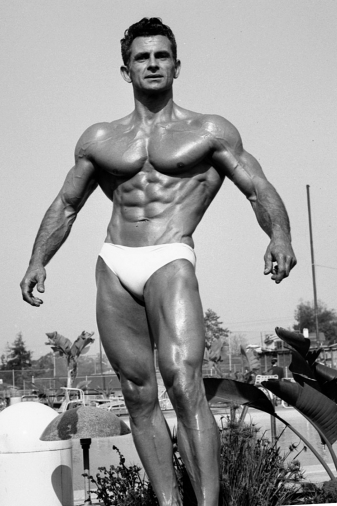
Vince Gironda’s squat and bench press
Gironda’s training method — he was known as the Iron Guru — taught Hollywood bodybuilders from the fifties to the nineties. His gym had no power rack and no regular flat bench. That’s not an anecdote but a deliberate choice. Let’s look at why the Iron Guru gave up two classic exercises and what he recommended instead.
Why Vince Gironda couldn’t stand the power rack
His reasoning was simple. The barbell back squat makes the glutes do more work than the quadriceps. For a bodybuilder who competes on proportions, that means oversized glutes and an underdeveloped front of the thigh — exactly the opposite of what earns points on stage.
He said it outright: most bodybuilders don’t need the barbell back squat at all. There is one exception. If a person’s deadlift is stronger than their squat, the classic squat can still work — in that case it builds the thigh muscles without overdeveloping the glutes. But that’s an exception, not the rule.
Try noticing where you feel the training load after five heavy barbell squats. If more of it goes into the glutes than the thigh muscles, Vince was right by his own observation.
Vince Gironda’s alternatives to the squat
To build the front of the thigh, he used four main exercises:
- Barbell front squat — the barbell rests on the collarbones, not the upper back. The torso stays more upright and the training load goes into the thigh muscles.
- Hack machine — Gironda-style hack squats, with the feet out front on the platform and the body leaning back.
- Sissy squat — the most isolated thigh exercise, which he himself made popular.
- Leg extension and Smith machine squat — a controlled movement path with less need to balance.
The common denominator: all of these exercises keep the body in a more upright position than the classic squat. The more vertical the back, the less work the glutes do and the more the thigh muscles do.
Bench press: where Vince Gironda went against the grain
For many men, the classic bench press is the measure of masculinity. “How much do you bench?” is a question that has echoed through gyms for decades. It’s usually asked by someone who wants to prove their superiority over weaker lifters, not by someone who is genuinely developing their chest muscles.
Vince viewed this exercise with skepticism. His observation: the classic bench press mostly develops the front deltoid, not the chest muscle. When the elbows move close to the body and the barbell comes down below the sternum, the shoulder takes on most of the training load.
His solution was different. He lowered the barbell to the upper part of the sternum and kept the elbows in a very wide position. This switches off the front deltoid and forces the chest muscle to do the work. His own chest development was enough to convince people — the Iron Guru’s whole lean physique spoke for itself.
What to use from Vince Gironda’s method today
You don’t have to rebuild your whole training around Gironda. But a few ideas are worth trying:
- If you notice that the barbell back squat leaves your glutes more sore than your thighs the next day, swap it for the barbell front squat or the hack squat for six weeks and see what changes.
- If your bench press is going up but your chest muscle isn’t, raise the barbell’s path by a couple of centimeters and move your elbows into a wider position. The weight drops, the training load on the chest goes up.
- A simple truth: the number on the barbell doesn’t count if the training load goes into the wrong muscle.
Honestly, Gironda doesn’t have to be right about everything for you to benefit from his ideas. He looked at the body like an artist — proportions before weight. It’s a perspective that tends to get lost in today’s generation of gym-goers.
FAQ
Does Vince Gironda’s method suit a powerlifter?
Probably not. Gironda trained bodybuilders whose goals were proportions and lean muscle mass. For a powerlifter, the classic squat and bench press are competition lifts, and they can’t be replaced.
Is the barbell front squat safe for a beginner?
The technique is more demanding than a regular squat — your arms and wrists have to be flexible. A beginner should start with a light barbell and learn the wrist position before adding weight.
Is the wide-elbow bench press dangerous for the shoulder?
A position that’s too wide can load the front of the shoulder joint. If you’ve had shoulder pain before, keep your elbows at roughly a 60-degree angle to your body, not 90 degrees. It’s better to start with a lighter weight and see how the shoulder reacts.
Edited by: Turg.Fitness.ee
Come and train! ArtGym