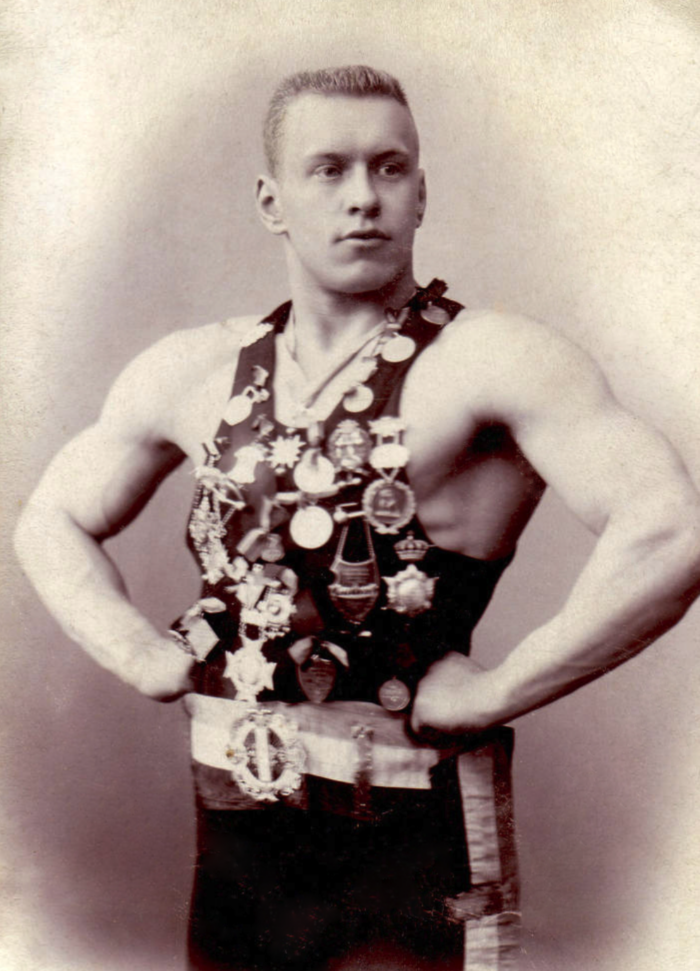
Why don’t Estonia’s young strongmen know who Lurich was?
A generation is growing up that lifts impressive amounts of iron yet has no idea whose shoulders this tradition rests on. Many of today’s gym-goers, strongmen and bodybuilders know contemporary role models such as Larry Wheels, Eddie Hall and Chris Bumstead, but ask them who Georg Lurich was, and they have no answer. It is a paradox: Lurich himself laid the foundations of the Estonian tradition of physical culture and strength training that we proudly carry on today.
Who was Georg Lurich?
Georg Lurich (1876–1920) was the first Estonian to put our nation on the world map through his strength, physique and spirit, rather than politics or art. He was a wrestler, strongman, coach and national role model who traveled across Europe and Russia, winning competitions and demonstrating his exceptional physical condition.
But Lurich was more than an athlete: he embodied the national awakening. His goal was not simply muscular strength, but mental and moral strength. He taught that strength must go hand in hand with education, discipline and honesty.
His message, “Be strong not only in body, but also in mind,” would resonate in a 21st-century gym, if only someone would pass it on.
How did Lurich fade from memory?
There are several reasons.
First, training culture itself has changed. Building muscle once went hand in hand with national pride and masculine endurance; today’s social media is dominated by the visual appeal of quick results: “before-and-after” photos, muscle definition and stage-ready physiques.
Second, the continuity of physical culture has been lost: schools no longer teach the history of physical education in Estonia, the pioneers of strength training or the country’s own role models.
Third, technology and the global culture of trends have shifted the focus. Young people draw inspiration from YouTube and Instagram, rather than Estonian sporting history. Lurich was not an “influencer,” but a man who built his influence through words and deeds, rather than algorithms.
Why does remembering Lurich matter?
Because his philosophy went deeper than any feat of strength. Lurich emphasized that health, character and a nation’s mental strength are interconnected.
If young strongmen knew that their training traditions stretch back more than a century, their attitude would change too: lifting iron would become more than a “hobby”; it would be part of their culture.
Georg Lurich was our first “fitness philosopher”: a man who connected training with ethics and national pride. His example could inspire not only athletes today, but also teachers, coaches and the people they train to ask themselves: what am I developing my body for?

In conclusion:
Estonia’s young gym rats often do not know who Lurich was because we no longer make room for him in education, the media or the gym. Yet his legacy lives on in every weight we lift, in every workout where we push beyond our limits.
Lurich’s spirit lives on when we remember that strength without values is empty, but strength combined with spirit is true power.
Estonian Strength Sports Museum
Come and train! ArtGym