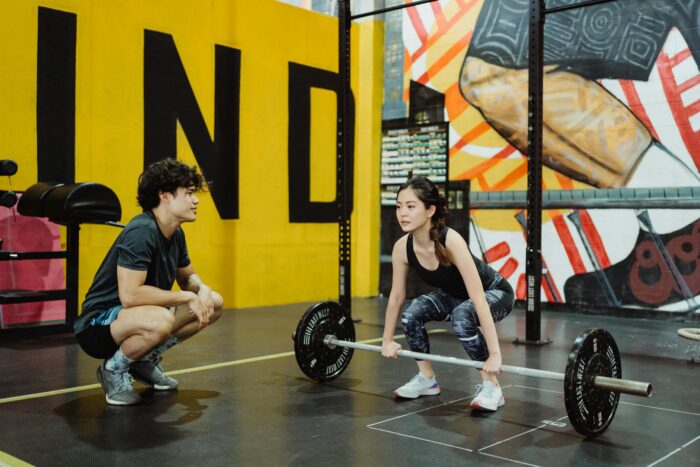
Gym for young people: safe strength training
The gym doesn’t cripple a young athlete simply because they are learning to use a barbell or dumbbells. The danger arises when there is no supervision, technique falls apart and weights are chosen by ego rather than skill.
This article tackles an old fear head-on: does strength training stunt growth, ruin joints or do children more harm than good? The short answer: properly done strength training can actually be one of the safest and most beneficial ways for a young person to train.
Why does the gym scare people when it comes to young people?
Weightlifting and children were a taboo subject in the US for a long time. Many people have heard the claim that weights stunt a child’s growth. Some add that strength training damages joints, ligaments and tendons. Honestly, that fear sounds familiar, but fear alone is not evidence.
When training is technically correct and supervised, strength training is not inherently more dangerous than other youth sports. If anything, the opposite is true. Soccer, basketball, track and field, jumps, throws and sprints often put a very sudden, explosive load on the body. It is precisely this jarring load that can be harder on joints and a growing body than a calm, controlled exercise in the gym.
In the gym, you don’t have to test your max with a barbell every time. The point of bodybuilding and general strength training is often constant tension, controlled movement and feeling the muscle work. That is something quite different from full-speed contact, landing or a sudden change of direction in a game.
Between 1977 and 1988, 90 football players at one US high school suffered spinal injuries or damage, fifteen of them even brain damage. This example doesn’t mean American football is bad. It only shows that sports risks need to be compared honestly.
The gym and growth: what actually happens?
Orthopedists have not found that properly supervised strength training damages a young person’s joints. On the contrary, training can strengthen bones, ligaments and tendons and support bone mineral density. The key word here is “properly”. Poor technique and too much weight are a risk at any age.
Let’s take a simple example. A 15- to 16-year-old athlete weighs 55–60 kg. They play basketball for 60 minutes and in that time make perhaps 50–60 serious jumps. Every landing puts a sudden load on the joints. This goes on week after week, month after month, year after year.
Does that mean you should fear basketball? No. But it does mean the gym shouldn’t automatically be treated as the enemy either. When a young person learns to squat, pull, press and use the core muscles at a calm pace, it may actually protect their main sport.
In Eastern European training culture, strength training for young people has been more common. Some children start general preparation involving weights from as early as the age of six. In the first year, they use their own body weight and learn general exercises. Once the basic technique is clear, load is added, and over the following 2–3 years the training becomes more precise and better suited to the sport.
A simple truth: a young person doesn’t need heavy weights first. They need good movement skills, a patient coach and an environment where technique is valued more than the number on the barbell.
What should a young person’s strength training look like?
The American Orthopaedic Society for Sports Medicine has confirmed that strength training can have a positive effect on children when it is supervised, technique is correct and the program is designed by a qualified coach. Children may not gain muscle mass the way adults do, but their strength numbers can improve noticeably. A large part of this comes from the nervous system working better.
Young people also achieve strength gains at lower intensities than adults. So there is no point in starting with unnaturally heavy weights. The risk of injury rises when technique is allowed to slip. When a young person works the right muscle, moves in a controlled way and listens to the instructor, the risk is much smaller.
Guidelines for training with young people
- Maximal weights shouldn’t be used in every workout. The ONE TO FIVE rep range is best used less often, because technical errors show up precisely under heavy weight.
- Technique must be the first priority. A child needs to be taught why position, tempo and movement path matter.
- Goals must be realistic. Not everyone can become a world-class athlete, a top sprinter or an elite distance runner, but everyone can become stronger and more skilled.
- Overtraining must be avoided. A growing young person needs enough sleep, food and recovery, because too much stress on the body increases the risk of injury.
- Young athletes need constant monitoring and supervision. A coach helps keep the program on track, maintain focus and ensure correct technique.
- Individualization applies to children too. Children develop mentally and physically at different rates, so one and the same plan does not suit everyone forever.
If you follow these principles, strength training can give a teenager a lot. It improves posture, builds self-control, supports their main sport and teaches a young person that progress comes from consistent work, not from one heroic workout.
The gym alongside other sports
The question about growth often comes from a parent. For example: my son is 16, started lifting weights at 13 and has played football since 4th grade. His coaches recommended the gym precisely to improve his strength and endurance. Could it stunt his growth?
The sensible answer is a calm one: appropriate gym training does not harm the growth process. It can help build a stronger skeleton and musculature, strengthen ligaments and tendons, and improve performance in football too. The same logic applies in many ball games and in athletics.
NBA basketball players, sprinters, throwers and jumpers don’t get strong just by dribbling a ball or running intervals. Strength training develops muscular endurance, strength endurance, anaerobic capacity, jumping ability and speed. The author gives the example that Tammert and Kanter do “whatever they want” with a 200 kg barbell. The point is not to hand a beginner 200 kg, but to show how important strength preparation is in elite sport.
Long-distance runners use the gym too. Circuit training and long sets with light weights may suit them. That doesn’t turn them into bodybuilders; it helps the body tolerate training load better.
One British study found that teenagers who took part in supervised strength training were injured several times less often than those who played basketball, did gymnastics, athletics, football and badminton. A study done in San Francisco looked at 1000 individuals who did strength training under partial supervision. According to the result, there was 1 injury for every 1000 hours of training. In basketball and running events there were 14 injuries for every 1000 hours of training.
What does strength training offer young people?
Associate Professor Jaan Loko’s book Bodybuilding II lists 21 positive effects of regular progressive strength training. These points sum up well why strength training is not just about building muscle.
- increases muscle strength
- raises muscular endurance
- is the best tool for shaping the body
- increases the durability of bones and ligaments, the thickness of cartilage tissue and the number of capillaries in the muscle
- improves health and physical condition
- raises athletic performance
- increases flexibility
- increases power and speed
- helps reduce stress and tension in everyday life
- fosters a positive opinion of yourself
- instills discipline and strengthens motivation, which carries over into other areas of life
- helps control body weight and reduces the amount of fat tissue
- strengthens the heart, speeds up metabolism and normalizes blood pressure
- may prolong blood pressure
- improves quality of life
- helps prevent diseases linked to calcium being drawn out of the bones in older people, one cause of which is physical inactivity
- increases blood hemoglobin and the number of red blood cells
- is a useful active pursuit for people of any age
- is a good form of recovery after muscle and joint injuries and is suitable for people with physical disabilities
- lowers the body’s cholesterol level
- satisfies the need for competition
Strength training is certainly not for the weak-willed and the inconsistent. If you want to build muscle mass and increase your strength numbers, the results won’t come overnight. It takes discipline, technique, recovery and honest work.
Gym for young people: FAQ
Does strength training stunt growth?
There is no good reason to claim that properly supervised strength training stunts growth. The fear is based more on myths than on science. In the early years, you simply need to choose suitable exercises, lighter weights and clear technique.
When can a young person start strength training?
The general rule is simple: if a child or teenager understands what the exercises require, can learn correct technique and follows instructions, they can start strength training. The start doesn’t have to mean a big barbell. It can mean your own body weight, core muscles and learning how to move.
Is the gym more dangerous for a young person than ball games?
Under supervision and with correct technique, the gym doesn’t have to be more dangerous. Many ball games involve sudden contact, jumps and landings. In the gym, you can dose the training load better and control the movement calmly.
Author: Janar Rückenberg
Come and work out! ArtGym