
Strength training for beginners: a practical guide
Strength training can feel intimidating when you’re a beginner — an unfamiliar gym, weights on the floor, someone breathing heavily in the corner. But the first few months are actually easier than you might fear. Here’s a clear plan: how to get started, what weights to use, how often to train and when to add weight.
Why strength training is worth the effort for beginners
You’ll make the fastest progress in the first half a year. Your nervous system learns to use your muscles, your coordination improves and your strength increases week by week. In English, this is known as “newbie gains” — your body responds to almost any stimulus. Later, every extra kilo will take more work, but for now you have the wind at your back.
Your goal determines everything else. Want to build muscle mass? You’ll need more reps and volume. Want pure strength? A lower rep count and heavier weights. Just want to get in shape? Functional training 2–3 times a week will go a long way. Set yourself a specific, measurable goal — “I want to squat 60 kg” is better than “I want to get stronger”.
Where to start — full-body training is king
Full-body training is the best fit for beginners: you train your entire body in one workout. The reason is simple — you won’t be able to fully fatigue any one muscle group yet, and recovery is quick. In fact, you can train the same muscle group again after 2–3 days without any problems.
The recommended frequency when starting out is 2–3 workouts a week, with a rest day in between. Each workout should last 45–60 minutes, including the warm-up. If you sit at work all day, add 5–10 minutes of stretching at the end — your back will thank you.
Strength training for beginners: 7 practical rules
- Technique before weight. The first few weeks are about learning the movement, not setting a personal record. A light bar and a well-executed squat are a thousand times better than a heavy bar and a rounded back.
- Compound exercises first. Squats, deadlifts, bench presses, standing overhead presses and pull-ups — these five account for 80% of your results. Isolation exercises (biceps curls, calf raises) come afterward.
- 3–5 sets per exercise, 8–12 reps. Keep the total to 20–25 working sets per workout, no more. As a beginner, you may sometimes struggle to finish even 15 — that’s okay.
- Rest for 60–120 seconds. Not five minutes on Instagram. And not 30 seconds when you’re still gasping for breath. Save your phone time for the changing room.
- Add weight in small increments. When you can comfortably complete every rep of your last set, add 1–2.5 kg next time. Slow, steady progress beats a sudden jump and an injury every time.
- Eat and sleep. Muscle grows while you rest, not during your workout. If you sleep 5 hours a night and eat one sandwich a day, no program will save you.
- Keep a training log. The notes app on your phone is fine. Record the exercise, weight and rep count. A month later, you can look back and see how far you’ve come — that’s the best motivation.
Strength training for beginners: common mistakes
The most common mistake is doing too much too soon. You watch elite athletes train on YouTube and try to copy them, training 6 days a week in 90-minute sessions. The result: after three weeks, you burn out, your recovery can’t keep up and you quit.
The second mistake is avoiding machines on principle. A machine provides a training load without requiring you to balance. Later, once you’ve mastered the technique, you can move on to free weights.
The third is ego. Nobody is watching how much you lift. Seriously. Everyone is focused on their own workout, not your barbell. Lift enough to make the last rep difficult while keeping your technique intact.
FAQ
Do I need a personal trainer?
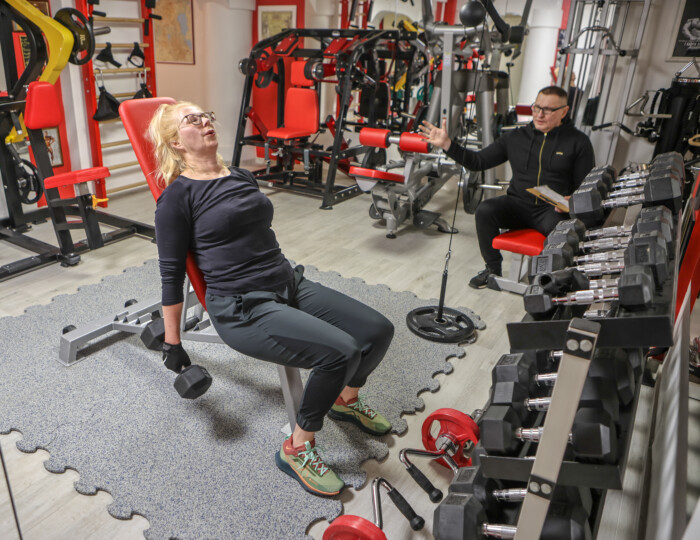
It’s not essential, but 2–3 introductory sessions with a trainer are worth the investment. Learning proper technique at the start will save you months later and significantly reduce your risk of injury.
How quickly will I see results?
Your strength will increase within the first month. Gains in muscle mass will be visible in the mirror after 6–8 weeks. A change in waist circumference takes 8–12 weeks, provided your diet is also on track.
Do I need to take creatine or protein powder?
As a beginner, you don’t need anything special. What matters most is your everyday diet — getting enough protein each day (about 1.6 g per kg of body weight). Powders are a convenience, not a necessity.
Author: Janar Rückenberg
Come and train! ArtGym




