
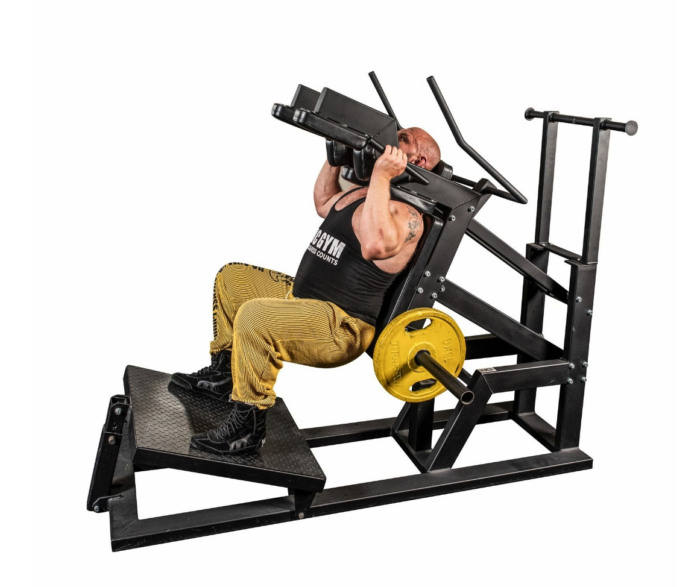
The hack squat is a good choice when you want to train your legs hard while keeping the movement under control. The machine doesn’t do the work for you, but it helps you focus on your thighs and glutes without balance issues ruining the whole set.
Why is the hack squat worth doing at the gym?
The hack squat machine is a very practical alternative in this situation. In fact, it’s more than just a backup option. For many people, it’s an even better fit because your body follows a fixed path, making consistent technique easier to maintain.
The hack squat primarily works your quads and glutes and, depending on foot placement, your hamstrings too. Your calves also contribute. Compared with a free-weight squat, your upper body doesn’t have to work as hard to maintain balance. Your back rests against a pad, and the weight follows a guided path. That doesn’t mean the exercise is easy. Instead, the reduced movement elsewhere lets you give your leg muscles a very targeted training stimulus.
This is especially useful for beginners who are still learning to feel how their knees, hips and feet work together. Experienced lifters also use the hack squat to work their thighs thoroughly after squats or leg presses.
How do you perform the hack squat correctly?
Start by positioning your shoulders under the pads and placing your back firmly against the back pad. Set your feet about hip-width or shoulder-width apart on the platform. Before adding weight, do one light practice set. Check that your heels stay down and your knees track in line with your toes.
Lowering the weight
Lower the sled slowly. Control the movement rather than dropping under the weight. It’s normal for your knees to move forward, provided your heels stay on the platform and you don’t feel any pain. Your depth depends on your mobility and the machine’s design. A good sign is being able to lower yourself far enough without your pelvis starting to tuck excessively underneath you.
Pressing back up
As you press up, think about pushing the platform away with your feet. Don’t snap your knees into lockout. Keep tension in your thighs and glutes. If you have to jerk your hips with every rep or your toes lift off the platform, the weight is probably too heavy.
The simple truth is that it’s easy to let your ego take over on the hack squat. The machine feels safe and adding weight is easy, but your knees and lower back will feel the effects of poor technique straight away. Clean reps with a moderate weight are better than partial reps with too much weight.
Hack squat foot placement: what can you change?
Foot placement makes quite a difference to how the exercise feels. Placing your feet lower on the platform usually makes your quads work harder. Placing them higher shifts more of the emphasis to your glutes and hamstrings. A wider stance may allow better movement at the hips for some people, while a narrower stance can make the exercise more demanding on your quads.
Don’t change everything at once. Try your usual stance in one workout and a slightly higher foot position in the next. This will help you work out what actually works. If you feel discomfort in your knee, reduce the weight, adjust your depth or move your feet slightly higher. Pain is not a sign of a hard workout.
You can use the hack squat in several ways. At the start of leg day, it works well as your main strength exercise, especially if free-weight squats aren’t comfortable at the moment. At the end of a workout, it’s a good choice for controlled sets where you focus on feeling your muscles work. In either case, keep your reps consistent and allow enough rest, because this machine tires your thighs quickly.
Hack squat: common mistakes and practical tips
The first common mistake is using too short a range of motion. Some people add weight but move only a couple of centimeters. This may be necessary for a specific goal, but most lifters benefit more from controlled reps with enough depth.
The second mistake is letting your knees cave inward. This often happens when the weight is too heavy or your foot position is uncomfortable for you. Think about keeping your knees tracking in line with your toes. If necessary, reduce the training load and find a stance that makes the movement feel stable.
The third mistake is rushing. You don’t need to perform the hack squat in slow motion, but the descent should be controlled. You can press up more forcefully, but keep the movement tidy. If you can perform every rep the same way, you have better control of the exercise.
In winter, when you do less outdoor running and cycling, a machine like this can be a good way to keep your legs strong. In spring and summer, stronger legs help you keep going for longer on hikes, on the bike and when playing ball sports. The work you put in at the gym carries over into everyday life quite quickly.
FAQ
Is the hack squat suitable for beginners?
Yes, provided you start with a light weight and take your time learning the movement. The machine supports your body, but you still need good technique.
Can the hack squat replace a regular squat?
It can replace the free-weight squat in some training programs, but the exercises aren’t a one-to-one match. The free-weight squat requires more balance and core engagement, while the hack squat lets you load your legs through a more guided movement.
What should you do if your knees hurt?
Reduce the weight, adjust your foot placement and temporarily shorten your range of motion. If the pain persists, skip the exercise and seek advice from a trainer or physiotherapist.
Come work out! ArtGym




