Shoulder muscles: strong, safe shoulder training
Your shoulder muscles give your upper body a shape that’s hard to hide: strong shoulders make you look broader and give you a more assured posture. Here’s the thinking behind Craig Titus’s shoulder workout, expressed in today’s terms: choose your exercises wisely, warm up thoroughly and don’t let your ego wreck your technique.
Why do shoulder muscles matter so much?
A V-shaped torso isn’t just about a wide back. Your shoulders do much of the visual work. When your shoulder muscles are rounded and well developed, your upper body looks wider and your arms look better, too. That’s true whether you’re on stage or wearing an everyday shirt.
The original article featured IFBB pro Craig Titus, whose shoulder workout began with a heavy compound exercise before moving on to the finer details. That approach still makes sense. Start with a big movement, then work the lateral and rear deltoids, and finish with work for the trapezius and shoulder girdle.
The simple truth is that the shoulder is a sensitive joint. Injure it, and your entire upper-body training often suffers. Presses, chest day, back day and even arm training can become uncomfortable. That’s why warming up is an integral part of the routine, not a box to tick.
Shoulder muscles and the thinking behind Craig Titus’s routine
Craig began his shoulder workout with the behind-the-neck barbell press. For him, it was a mass builder. However, this exercise carries risks, especially if your shoulders are stiff or your warm-up is too brief. If you’re a recreational lifter today, approach it cautiously: if the movement doesn’t feel right in your shoulders, choose a barbell press to the front or a dumbbell press.
The original recommendation was to do two long, light sets before the heavier work to get blood flowing into the muscles. That’s a good idea. It also mentioned circular movements with a light weight plate of around 10 kilograms before the exercise. Keep these controlled rather than swinging the plate around. The aim is to warm up your shoulders, not leave them drooping with fatigue.
Titus recommended the Smith machine for those already using heavier weights. Its fixed path can reduce the risk associated with balancing the weight, but it doesn’t automatically make the exercise safe. Adjust the bench, your grip and your range of motion so that your shoulders don’t move into a painful position.
Your rear deltoids aren’t an optional extra
Bent-over dumbbell lateral raises work the rear deltoids. Many people neglect this area because the front and lateral deltoids are more visible in the mirror. Yet it’s the rear deltoids that give your shoulders a complete shape and help you maintain your posture.
In the original routine, Craig performed this exercise without a separate warm-up, doing four pyramid sets with between 9 and 12 reps. The same approach can work for recreational lifters as long as technique stays strict. If your lower back starts helping with the movement, perform the exercise lying face down on an incline bench. This makes it harder to use momentum and easier to feel your rear deltoids working.
How do you build wider shoulders?
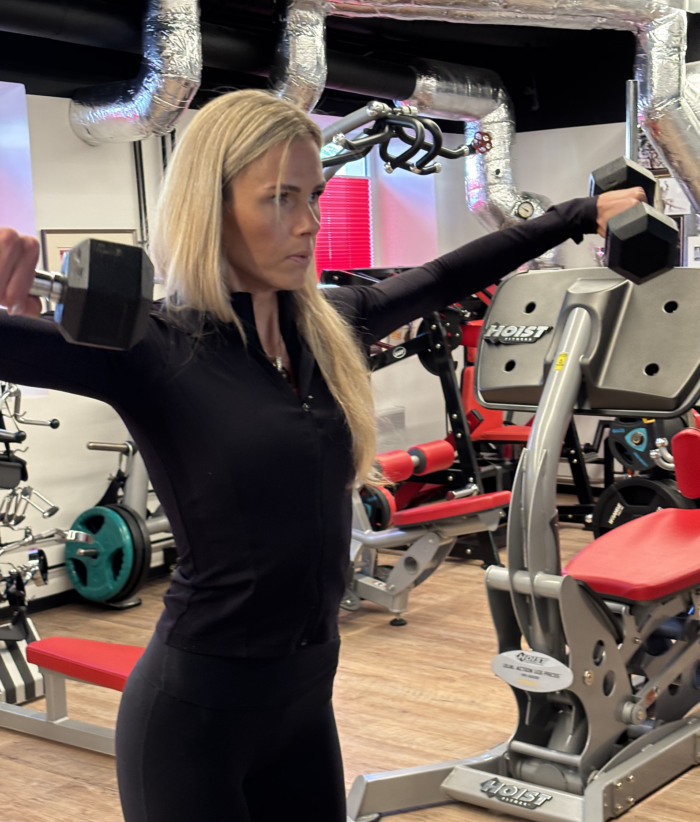
Dumbbell lateral raises are a classic exercise for the lateral deltoids. This is the part that creates a broader appearance. Here, the best results usually come from the cleanest rep, not the biggest dumbbell.
If you choose too much weight, body movement, your traps and momentum start taking over. Your shoulder muscles get less benefit while the joint takes more stress. Keep the movement controlled. At the top, your elbows should be slightly higher than the dumbbells. A half-second pause at the top helps you feel your shoulder muscles working.
Barbell upright rows can fit well at the end of a workout, but you need to perform them carefully. Craig used them to put the finishing touches on both his shoulder muscles and his traps. The original recommendation was to use an EZ bar, since many people find its angled shape more comfortable for their wrists than a straight bar.
If you feel a sharp pain in your wrist or shoulder, don’t push through it. Craig pulled the bar up to his eyebrows, although the traditional movement brings it up to the chin. This makes the movement very intense, but it doesn’t suit everyone. Choose a range of motion that lets you work the muscles without working through pain.
Practical tips for shoulder training
Begin every shoulder workout with a light warm-up. Do a couple of controlled sets, get a feel for the movement path and only then add weight. If you go into your first heavy set with cold shoulders, the risk outweighs the benefit.
Keep your routine balanced. Presses place a lot of demand on the front deltoids. If you only add lateral raises, your rear deltoids may lag behind. Include bent-over raises or another rear deltoid exercise in your routine.
Don’t judge your shoulder workout solely by the weight you lift. Shoulders respond well to strict technique, pauses and a strong mind-muscle connection. Sometimes a lighter dumbbell works the muscles better than a heavy weight that has your whole body bouncing along.
Whether your goal is a stage-ready physique like Craig Titus’s or simply the best body you can achieve, small, sloping shoulders stand out. So do powerful, rounded shoulder muscles developed through controlled training.
FAQ: shoulder muscles and safe progress
Are behind-the-neck barbell presses necessary?
No. They can be an effective mass-building exercise, but they’re only suitable if your shoulders move freely and your technique is solid. For many people, a barbell press to the front or a dumbbell press is a better choice.
Why should you train your rear deltoids?
Your rear deltoids give your shoulders a complete shape and help prevent you from slumping forward. Visually, they make your shoulders look rounder, rather than simply bigger at the front.
Do you need heavy weights for shoulder training?
You can use heavier weights for presses, but moderate weights often work better for lateral and rear deltoid raises. If your technique breaks down, you’re no longer targeting your shoulders as precisely.
Come and train shoulders with us! ArtGym
Author: Mikk-Alvar Olle, adapted from Musclemag
Source: WHO – physical activity.