Water aerobics is one of the few types of training where sweat doesn’t cling to your skin and your joints don’t scream at you the next morning. Moving in water gets your heart working, trains your muscles and releases tension — all at once. That is exactly why it’s so popular in Estonia among older adults, pregnant women and athletes who are returning from injury.
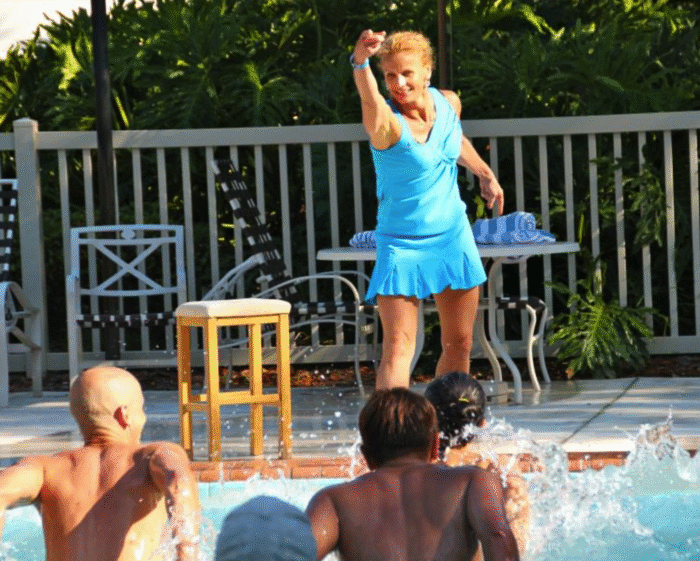
Last winter I watched a class at a Tallinn swimming pool where a 70-year-old woman and a 30-year-old runner did the same exercises side by side. Both came out with rosy cheeks and wide smiles. That’s the magic of water — the training load is there, but your body isn’t crushed.
What is water aerobics?
Water aerobics is a group training session held in a pool, where exercises are done to the rhythm of music to build aerobic endurance, muscle strength, balance and flexibility. Classes are usually held in chest-deep water, and some take place in the deep end, where a belt keeps your body afloat.
Water creates natural resistance — every movement is harder than on dry land, but also softer. There is no jarring. Your joints can do their work without impact loading. That makes water aerobics one of the safest forms of cardio training you can find.
Why water aerobics suits everyone
Honestly, I don’t know of any other type of training where a 25-year-old athlete and a 75-year-old grandmother can sweat together without getting in each other’s way. Water levels everything out. Each participant can adjust the training load themselves: faster or slower, with a bigger or smaller range of motion.
- Joint-friendly. Water supports your body and reduces the load on your knees, hips and spine by up to 90%. For people who are overweight, older adults and pregnant women, it is often the only sensible cardio option.
- Your heart and lungs get a workout. The pressure of the water on your chest makes your breathing muscles work harder and improves circulation. Many people notice a moderately lower resting heart rate within just a couple of months.
- Regulates blood pressure. The hydrostatic pressure of water promotes circulation — high blood pressure tends to come down, and low blood pressure tends to rise into the normal range.
- Relieves stress. After a class you feel a light tiredness that no gym can match. Sleep comes on its own in the evening.
- Discreet. The water covers your body up to the chest — for many beginners, this is the first training session where they don’t feel watched.
What a water aerobics class looks like
A typical class lasts 45–60 minutes and is divided into three parts: warm-up, main part and stretching. The instructor stands at the edge of the pool and demonstrates the exercises — running steps in water, knee lifts, arm circles, jumps with a belt in the deep end. The music keeps the tempo.
Equipment keeps the class varied:
- Aqua gloves — increase water resistance and put your shoulder and arm muscles to work.
- Flotation belt — keeps your body afloat in deep water so you can do running or cycling movements without touching the bottom.
- Pool noodles — long foam tubes that help develop your deep muscles and balance.
- Resistance bands and water dumbbells — for building muscle strength in the shoulder girdle and core.
- Hydrorider — special water bikes that you pedal in the pool. High intensity, but still joint-friendly.
You don’t need to know how to swim. Most classes take place in shallower water, and in the deep end the belt keeps your head firmly above the surface. If you’re afraid of water, tell the instructor before the class — your place in the pool will be arranged accordingly.
In Estonia, water aerobics classes are offered by many swimming pools and spas — Tondiraba, the Kalev Central Stadium pool, the pools of Pärnu’s spas, Tartu Aura. A trial class usually costs 8–15 €. It’s worth checking your local pool’s schedule and asking whether the instructor is AKT-certified or has completed another water aerobics course.
FAQ about water aerobics
Does water aerobics help with weight loss?
Yes, but moderately. A class burns 400–500 kcal on average, which is comparable to a brisk cycling session. Results come from consistency — two to three times a week over a couple of months.
Is water aerobics suitable for pregnant women?
Usually yes, throughout the pregnancy, as long as your doctor has no objection. Water reduces back pain and swelling and supports your growing belly. Choose a class with a calm tempo and let the instructor know.
How often should you go?
For beginners, two sessions a week are enough. More experienced people add a third or fourth class, often alongside gym or running training. You don’t need to go every day — your body needs recovery even after a gentle training load.
Come and train! ArtGym