
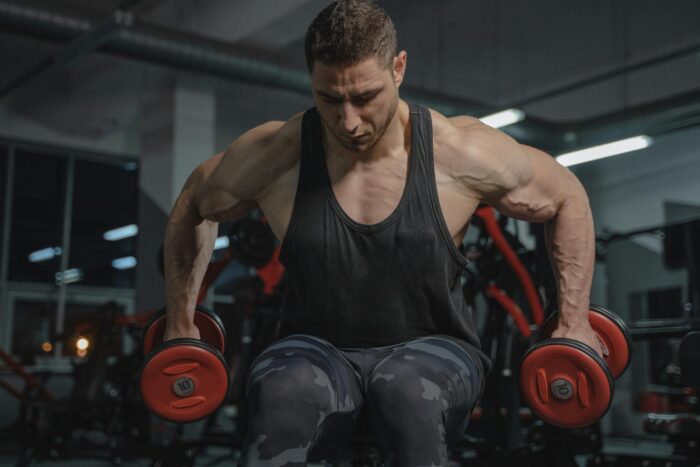
Traps: exercises and a growth workout in the gym
Your traps don’t always grow with heavier weight. When shrugs turn into yanking 100 kg dumbbells up and rolling your shoulders, the ego is doing more work than the muscle.
The simple truth: the traps want control, an adequate rep count and movement in the right direction. Here is a practical way to train both the part of the traps that shows above your shoulders and the part that extends across your back.
Translated by Janar Rückenberg
Why aren’t your traps growing?
After I answered someone who had asked why their trapezius wasn’t growing, they went rather quiet. They told me they do shrugs with 100 kg dumbbells for four sets of six reps. On top of that, they rolled their shoulders back during the lift.
My answer was blunt: they were doing almost everything wrong.
First, lifting your shoulders up and back, in other words rolling them, is no secret trick for the traps. It stresses the shoulder ligaments and adds little to the work of the muscle. If you think about how a muscle shortens and lengthens, it’s pretty clear. To get the traps working, it’s enough to lift your shoulders up and lower them straight back down.
What’s odd is that bodybuilding magazines were already writing in the 40s that rolling your shoulders gives the traps no noticeable benefit. Honestly, it’s strange that the same mistake is still being made in gyms.
Traps need more reps
My 22 years of training experience have shown me that some body parts respond better to a higher rep count. These include the forearms, abs, calves and trapezius exercises too. These muscles are working a lot in everyday life. The forearms help the fingers work, the abs hold up the upper body, the calves act with every step, and the traps control the movement of the head and shoulders.
So what actually happens when someone struggles with their traps? Usually they add weight and cut the reps. That is often exactly the opposite of what’s needed.
My magic number for the traps is 16. For some odd reason, 16 reps works best for my traps. Because the weight is lighter, the work has to be dense and deliberate. Personally, I do 12 sets in total for the traps.
The first four sets are shrugs. I usually do them with dumbbells, straight up and down. I hold the dumbbells in front of my upper thighs, because that lets me work the traps better and gives me a greater range of motion. When the dumbbells hang at your sides, the movement stays shorter.
Every rep has to be controlled. At the bottom, let the muscle stretch. At the top, feel the peak contraction. Not just up and down, but up, hold for a moment, then lower calmly.
How to actually get your traps working in exercises
Don’t jerk your shoulders. It’s one of the easiest ways to overload the biceps, the shoulder ligaments or the shoulder joint. If you can’t do the exercise without jerking, the weight is too heavy. Lower the weight and do the rep cleanly.
Shrugs alone won’t build massive traps. The reason is simple: the traps don’t sit only on top of your shoulders. Many people train only the part they can see in the mirror. But a mirror gives you a two-dimensional picture.
From the front, the trapezius looks like a pyramid-shaped muscle above the shoulders. From the side and from behind, the picture is different. The trapezius extends onto the back and forms a diamond-shaped area. It’s precisely this part on the back that makes the traps above the shoulders stand out better. When you hit a double biceps pose from behind, your traps should rise up like an avalanche.
The T-bar row develops the traps on your back well. It isn’t only a lat exercise. If you hold your body position steady and pull with control, the traps get very strong work.
The right grip on the T-bar row
For fuller trap development, I use the T-bar row with several grips. A narrower grip suits the lower traps and the outer edges. For the upper traps and the inner parts, I use a wider grip. Once again, it’s seemingly the opposite of what you’d guess at first glance.
Theorists sometimes recommend tilting your torso 90 degrees, since that should isolate the muscle better. In practice, it’s not a good idea. That position puts the spine under a very heavy load and feels as if you’re folding in half.
My position is different. The hips are at the center of gravity, the legs are stretched far out and the head stays up throughout the set. The range of motion doesn’t have to be full. You don’t need to stretch your arms out completely at the bottom. Keep constant tension in the traps and work in the upper three quarters of the range of motion.
Traps: practical tips for the gym
If you want your trapezius to develop, don’t do an exercise just to move the weight. Feel where the training load goes. If your neck, lower back or biceps do most of the work, the exercise is no longer what you need.
- Do a couple of warm-up sets before each exercise.
- Consciously use the traps when training other muscles too, e.g. the squat.
Add one more simple rule: choose a weight you can lift for every rep at the same tempo. If the first rep is clean and the last is just jerking with your shoulders, the set has already got away from you halfway through.
Bob Cicherillo, the 2000 NPC Super Heavyweight and Overall winner, also emphasized feel, grip and control. Trapezius exercises don’t need tricks. The muscle needs work that is heavy enough, but not so heavy that technique falls apart.
FAQ: traps
Do you need to roll your shoulders during shrugs?
No. The traps work when you lift your shoulders up and lower them back down under control. Rolling adds unnecessary load to the shoulder joint.
How many reps suit the traps?
The experience cited in the original says that 16 reps work well. What matters is that the reps are controlled and the tension stays in the muscle.
Are shrugs alone enough?
Usually not. The traps also extend into the back, so it’s worth including pulling exercises too, for example the T-bar row with different grips.
Author: Janar Rückenberg
Source: WHO – physical activity.
Come and train! ArtGym




