Abs: 16 training tips
Your abs only become visible when training, nutrition and daily movement work together. Endless sit-ups alone won’t give you a lean midsection, but well-planned ab training gives your body a stronger foundation and improves your posture.
Why your abs need more than sit-ups
Many people start training their abs hoping to lose fat exactly where they feel the burn. The truth is, your body doesn’t work that way. If a layer of fat covers your stomach, the muscle won’t show even if you do hundreds of repetitions every day.
Exercise strengthens your midsection, but how it looks also depends on your diet and cardio training. The best results come when ab exercises are part of a complete approach: strength training, a suitable amount of physical activity, a sensible diet and recovery.
16 practical tips for training your abs
- 1. Diet and cardio. Your abs won’t show if a layer of fat covers your stomach. To reduce it, you need to adjust your diet and do workouts that support fat burning.
- 2. Variety. When your usual exercises become easy, change the angle, tempo or body position. Muscles adapt quickly, so they need a new challenge.
- 3. Correct posture. Keep your neck, head and shoulders aligned. Don’t clasp your hands behind your head or pull on your neck. Keep your hands by your ears instead.
- 4. Effort. Perform the exercise so that you can feel the muscle contracting. When you’re starting out, it helps to place one hand on your stomach and briefly hold the end position.
- 5. Repetitions and sets. If you want visible abs, do 10-15 repetitions per set. For muscle mass and endurance, 15-25 repetitions work well. More than 25 repetitions mainly keep the muscles toned.
- 6. Lower back. Your lower back muscles work on the opposite side of your body to your abs. Include back extensions on a back extension bench or other back-strengthening exercises, or your posture will suffer.
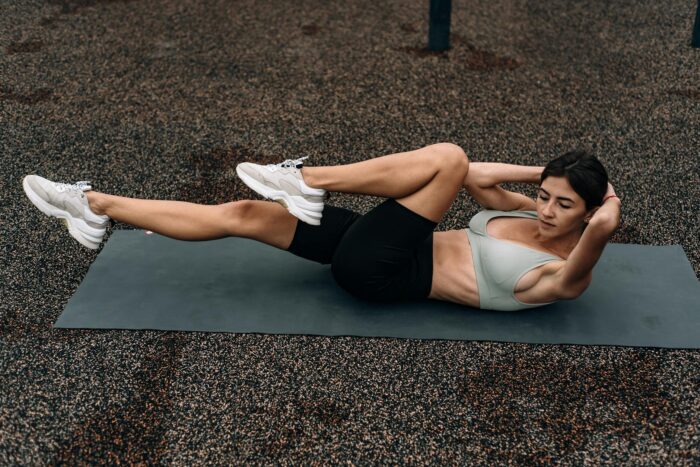
- 7. Obliques. Torso rotations and diagonal movements work your obliques. Move your torso toward the opposite knee or bring your knee toward the opposite shoulder.
- 8. Constant tension. Your abs recover quickly. Resting for even a couple of seconds between repetitions makes it harder to fully fatigue them. Maintain tension throughout the movement.
- 9. Your body’s foundation. Your abs aren’t just about appearance. Together with your lower back muscles, they protect your torso, support your spine and help you maintain better posture.
- 10. Range of motion. When training your abs, you don’t always need to rise as high as possible. Raising your torso to 30-45 degrees above horizontal helps the muscles contract effectively. Going beyond 45 degrees adds little extra work for your abs and may engage your hip flexors.
- 11. Control. Move slowly through a consistent range of motion. Fast, swinging movements increase the load on your back and make the exercise sloppy.
- 12. Resistance. Your body weight is enough to begin with. As your midsection gets stronger, change the position of your arms and legs or add a dumbbell, weight plate or another weight.
- 13. Upper and lower abs. Your rectus abdominis is actually one continuous muscle, but you can shift the emphasis. Bringing your knees toward your chest places more load on the lower portion, while lifting your upper body toward your hips places more load on the upper portion.
- 14. Basic movements. If you’re a beginner, start with simple exercises. When you get tired, rest briefly and pick up where you left off. Poor technique offers little benefit and can cause injury.
- 15. Breathing. Breathe out during the effort and in as you finish the exercise. Exhaling helps you contract your abs more strongly.
- 16. Exercise order. Exercise order isn’t the most important factor, but many people have weaker lower abs. Start there. If your lower abs are stronger, start with the upper portion.
How to really engage your abs during a workout
The simple truth is that ab training doesn’t have to take long, but it does require precision. If your neck is working harder than your abs, the exercise is either a poor choice or too difficult. If your lower back sags, take a step back and try an easier variation.
A good ab workout starts with control. Choose 2-4 exercises, perform them at a steady, unhurried pace and end each set before your technique breaks down. Your abs don’t need punishment. They need to learn to contract at the right time and in the right position.
Your workout should include at least one movement that brings your upper body toward your hips, one that brings your knees toward your chest and one exercise that requires you to keep your torso stable. This works your rectus abdominis, obliques and deeper core muscles.
Abs: what to watch for in your technique
The first sign of good technique is feeling the effort in your abs, not your neck or hip flexors. If you come up too high or use momentum, other parts of your body take over. So what actually helps? A slower tempo, a shorter range of motion and a conscious effort to engage your abs.
Don’t forget your lower back. A strong core means strength on both sides: your abs and your back. If you only train your abs, your posture can become unbalanced. A couple of solid back exercises a week can make a big difference here.
You don’t need to do the same exercise every time, either. Change the tempo, angle, rep count or weight from time to time. If your body always gets the same stimulus, your progress will stall sooner or later.
FAQ
Can exercises alone make your abs visible?
No. Exercises strengthen the muscle, but how visible it is depends largely on the layer of fat covering it. To change that, you also need to address your diet and overall movement.
Can you train your abs every day?
You can, as long as the training load is light and your technique stays good, but harder workouts require recovery. If the muscle is sore or your technique breaks down, take a rest day.
Can you train your lower and upper abs separately?
You can’t isolate them completely, because the rectus abdominis works as a whole. You can, however, shift the emphasis: knee raises work the lower portion more, while curl-ups work the upper portion more.
Come and train your abs! ArtGym
Author: M&F ABS, translated by Renita Hunt
Source: WHO – physical activity.