
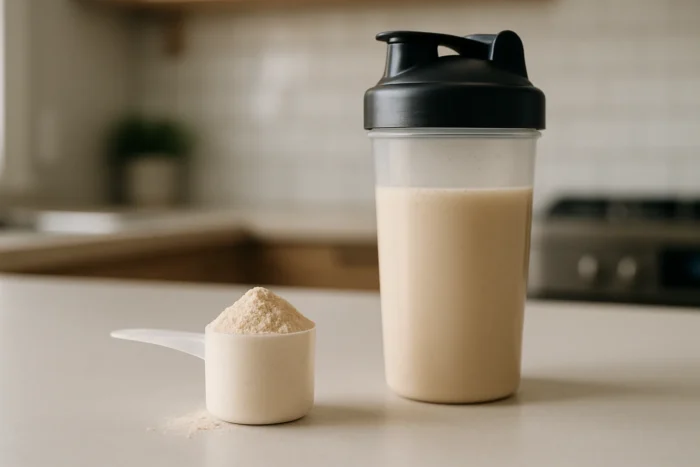
In short:
- Casein is absorbed slowly (about 3–7 hours), supplying amino acids throughout the night.
- A typical dose is 30–40 g of casein before bed, for example as an evening shake made with milk.
- Your total daily protein intake remains the most important thing; casein before bed is a useful addition, not an obligation.
Casein before bed is a simple way to extend the availability of amino acids overnight, when your body recovers most actively. Unlike fast-absorbing whey protein, casein is digested slowly, releasing protein over several hours — which is exactly what makes it a logical evening protein source. The Summer Shape Workbook places casein in the advanced kit precisely for “overnight recovery,” recommending 30 g before bed. Let’s look at what that means in practice.
How does casein before bed support recovery?
Casein forms a gel-like structure in the stomach, so its digestion and amino acid release take about 3–7 hours — considerably longer than whey, which is absorbed in 30–60 minutes. That means that while you sleep, when you normally go 7–9 hours without eating, your muscles keep receiving a steady flow of amino acids. The Summer Shape Workbook cites a study (Res et al., 2012) according to which casein before bed can support overnight muscle protein synthesis. The article Overnight muscle growth covers the topic in more depth, explaining why an important part of recovery happens specifically during sleep. It’s worth stressing: casein doesn’t “build muscle during sleep by itself” — it simply keeps the building material needed for recovery available. Muscle protein synthesis continues during sleep, but without a supply of amino acids it slows down; slow-release protein eases this overnight “fast.” That’s why casein before bed is a common practice for people whose dinner falls several hours before bedtime.
Casein vs whey protein — which one suits which moment?
Whey protein and casein complement each other: fast whey suits the post-workout window, slow casein suits the evening. Isolate is ~90% protein, while concentrate and casein are ~80%; absorption speed, however, is the main difference. If you want to get one comparison straight, read Whey vs. Casein. In practice you don’t have to choose one — many people who train use whey during the day and casein before bed. The most important thing is still your total daily protein intake: the Morton et al. (2018) meta-analysis found that 1.6–2.2 g of protein per kilogram of body weight per day is the optimal range for muscle growth and maintenance. Casein before bed helps you reach that target, especially when evening hunger would otherwise get in the way.
How much casein should you take before bed, and how do you prepare it?
A typical dose is 30–40 g of casein before bed. The International Society of Sports Nutrition (ISSN) position stand on protein (2017) points out that 30–40 g of slow-digesting protein before bedtime can support overnight recovery without disrupting next-day appetite. A simple recipe from the workbook: 30 g of casein + 200 ml of milk + 100 g of frozen berries makes a thick, filling evening shake (~300 kcal, ~35 g of protein). If you prefer food to a shake, you can choose cottage cheese (quark), which is also rich in casein. You’ll find more tips on evening eating in the article Eating before bed. Avoid adding a lot of sugar or fat to it if your goal is fat loss — keep the shake protein-focused.
Who benefits most from casein before bed?
Casein before bed makes the most sense for people who train intensively, who find it hard to hit their daily protein target, or whose last meal falls long before bedtime. For a beginner who already gets enough protein from food, it isn’t necessary — it’s more of an optimization tool for the advanced. People who are sensitive to lactose should keep in mind that casein contains a moderate amount of lactose. If you have kidney disease or another chronic condition, consult your doctor before adding larger doses of protein. It’s also worth knowing the difference between products: both micellar casein (natural, slow) and caseinate (a processed form that is absorbed faster) are on the market — micellar casein is better suited for overnight recovery, because its release is the most even. It’s worth trying both: casein thickens more in liquid than whey, which is why many people prefer to eat it as a pudding with a spoon. If evening cravings tend to wreck your plan, a thick casein shake helps keep hunger in check without adding many calories. All in all: casein before bed is not a miracle cure but a convenient tool for making overnight recovery run more smoothly, and it works best alongside good sleep and consistent nutrition.
References
- Res, P. T. et al. (2012). Protein ingestion before sleep improves postexercise overnight recovery.
- Morton, R. W. et al. (2018). Systematic review and meta-analysis of protein supplementation (49 studies).
- International Society of Sports Nutrition (ISSN), position stand on protein and exercise (2017).
- Summer Shape Workbook (Fitness.ee), Chapter 3: protein — your main tool.
Frequently asked questions
How much casein should you take before bed?
A typical dose is 30–40 g of casein before bedtime, for example as a shake made with milk. Still, your total daily protein intake matters more than any single serving.
Does casein before bed make you fat?
Not in itself. Body weight is determined by your daily calorie balance. If a casein shake fits within your daily calories, it won’t make you fat — if anything, it helps keep hunger in check.
Can quark replace casein?
Yes, cottage cheese and quark are naturally rich in casein and also work well as a slow overnight protein source.
Is casein suitable for people with lactose intolerance?
Casein contains a moderate amount of lactose, so very sensitive people may prefer a lactose-free product or whey isolate. If in doubt, talk to your doctor.
Time to train! ArtGym




