
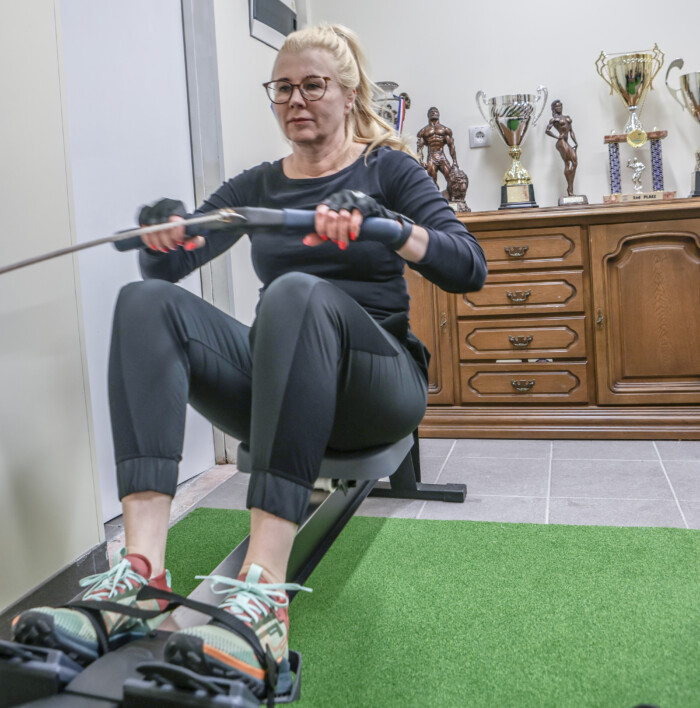
Rowing machine workout: benefits and training program
The rowing machine is often free in the gym even when the treadmills are all taken. That’s good news: with a single machine you can do a strong cardio workout, train your legs, back and arms, and keep your joints working reasonably gently at the same time.
If you’ve so far seen this machine as a slightly boring warm-up tool, it’s worth a second look. With the right technique, rowing is a genuine full-body workout, not just pulling with your arms.
Why is a rowing machine worth your time?
The Estonian winter is long, and slippery sidewalks don’t always invite you to run. That’s exactly when a rowing machine is a practical choice. You don’t depend on the weather, you can set the training load precisely, and the screen immediately shows your pace, distance and time.
Rowing works a large part of your body at once. The drive comes from the legs, the torso holds your position, and the back and arms finish the movement. That means the workout isn’t limited to a single muscle group. If your day is busy, 15–25 minutes of rowing already gives you a solid sense that you really got something done.
One more plus: the impact is low. When you run, every step gives your knees and ankles a fair jolt. On the rowing machine you move smoothly and seated. That doesn’t mean the workout is easy, only that the training load is easier to control.
How does the rowing machine train your body?
A common beginner mistake is pulling with the arms too early. The actual order is simple: legs, torso, arms. On the way back the movement reverses: arms forward, torso follows, then bend your knees. Once you get this rhythm down, rowing immediately becomes smoother.
A good row starts with a strong leg extension. Think of pushing the machine away from you, not yanking the handle frantically toward your chest. The arms come into play only at the end. The handle travels to roughly the lower part of your breastbone, your shoulders stay low and your back doesn’t collapse into a hunch.
So what actually happens? Your heart rate rises, your breathing gets deeper and your muscles work over a longer period. This kind of training load suits building endurance, supporting fat burning and maintaining overall fitness. Add short, faster bursts and it turns into a properly sharp interval workout.
A simple beginner workout
On your first try, row 5 minutes at an easy pace, then do 6 times 1 minute slightly faster followed by 1 minute slow. Finish with 3–5 minutes at an easy pace. It’s short enough that your technique doesn’t fall apart, but long enough for your body to understand what’s being asked of it.
The rowing machine in your training plan
You can use the rowing machine in several ways. Before a strength workout, 5–8 minutes is enough to warm up. On a separate cardio day you can do 20–40 minutes of easy work. If intensity is the goal, short intervals work well: for example, 10 times 30 seconds hard and 60 seconds easy.
Don’t crank the resistance all the way up right away. Many machines let you adjust the air vent (damper) or resistance, but a higher number doesn’t automatically mean a better workout. Rowing against too much resistance ruins your rhythm and wears out your lower back. Start with a medium feel where you control the movement, not the machine controlling you.
Keep an eye on your pace, your strokes per minute and how you feel. A beginner doesn’t need to race the numbers. The first goal is rhythm.
Common rowing machine mistakes
The most common mistake is a rounded back. If you sit like someone slumped in an office chair, your lower back quickly takes on too much load. Keep your chest open, your eyes ahead and your abs lightly tensed. You don’t have to be stiff, but your posture has to be strong.
The second mistake is starting too fast. The first two minutes feel easy, then the bill arrives. It’s better to start calmly and raise the pace toward the end. Honestly, for most workouts that’s smarter than a heroic start and an exhausted finish.
The third mistake is yanking the handle up to your chin. The handle travels in a straight line, with your elbows going back and your shoulders relaxed. If you feel the rowing only in your arms, your technique is probably off. Your legs should do most of the work.
Rowing machine: FAQ
Is a rowing machine suitable for beginners?
Yes, if you start easy and learn the technique before adding speed. Your first workouts should be short, about 10–20 minutes including breaks.
Does rowing help with weight loss?
Rowing can support weight loss because it burns energy and works many muscles at once. Still, consistent training, sleep and nutrition remain the decisive factors.
How many times a week should you row?
A good start is 2–3 times a week. If your recovery is in order and your technique holds up, you can add one longer easy workout or a short interval day.
Edited by: Arnold Tokko
Illustrative photo: Mati Hiis
Model: Piia Ausman
Come and work out! ArtGym




