Get your hips moving: run and train better
Your hips soon let you know when you have spent the day sitting or started a workout without warming up. Here is a straightforward look at why hip mobility affects your running, squats and lower back, and which exercises are worth doing before a workout and on a dedicated mobility day.
Why do your hips matter in every workout?
If your lower back feels stiff after a run or leg day, your back itself is not always to blame. Very often, the problem starts at your hips. Your hips connect your torso and legs, transferring force as you run, lunge, squat or simply walk up the stairs.
Prolonged sitting shortens your hip flexors and leaves your glutes feeling lazy. This is common among office workers, but also drivers and students. Sound familiar?
Stiff hips mean more than a reduced range of motion. Your body starts looking elsewhere for the movement it is missing. Often, your lower back or knees take over. That is how an easy run, a light squat or a yoga class can start to feel uncomfortable, even when the training load is low.
The simple truth is that mobile hips are not just for yoga. You need them for strength training, running, ball sports and everyday movement. When your hips move more freely, your body can direct force where it is needed more easily.
How do your hips affect running and strength?
Your hips are a central link when you run. They help you maintain balance, bring your leg forward and propel your body ahead. When your hips are tight, your stride shortens. Your body then has to work harder to maintain the same pace. Some people tense up through their shoulders; others start rotating through their lower back to compensate.
The same applies in the gym. A squat requires hip flexion and control. A lunge requires stability. A hip thrust requires your glutes to work. When your hips do not move well, exercise technique quickly breaks down. Your knee caves inward, your back arches or your weight shifts onto your toes.
Frankly, not everyone needs to do the splits. That is not the goal. The goal is for your hips to move well enough for your sport and everyday life. As a runner, you need a good stride. If you do strength training, you need to control your position. If you practice yoga, you need to move calmly without forcing anything.
What is actually happening?
When the muscles around your hip are tight, the joint has less room to move. Your hip flexors, glutes, hamstrings, inner thighs and lower abdominals all work together. If one area is very stiff or weak, another has to work harder. That is why stretching alone is not enough. Your core muscles and glutes need to work too.
Get your hips moving: a simple exercise plan
A good mobility routine does not have to take half an hour. Before a workout, 6-10 minutes is often enough. Perform the exercises slowly and calmly, without pain or jerky movements. It is worth starting a little more gently, especially in winter when you come into the gym from the cold outdoors.
Start with hip circles. Stand with your hands on your hips or use a wall for support. Make slow circles in each direction. The aim is not to put on a big show, but to feel the joint waking up. This works well before a run or at the start of leg day.
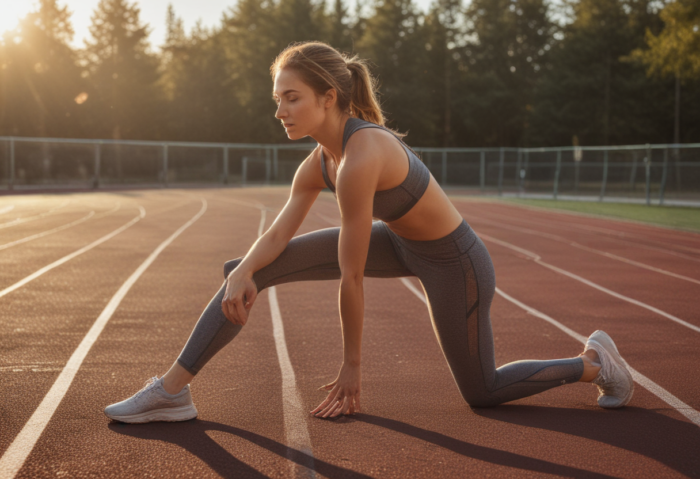
Next, do a deep lunge with a torso rotation. Step one foot forward, lower your back knee almost to the floor and turn your upper body toward your front leg. Keep your breathing calm. This opens up your hip flexors and teaches your core muscles to hold the position.
Add a glute bridge. Lie on your back with your knees bent and feet on the floor. Press your heels into the floor and lift your hips. Do not overextend your lower back. Instead, focus on letting your glutes do the work. When your glutes are active, your lower back does not have to carry the whole load alone.
A simpler version of pigeon pose, lizard pose and a low lunge are good yoga options. You do not have to go deep into these positions. If your body tenses up to protect itself, you have gone too far. The stretch should feel distinct but tolerable.
What do your hips need besides stretching?
Opening up your hips can sound as though it is all about stretching. In reality, your hips need three things: mobility, strength and control. If you stretch a lot without strengthening, your body may feel unstable. If you only lift weights without moving through a full range of motion, you are still missing part of the picture.
Add exercises to your week that work one leg at a time. Lunges, Bulgarian split squats and single-leg deadlifts quickly reveal whether your left and right sides are similar. A difference does not have to be a big deal, but it is worth noticing.
Your core muscles matter here. Planks, side planks and dead bugs may not look exciting, but they teach you to keep your pelvis stable. When your core holds steady, your hips can do their job. Your posture then improves too, and you can breathe more freely during training.
Do not save mobility work for when something hurts. Treat it like brushing your teeth: a little, often. Ten minutes three times a week is more realistic for many people than one long stretching session that never happens.
If you want to see the original movement idea, the illustrative material comes from fitmethods, and you can watch the video here! Use it as a guide rather than a competition. Your body’s pace matters more than someone else’s mobility on a screen.
FAQ: hips and mobility
Should you get your hips moving before every workout?
Yes, especially before running, leg day and exercises that involve plenty of knee and hip movement. A short warm-up is enough. Use dynamic movements rather than long passive stretches immediately before a heavy set.
Can stiff hips cause lower back pain?
Yes, although lower back pain does not always have just one cause. When your hips do not move well, your body often compensates through your lower back. If the pain is sharp, persistent or radiates down your leg, it is worth speaking to a physiotherapist or doctor.
How quickly can hip mobility improve?
You may notice an initial difference after just a few warm-ups, but lasting change takes weeks. A steady, consistent approach works best: mobility, core strength and glute activation in the same plan.
Come and train! ArtGym