
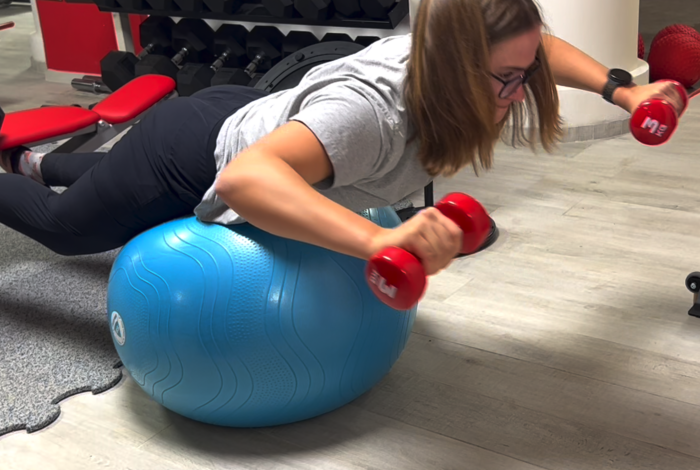
Stability ball training at home and in the gym
A stability ball is one of those pieces of equipment that sits in the corner of many gyms but gets too little attention. This large rubber ball is useful for more than just ab exercises. Used correctly, it adds balance work, core engagement and exercises you otherwise couldn’t do at home without a bench.
Why does a stability ball deserve a place in your training?
If you’ve been to a gym, you’ve probably seen these large, colorful balls in the corner of the aerobics studio or beside the stretching mats. Some people see them as tools for warming up or rehabilitation. Others think a stability ball is only useful for ab exercises.
Honestly, that’s a fairly narrow view. Exercise ball, fitness ball, balance ball and Swiss ball all mean essentially the same thing: a sturdy rubber ball that supports your body weight and makes you maintain stability during an exercise.
The big difference compared with a standard gym bench is instability. When you lie on a bench, it gives you firm support. When you lie on a ball, your core muscles, glutes, back and even your neck have to work to keep your body aligned. That’s what makes the exercise different.
Deborah Mullen, a personal trainer with CSCS certification, co-owner of “Lihtsad Vormisoleku Lahendused” and a stability ball sales representative, has pointed out that a ball can replace a gym bench for almost all arm, shoulder and chest exercises. That doesn’t mean benches become pointless. A ball simply gives you one more option, especially if you train at home with limited equipment.
How does a stability ball make an exercise harder?
Take a simple example: the dumbbell chest press. On a bench, you focus mainly on pressing the weight up. Lying on a ball, you also have to maintain your balance, keep your hips up and control your shoulders. If your midsection sags or your head drops back, your form quickly deteriorates.
So what’s actually happening? Your body can no longer rest passively on a support. Small stabilizing muscles have to get involved. That’s why the same weight can feel heavier on a ball than on a bench. When you’re starting out, leave your ego out of it. Lighter dumbbells and good technique will do more for you than rushed, sloppy movements.
A stability ball is also useful because it connects strength and mobility with everyday movement. Housework, lifting a child, carrying a shopping bag or picking something up off the floor never happens on a completely rigid bench. Your body has to adapt constantly. A ball teaches you to do that in a controlled environment.
Exercises you can do with a ball
A stability ball can serve as a bench for several familiar exercises. For example, you can do dumbbell chest presses, chest flyes, seated dumbbell shoulder presses, dumbbell front raises, rear delt flyes and back extensions.
You can also use the ball for one-arm dumbbell rows, seated dumbbell forearm curls (wrist curls), bent-over barbell or dumbbell biceps curls, and seated or lying French presses (triceps extensions). You don’t need to include all of these in your program at once. Choose a couple of exercises and learn to do them properly.
For home training, a major advantage of a stability ball is variety. When space and equipment are limited, routines tend to become repetitive. A ball lets you do more variations with the same pair of dumbbells and give familiar movements a fresh feel.
Stability ball basics before you start
Before adding weights, learn to sit and lie on the ball and hold your position. That sounds almost too simple, but this is where many mistakes happen. If you can’t maintain your balance steadily on the ball, adding dumbbells isn’t a good idea yet.
- Before using additional weight, find your balance and get a feel for how the ball moves.
- Leave enough space around you so that you won’t hit furniture if you trip or tip sideways.
- Work out the minimum ball diameter you need. When you sit on the ball, your thighs should be parallel to the floor. Your hips can be higher than your knees, but never lower.
- Using a mat is recommended on linoleum, wood or parquet flooring. You don’t usually need an exercise mat on carpet.
- You don’t need any special gadgets to inflate or deflate the ball. A bicycle or air mattress pump and a spoon will do the job.
- There’s no need to worry too much about the ball bursting. These balls are designed to withstand considerable pressure. If a ball develops a small hole, it deflates slowly rather than bursting with a loud bang like a balloon.
The simple truth is that a stability ball doesn’t automatically make an exercise better. It makes it better when you use it with a purpose. If your aim is to improve stability, work your core muscles and expand your home routine, a ball is a very sensible choice.
FAQ: using a stability ball in your training
Is a stability ball suitable for beginners?
Yes, but start with bodyweight exercises and simple positions. Only add dumbbells or more complex movements once you can maintain your balance.
Can you only use a ball to train your abs?
No. Your abs do plenty of work, but a ball is also suitable for chest, shoulder, arm, back and core exercises.
Can a stability ball replace a gym bench?
For some exercises, yes, but not always. If you’re lifting very heavy weights, a stable bench is safer. A ball is better suited to controlled technique and moderate weights.
Find a suitable FitBall here: https://turg.fitness.ee/en?vendor=fysioline
Author: Muscle&Fitness, translated by K. Reial
Source: WHO – physical activity.
Come and train! ArtGym




