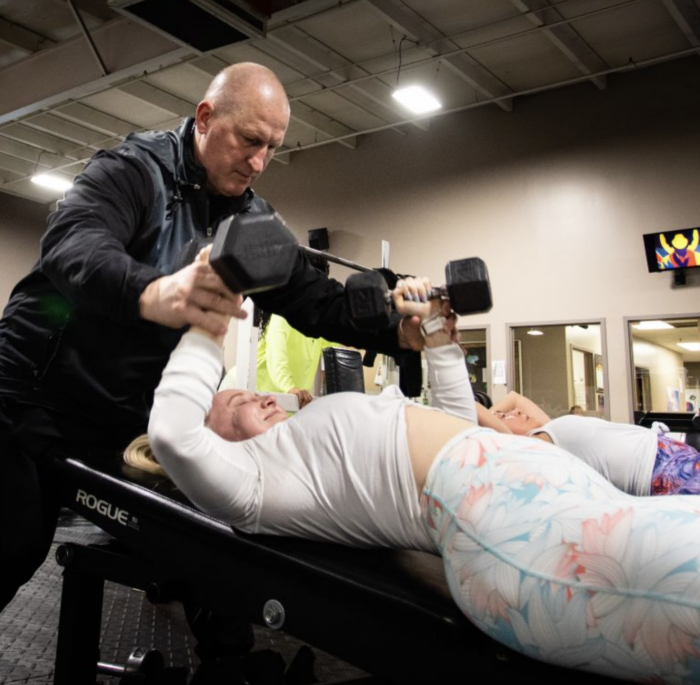
Mike Davies’s training advice
mr fix it was the name given in a Muscle & Fitness Hers article to Mike Davies, a trainer from Columbus, Ohio, who helped many women fine-tune their physiques for the stage. Here are his ideas in today’s language: less chatting during workouts, more planning, patience and proper eating.
Training guru Mike Davies wasn’t selling miracles. His core message was simple: if you’re not getting results, first look at your nutrition, your effort and whether you’re giving your muscles enough work at all.
mr fix it on the biggest mistake: a weak foundation
Davies was blunt: for many women, nutrition is what holds back their progress, rather than their choice of exercises. You can be very active, but changing your body is difficult if your diet doesn’t support your strength training. He singled out protein: if you’re going to train with weights, your food needs to support that work.
Cardio is the second area where things fall apart. In Davies’s view, if you can comfortably chat with a friend during cardio, the intensity isn’t high enough. Training doesn’t have to be punishment, but it does have to involve work. Talking should become harder, rather than the workout remaining a comfortable chat.
The third mistake was rep count. Davies criticized training several body parts in the same workout and doing, for example, only six reps for your shoulders. If you want to give your shoulders a meaningful training load, make them stronger and shape them, you need to increase the training volume. His recommendation was to focus on one body part per day.
The mr fix it goal: don’t let the scale dictate your life
Davies didn’t talk much about weight. To him, how your body looked and how your clothes fit mattered more. He gave a simple example: someone could weigh 130 pounds and wear a size 8, or weigh 130 pounds and wear a size 3. The number on the scale doesn’t tell the whole story.
Honestly, that advice still makes sense. When you train at the gym, you can gain muscle and lose fat at the same time. The scale may not move as quickly as you’d like. Davies recommended buying jeans two sizes smaller and trying them on every three weeks to see how they fit. If they’re getting easier to put on, you’re making progress.
How did Mike Davies structure his training?
When it came to legs, Davies was very clear: lunges, lunges and more lunges. He used different lunge variations and trained the entire leg with weights once a week. The idea was to maintain the right heart rate throughout the work, rather than simply get through the exercises.
He said he wouldn’t go beyond 15 reps in an exercise, but would pair muscle-shaping movements in supersets. For example, a set of leg curls could be followed immediately by a set of plyometric split jumps. These are jumping lunges that use your own body weight as resistance.
Davies considered the back one of the hardest body parts to train. The reason? Technique. Many people don’t make use of the stretch or feel the muscle working. His instruction was to let the weight stretch the muscles before starting the movement, then contract them fully. If you want to master this, find a patient trainer or an experienced training partner who pays close attention to what you’re doing.
Intensity was at the heart of his system. According to Davies, women often rest too long between sets. You don’t always have to lift heavy weights, but you do need to keep the work closely spaced. He emphasized that results depend more on the time you spend working than on your total time in the gym. His clients did 45 minutes of strength training and noticeably changed their bodies within a short period.
A practical training plan and cardio advice
For a woman training 4-5 times a week, Davies recommended the following split:
- Day 1 legs
- Day 2 shoulders
- Day 3 rest
- Day 4 back
- Day 5 arms
- Day 6 chest
- Day 7 rest
He recommended training calves 2-3 times a week at the end of a workout and abs 3-5 times a week. He paired ab exercises with exercises for smaller body parts in supersets to keep the heart rate up. For example, a set of barbell curls followed by 15 sit-ups.
For the average gym-goer, his cardio recommendation was 30 40 minutes at high intensity, five days a week. Many of his clients did cardio in the morning, plus three shorter evening sessions. This also applied to those who simply wanted to get in better shape without competing. An important addition: eat enough calories to support your training.
Davies was even more emphatic about changing your workouts. He said he never did the same workout twice. You need to learn exercises, switch them up and use a wide variety. He didn’t favor full-body workouts for his goals because he believed they didn’t give the muscles enough work.
He did not support following a rigid plan based on body type either. His advice was to experiment and find what works for you. In one workout, you might do 6-8 reps per set of one exercise and 30 of the next. The simple truth: train smart, but don’t just go through the motions.
FAQ: Mr Fix It’s training advice
Is the number on the scale the most important measure of training progress?
No. Davies paid more attention to body shape, how clothes fit and overall condition. Your weight can stay the same even as your body composition improves.
Should women train their whole body in a single workout?
Davies’s answer was no. He favored training separate body parts, as this gives each muscle more attention and work.
What was Mike Davies’s final piece of advice?
Whatever you choose to do in the gym, do it with intensity. That sums up the whole article well.
Author: No Kia
Source: WHO – physical activity.
Come work out! ArtGym