
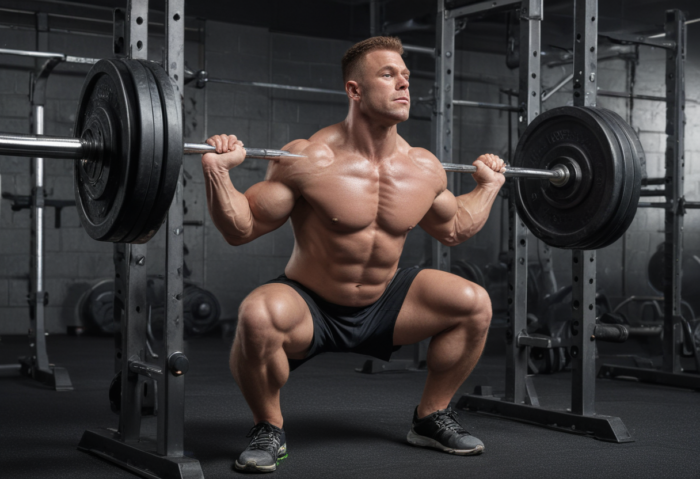
Barbell squat: high or low bar position
A barbell can feel uncomfortable on your upper back during a squat, especially if the placement doesn’t suit your build. The good news is simple: you often don’t have to avoid squats, you just need to find the spot where the barbell stays secure and the movement feels more natural.
Why does the barbell matter in the squat at all?
The squat is one of those exercises in the gym that everyone has an opinion about. Some love it, some always skip it. Very often the reason isn’t laziness but the feeling that the barbell placement presses on your neck, chafes your upper back, or makes the whole exercise unpleasant before the first repetition.
Honestly, there’s some truth in that. The squat can be uncomfortable. It’s a demanding exercise for the legs, the breathing and the concentration alike. The old text said bluntly that it can be a real sweat festival and lactate party. That sounds a bit colorful, but the point stays the same: the squat isn’t easy.
At the same time, discomfort doesn’t automatically mean the exercise isn’t right for you. Often the question is whether the barbell sits too high on your upper back, too low, or simply in the wrong spot for your body. Barbell placement changes how upright your torso is, how far your knees travel forward and how much work your hips do.
Barbell high, low or in between
There are two main placements: high and low. A high placement means the barbell rests on the upper part of the trapezius, fairly close to the neck. A low placement means the barbell sits more on the back, on the lower part of the trapezius. The third option is to place the barbell between the two, roughly in the middle of the trapezius.
A squat with a high barbell usually has a more upright torso. The training load is shared more evenly between the hips and the knees. Many people feel that the front of the thigh works harder in this variation. Put simply: you squat more with your legs.
A low barbell changes the movement. To keep your balance, the hips move further back and the torso leans forward more. That gives the hips, glutes and the whole posterior chain a bigger role. At the same time, the shins often stay more vertical during the squat, which can reduce stress on the knee joint.
This doesn’t make one variation better than the other. It’s a matter of goal and fit. For some lifters a high placement is strong and natural. For others a low placement feels more secure, because their build favors more work from the hips.
How to choose the barbell placement for your body
Body structure affects the squat more than it first seems. The length of your legs and torso determines how much you have to lean forward, how deep you can comfortably descend and how wide a stance your body naturally looks for.
- Long legs and a long torso: the barbell often sits better on the lower part of the trapezius, i.e. lower. Your stance can be as wide as is still comfortable.
- Long legs and a short torso: the barbell may suit the middle of the trapezius. Here too, your stance can be as wide as is still comfortable.
- Short legs and a short torso: the barbell placement often suits the upper part of the trapezius, i.e. higher. Your stance can be shoulder-width.
- Short legs and a long torso: the barbell may suit the lower part of the trapezius, i.e. lower. Your stance can be shoulder-width.
The old text had a typo in the form 8madalal, but the meaning was clearly a low placement. Treat this as a practical direction, not a rule set in stone. Your body proportions give a hint, but the final answer comes under the barbell.
Practical signs to watch for in the squat
Start with an empty barbell or a very light weight. Try the high placement, the low placement and the in-between variation. Do a few calm repetitions in each position and notice where the barbell stays most secure without you gripping it hard with your hands.
If the barbell rolls on your upper back, the placement or the tension in your upper body is probably off. If you feel sharp pain in your neck, the barbell is too high or pressing directly on the bone. If your back collapses forward uncontrollably in the squat, a low placement may be too demanding for you right now, or your technique needs polishing.
One translator’s note deserves to stay: towels, sponges and padding may not be a good habit if you seriously plan to train in the gym for years. They can make the barbell less stable and hide whether the placement is actually right. The squat may never become 100% comfortable, but you don’t have to put up with unnecessary pain either.
A simple truth: choose the placement that lets you squat in a controlled, stable way without forcing your joints. When your knees, hips and back feel better, your confidence to add weight usually improves too.
FAQ: barbell and squat placement
Is a high barbell better for a beginner?
A high placement is often easier for a beginner, because the torso stays more upright and the movement feels more familiar. That doesn’t mean a low placement is wrong. You can learn it later, once your basic technique is more solid.
Does a low barbell spare the knees?
A low placement can reduce how far the knees travel forward and direct more work to the hips. If your knee hurts, don’t just change the barbell position; review your whole technique, training load and range of motion.
Should you use padding after all?
In the short term it can help reduce fear, but a lifter with a long-term plan should learn to place the barbell on the back correctly. The right spot, a tight upper back and calm practice give more benefit than thick padding.
Reference
This article comes from: Muscle & Fitness, July 2007.
Translated by: Janar Rückenberg
Source: Turg.Fitness.ee
Come and train! ArtGym




