
Muscle contraction types: how your muscles work
Understanding muscle contraction types helps you make sense of what actually happens during a rep in the gym. When you know when a muscle shortens, lengthens or holds a position, you can make better choices about tempo, training load and recovery.
Why muscle contraction types matter in training
During strength training, a muscle does more than simply switch on and off. A single squat, press or row involves several distinct phases. In one phase, the weight moves up; in another, it moves down. Sometimes your body simply has to hold the weight still.
Take a biceps curl as a simple example: the muscle does not work in the same way throughout the rep. As you lift the weight, your biceps muscle shortens. As you lower it, the same muscle lengthens. If you hold the dumbbell still halfway through the movement, the muscle stays almost the same length. These are different types of muscle contraction.
This knowledge is more than textbook theory. It has implications for muscle strength, muscle mass development, fatigue and recovery. This is especially clear with heavy eccentric work, where recovery can take up to 72 hours when training loads are high.
Muscle contraction types: four main forms
The four most commonly discussed types are eccentric, concentric, isometric and isokinetic contractions. Each describes how a muscle works during a movement.
Eccentric muscle action
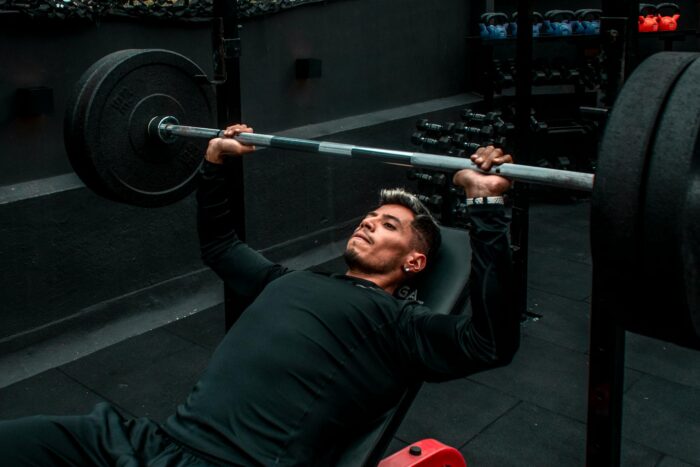
During an eccentric contraction, the muscle lengthens. Lowering a weight is a classic example (Washington et al. 2001). In a bench press, this means lowering the bar to your chest under control. In a squat, it is the downward phase.
Eccentric muscle actions can produce more force relative to muscle size. They recruit fewer motor units for a given level of tension and require less energy for the same force output. At the same time, they can cause more severe delayed-onset muscle soreness than concentric actions (Kraemer & Ratamess 2004).
Honestly, this is where many people rush. They let momentum take over as they lower the weight, lose control of the rep and miss out on some of the training benefit. Lowering the weight steadily does not make for a boring workout. It means better control.
Concentric muscle action
During a concentric contraction, the muscle shortens. For example, your biceps muscle shortens as you bend your elbow (Washington et al. 2001). This is the part of the rep most people notice most: you press, pull or lift the weight up.
Fatigue quickly changes this phase. One study showed that during a 5RM bench press set, the concentric phase lasted about 1.2 – 1.6 seconds for the first three reps. The last two reps lasted 2.5 and 3.5 seconds, respectively (Kraemer & Ratamess 2004). So what is actually happening? The same weight moves more slowly because the muscle is tiring.
Isometric muscle action
During an isometric contraction, muscle length stays the same. A wall sit is one example: you hold a squat position with your back against a wall (Washington et al. 2001). There may appear to be no movement, but your muscles are still working. Your thighs, glutes and core hold your body in place.
Some advanced training programs may include various isometric exercises (Kraemer & Ratamess 2004). Isometric training may help develop peak force and movement speed, particularly in untrained participants. However, its effect on explosive force production is relatively minor (Stone et al. 2000).
Isokinetic muscle action
During an isokinetic contraction, the speed of muscle contraction remains constant throughout the range of motion (Washington et al. 2001). You will encounter this less often in a typical gym because it requires specialized equipment. It is more commonly used in testing and rehabilitation.
Many doctors and some exercise scientists have believed that isokinetic training and testing offer advantages over other methods. However, scientific evidence suggests that they may be no better than other forms of testing and methods of strength training (Stone et al. 2000).
Studies of isokinetic exercises have shown that training at fast movement speeds (180°•s-1) is more effective than training at slow movement speeds (30°•s-1) when the goal is to improve local muscular endurance. Fast contraction speeds are therefore recommended for isokinetic training (Kraemer & Ratamess 2004).
How to use muscle contraction types in your training
In practice, you do not need to turn every workout into a science project. Simply pay attention to the different parts of each rep. If your goal is to build muscle mass, do not just let the weight drop. Keep the eccentric phase under control and perform the concentric phase forcefully, while maintaining good technique.
If you want to improve a specific position, such as the bottom of a squat or the top of a pull-up, an isometric hold can be a useful addition. It does not replace the full movement, but it helps you learn control at the point where your form tends to break down.
Be careful with eccentric work. Very heavy negative work can provide a strong stimulus, but it can also cause more soreness. If your legs are stiff for several days after a workout, your next heavy leg day may come before you have recovered. Bear in mind that recovery after very high training loads can take up to 72 hours.
Practical tips for different types of muscle contraction
Start simple. Perform each repetition with an awareness of when the weight moves up, when it moves down and when you need to hold a position. If your technique breaks down, the weight is too heavy or the tempo is too fast.
Do not use the eccentric phase solely to brake the movement. It is part of your training. The same applies to isometric holds. If a pause is planned, keep your body under tension rather than simply resting under the weight.
It is normal for the concentric phase to slow down towards the end of a set. As the 5RM bench press example showed, the final repetitions took 2.5 and 3.5 sec. This does not automatically mean poor technique, but it does indicate fatigue. If you lose control of the movement, end the set.
FAQ: muscle contraction types in training
Is the eccentric phase important for muscle growth?
Yes, eccentric actions are important for optimal muscle hypertrophy (Kraemer & Ratamess 2004). However, they need to be incorporated sensibly, as heavy eccentric work can increase muscle soreness.
Is isometric training suitable for beginners?
Yes, provided the exercise is simple and you can maintain control of your position. Holding a squat position against a wall, for example, teaches you to maintain tension and body position. There is no need for overly demanding holds at the start.
Is isokinetic training necessary in the gym?
For most people, no. It is mainly used for training and testing with specialized equipment. Regular strength training already provides plenty of opportunities to train with slow, moderate and fast movements.
References:
Kay, D; Gibson, A. St C; Mitchell, M.J; Lambert, M.I; Noakes, T.D (2000). Different neuromuscular recruitment patterns during eccentric, concentric and isometric contractions. Journal of Electromyography and Kinesiology. 10:425–431
Kraemer, W.J; Ratamess, N.A (2004). Fundamentals of Resistance Training: Progression and Exercise Prescription. Medicine & Science in sports & exercise. 36(4): 674-688
Stone, M.H; Collins, D; Plisk, S; Haff, G; Stone, M.A (2000). Training principles: evaluation of modes and methods of resistance training. National Strength & Conditioning Association 22(3): 65–76
Washington, R.L; Bernhardt, D.T; Gomez, J; Johnson, M.D; Martin, T.J; Rowland, T.W; Small, E (2001). Pediatrics. 107(6)
Author: Marko Mumm
Source:Turg.Fitness.ee
Come and train! ArtGym




