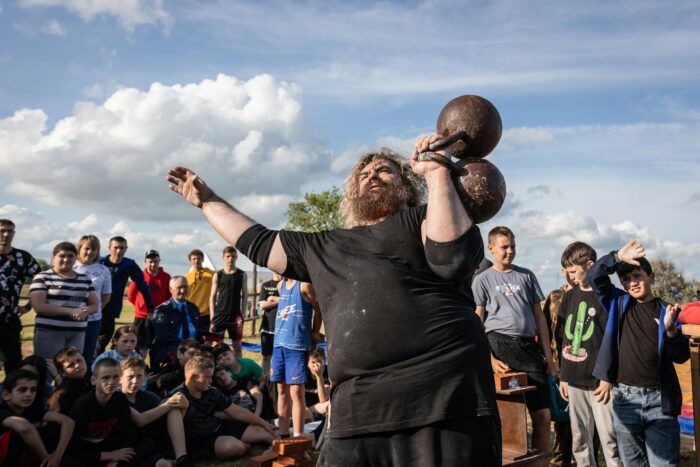
Janar Rückenberg: from bodybuilder to strongman
I don’t even know where to start. The regulars on the Fitness.ee forum probably know me mainly through my articles. For those less familiar with what I do: I’m not just a dry writer. I have about 10 years of serious training experience behind me, and I’ve tried my luck, with fairly decent results, in bodybuilding too.
I haven’t managed to win any special titles, but that isn’t what matters most right now. What I consider most important is that I’ve managed to get into really proper shape a couple of times in my life. I’ve come to understand more or less how to look on stage. I actually decided to step back from active competitive bodybuilding after autumn 2005, when I took my diet a little too far. In 2007, in the spring to be exact, I did one more successful competition in Latvia, but my mind was already made up. I would rest and step back somewhat from bodybuilding. Clear interests and goals emerged: I could try powerlifting and strongman. And that’s how it went.
My background and goal
By now I’ve trained as a powerlifter and strongman for more than 1.5 years, which is of course next to no experience. But considering that I have some foundation from bodybuilding training as well, you can’t quite call me a complete novice.
The aim of this piece is to give you my view, my experience and an overview of these three strength sports. This short overview might help some of the guys who are facing a choice. Let me add that although I haven’t looked like a bodybuilder for a long time now, I’m still writing this from a bodybuilder’s point of view.
Weekly training split: three disciplines side by side
I have a lot of thoughts, and I’m laying them down on paper all jumbled together. Let me start with training. Comparing the three: at first I thought bodybuilding training methodology was complicated, but now I think it’s far from it. I realized long ago, and still stand by it, that how successful you are in your training depends very largely on how well you manage to set up your weekly split (of course, other factors underlie success too).
In my opinion, the hardest one to put together is a strongman’s weekly training split. In powerlifting and bodybuilding things are very clear-cut. In bodybuilding you build your split so that each muscle is trained once a week, and that’s it. Alongside many exceptional approaches, broadly speaking that’s how it is. In powerlifting the “bookkeeping” revolves more around the lifts, so all training is connected and consists of training the three main competition lifts: squat, bench press and deadlift.
I won’t go into details and exceptions, but basically the deadlift is trained once a week, and the bench press and squat 1–2 times a week. There are of course exceptions, but for the most part that’s how it is. Training mostly follows progressive systems or programs calculated by various calculators, the aim being that as the program advances, the number of sets and reps goes down while the training load, i.e. intensity, goes up. The program should culminate in a competition.
It’s good and simple, really. I’m certainly not saying this to claim that powerlifters’ training is easy. Far from it. But I firmly maintain that everything is neatly in place, and you can recover well from the different sessions. A typical powerlifter’s training schedule looks like this:
- Monday: squat
- Tuesday: rest
- Wednesday: bench press
- Thursday: rest
- Friday: deadlift
- Saturday: rest
- Sunday: rest
Or a variation of it. With a split like this you can recover satisfactorily.
Bodybuilding training splits are even better when it comes to recovery. Different body parts are trained in even more isolation. Although compound exercises make up a large share of every serious bodybuilder’s training program too, the training volume per exercise is still smaller than, for example, a strongman’s or powerlifter’s. The weights are smaller as well.
In practice, the idea is that when a bodybuilder squats, they do perhaps 4–5 working sets and move on to the next exercise, whereas a powerlifter or strongman may do 10–15 sets of squats in a leg-day session (not always, of course; sometimes the volume is lower in a single session, but then the squats come more often). This means, though, that because strongmen and powerlifters mainly do compound exercises, they also have to deal with a considerably higher level of general fatigue. A bodybuilder mostly isolates their muscles and different body parts through exercises, while strongmen and powerlifters focus primarily on compound exercises.
Although a powerlifter also focuses on compound exercises, the recovery options are still significantly better than a strongman’s. I won’t give any strongman split as an example, but from my limited experience I understand more and more that training as a strongman and finding a good, correct weekly split is, in my opinion, a science in itself.
Why strongman training is so draining
What do they train? Squats, deadlifts, snatches, clean and jerks, cleans, jerks, bench press (a little), log jerks, plus the event disciplines (stones, suitcases, sailor’s walk, car pulls, Conan’s wheel and so on), each trained separately. Do you know what I find truly insane about all this? They only do exercises that thoroughly work your entire body in every workout. And that’s not all: you might get away with everything else, but the common thread in all the exercises above is that THEY ALL LOAD THE BACK VERY HEAVILY. And once your back has been seriously wrecked by one workout, it takes days to recover properly.
If a bodybuilder trains chest and triceps today, there’s a “million” options for tomorrow: lats, shoulders, biceps, legs, whatever. The powerlifter’s split was what it was.
But if a strongman does a serious deadlift workout today (full pulls + half pulls = 12 sets), I’m faced with a real dilemma about what to do tomorrow. Squats? Hopeless. How do you squat when your back is so drained from pulling that even 120 kg is hard to hold on your shoulders? Clean and jerks? Those combine the pull + the clean + the jerk, and all of them demand a strong, recovered back. Jerks on their own? Pointless. Anyone who has done them, especially with heavy weights, knows what they do to your back. Event disciplines such as stones, tire or suitcases? Again, all of them demand a strong, recovered back. Bench press? OK, it’s the only option, though I should say many strongmen don’t do it at all. And the same overlaps exist between practically all strongman exercises. Do jerks and your back is wrecked again, and pulls, squats and clean and jerks are off the table for a couple more days afterwards.
In short, the moral of the story is that because strongmen almost exclusively do exercises that constantly work the whole body, and especially the back, recovery is relatively hard.
Injury risk across the disciplines
That brings us smoothly to a new problem: injuries. Since I’ve done bodybuilding for most of my training career and strongman “business” for only 1.5 years, I boldly claim that bodybuilding is an EXTREMELY safe strength sport that causes few injuries. I think that if you follow a typical powerlifting split and powerlifter-style training, the same goes for powerlifting. In bodybuilding, where the weights are lifted in a controlled way and under constant tension, injuries are practically nonexistent as long as your technique is more or less in order.
Strongman is a different story. Raw heaving of huge weights, especially in a competition situation, carries the highest injury risk there is. And since I just said that training consists mostly of basic exercises that work the whole body all the time, that also means the risk of injury is extremely high.
I’ll be honest with you and lay my cards on the table. When I was doing bodybuilding, my only concern was my left shoulder, which I once injured while pressing and which only made itself felt now and then. Today, after about 1.5 years of training with heavy weights, I feel pretty beaten up on quite a few days. In that year and a half my strength numbers have grown enormously, but besides the left shoulder, these cause me VERY SERIOUS PAIN AND WORRY: both shoulders, both knees, my left biceps, which has survived a severe stretch and whose ligaments and tendons ache all the time, and a month and a half ago I found out that my spine is curved (scoliosis). Most likely because of that, my back is very stiff every morning and aches at night so much that I can’t sleep. So I’m living proof that bodybuilding training is very safe stuff.
Want to know the “coolest” part? I haven’t even made it to a single prestigious strongman stage yet :)))!!!
But despite all this, I’m definitely not giving up yet. I’ll certainly keep trying.
Advice for young lifters
To everyone who puts heart and soul into the jerk: listen to your body and don’t kill yourself with excessively heavy weights, especially the young lifters. Although I still maintain that it’s a great exercise, with maximal weights it also takes a real toll on the spine and can lead to serious injuries.
When squatting, watch your knees. Take the three-part squat article I translated and learn how to squat with correct technique. Your back and knees are the most important things.
Deadlift: as deeply satisfying as it is to rip your coveted weight off the floor, don’t do it with a rounded back. YOUR BACK SHOULD BE STRAIGHT OR ARCHED THROUGHOUT THE ENTIRE RANGE OF THE PULL. And if you can’t do that, the weight is clearly too heavy for you, or it’s time to end the set.
Looks, eating and compromises
One more thing: as a former bodybuilder, I’m used to big, pumped, massive muscles, especially in the arms. Now, training the strongman way, I miss that. Let’s be honest: there’s simply no time to give biceps and triceps that kind of attention anymore. I just can’t fit it in. In my last workout I did 8 sets of cleans, 8 sets of half pulls, 6 sets of traps and then only 4–5 measly sets of biceps. I couldn’t do more because my body was simply so empty of energy. And it’s like that all the time: there are workouts where I plan to do biceps or triceps, but it falls by the wayside at the end because I just can’t do it. But you have to get used to that.
The exact same goes for the lats, which also no longer fit anywhere in my training programme. Only once every two weeks is there some “room” in the programme to train them. It’s odd that strongmen actually value them so little, because the lats are very active in the various pulls (cars, tractors and so on). Then again, these days more of the pulling is done with harnesses.
If you compare strongman with powerlifting, what makes strongman training even more extreme is that in powerlifting the goal is to increase your competition lift 1 RM, while in many cases at strongman competitions that isn’t enough. There are events where you have to do as many repetitions as you can with very heavy weights. So you can’t train quite the way powerlifters do, or at least not only that way.
Appearance: as I’ve already mentioned, I can definitely no longer call myself a bodybuilder, as quite a bit of fat has built up on my belly. At the Lurich Strongman I talked with Andrus Murumets, who suggested I should eat my midsection a bit thicker, as it helps the back carry heavier weights. That’s right in its own way, and I’ve read myself that a big belly on powerlifters and strongmen isn’t a problem at all but is actually quite necessary (related to how the centre of gravity is distributed during a lift, and so on). Still, I will probably never be able to get used to it or make peace with it.
But the strongman “profession” and powerlifting have plenty of positives too. One of them is undoubtedly eating. You can allow yourself a lot, and you have to, or you won’t lift big weights. Overcoming heavy weights is also deeply satisfying.
As for strongman training specifically, the exercises and events, the training is inherently very exciting. The different events and exercises are interesting. Practically every workout wears out the whole body, but in terms of exercises it’s very varied and challenging. And for a man who likes to test himself, there are plenty of opportunities.
So those are my thoughts, then…
Video clips of my feats
For those who haven’t seen them yet, I’m adding video clips of my feats so far:
http://www.youtube.com/watch?v=qYSPEVI7qsE
http://www.youtube.com/watch?v=Ko9IUcrwVng
http://www.youtube.com/watch?v=78zNL9CEq2g
http://www.youtube.com/watch?v=yes4XauBCho
http://www.youtube.com/watch?v=NnpKsqjWE64
http://www.youtube.com/watch?v=mrDNP2o9FHA
http://www.youtube.com/watch?v=9S82Im_l_9s
http://www.youtube.com/watch?v=rnNMA2ZaNIw
http://www.youtube.com/watch?v=YKPC3v4WTQA
http://www.youtube.com/watch?v=nLBbCAd69Jg
http://www.youtube.com/watch?v=XMp_M4Ze4j0
http://www.youtube.com/watch?v=DEtpoEx7kC8
http://www.youtube.com/watch?v=XFc9mGQcwF4
Of course, what’s a feat for some isn’t for others :)))!!!
Author: Janar Rückenberg
Come and train! ArtGym