
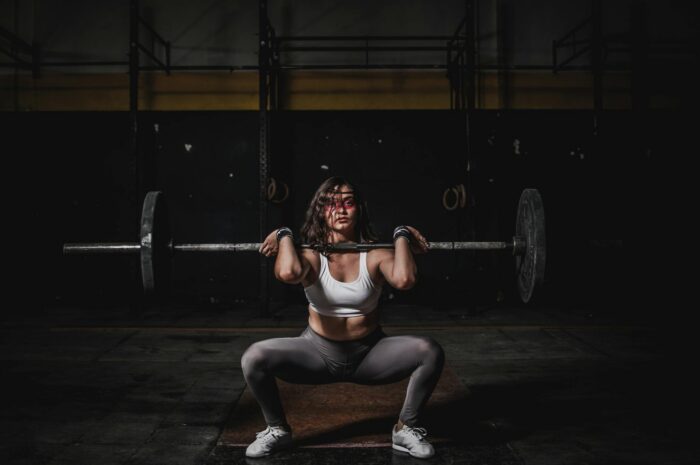
Pause squats: build stronger leg muscles
Squats are a simple exercise only on paper: barbell on your back, down and up. Pause squats make it even more honest, because in the bottom position you can’t use momentum or bounce.
If you want stronger legs, a better deadlift and more solid technique, it’s worth swapping a pause squat in for the regular squat now and then. It isn’t a comfortable exercise, but it works.
Why do squats matter in leg training?
Leg strength should be part of every strength training program. Strong legs help not only in the squat but also in the deadlift and even the bench press, because your body learns to handle load better.
Honestly, plenty of beginners have made the same mistake: chest, biceps and then chest again. Leg day gets skipped because it’s hard. The author admits to the same experience from their own youth. Lost time is difficult to make up later.
The legendary strongman and lifter Paul Anderson was able to squat more than 540 kg. Squats were the cornerstone of his leg training. Interestingly, he didn’t particularly like the exercise himself. He still did it consistently, because the results were too obvious to ignore.
How do pause squats work?
The pause squat is a variation of the regular squat. You lower yourself under control, stay completely still in the bottom position and then drive back up forcefully. A simple truth: when the movement stops, the momentum disappears.
That is exactly what makes the exercise valuable. In a regular squat, the energy generated by the stretch of the muscle and tendon helps you out of the bottom position. In a pause squat you have to start from an almost dead stop. This builds explosive strength and teaches your body to hold tension.
This kind of strength is needed in many sports. In soccer and basketball you often have to move up quickly from a low position. In strongman events the same situation comes up when lifting stones, carrying heavy suitcases or flipping tires. In the deadlift you also start from a position where your knees are bent and your legs have to start working right away.
If your deadlift numbers have stalled for a while, pause squats may help. Not by magic, but for a very practical reason: they make the bottom position stronger.
How do you do pause squats correctly?
Start in a power rack and set the safety bars to the right height. Take the barbell on your back, squat down so deep that your thighs go below parallel, and have someone mark where the barbell ends up in the bottom position. Set the safety bars at that height too.
The lift starts like a regular squat. The barbell is on your back, your back is straight, your head is up and your eyes are looking forward. Lower yourself calmly. When the barbell lightly touches the safety bars, stay completely still. Don’t relax your body. Keep your core tight and your legs ready.
Hold a 1-2 second pause in the bottom position. Then drive back up with maximum speed and strength, but don’t let your technique fall apart. Repeat the same way until the set is done.
VERY IMPORTANT: don’t bounce the barbell up off the safety bars. If you use the bars as a spring, the point of the exercise is lost. The pause has to be a real pause.
Smith machine and other variations
You can also do pause squats on a Smith machine. On most Smith machines the lower stoppers can be set to a suitable height. Set them according to your squat depth and perform the movement on the same principle as with a barbell.
Squats done on the Smith machine usually load the quadriceps more, because your body position stays more upright. That doesn’t make the variation better or worse. It’s simply slightly different work.
Squats in your training program: practical examples
Use pause squats now and then in place of regular squats. A good starting point is 3-4 working sets of five with a heavy weight. If you complete 5 repetitions properly in every one of the 3-4 sets, you can increase the weight by 5-10 kg next time.
Pause squats pair well with hack squats, leg press, leg extensions and leg curls. Don’t pile too much heavy work onto the same day. This exercise taxes the legs more than it seems at first glance.
- a. Pause squats 3-4 working sets of 5 repetitions per set
- Hack squats 3 x (5-10)
- Leg curl 3 x 10
- b. Pause squats 3-4 working sets of 5 repetitions per set
- Leg press 3 x (10-20)
- Leg curl 3 x 10
- c. Pause squats 3-4 working sets of 5 repetitions per set
- Seated leg extension 3 x (10-15)
- Leg curl 3 x 10
If you don’t have a power rack, you can also do the exercise with spotters. In that case, safety has to come first. Choose a weight you can keep under control in the bottom position.
And be prepared: pause squats will officially wear you out, make your legs stronger and make them grow. Don’t forget about nutrition, either.
FAQ
Are pause squats suitable for beginners?
Yes, as long as your technique is already solid and the weight is moderate. Still, it isn’t the best choice of exercise for your very first workouts.
How long should the pause in the bottom position be?
To start with, a pause of 1 to 2 seconds is enough. What matters is that the pause is controlled and without any bounce.
Does the pause squat replace the regular squat?
Not always. It works well as an occasional change of pace, especially if you want to improve your strength out of the bottom position.
Translated by: Janar Rückenberg
Source: Turg.Fitness.ee
Come and train! ArtGym




