Aqua fitness is water-based training that suits beginners, regular exercisers and anyone who wants gentler stress on the joints. Water makes a workout softer and harder at the same time: the impact is smaller, but every movement takes effort.
If you’ve ever walked fast in a pool, you know the feeling. A seemingly simple movement instantly becomes more serious in the water. That’s exactly where the magic of water training lies.
Why does aqua fitness really count?
Water training isn’t just gentle gymnastics in a pool. Athletes use it for recovery, regular exercisers to stay in shape, and seniors for the joy of movement. The same class can be moderate activity for one person and a proper endurance workout for another.
Water supports the body. That means your knees, hips and back don’t take the same heavy impact as on a running track or in jump training. At the same time, water doesn’t let you simply coast along. Every arm and leg movement meets resistance.
A simple truth: the harder you move in the water, the harder the water pushes back. A beginner can keep the pace calm. A more experienced person can do the same exercise faster, with a bigger range of motion or with extra equipment.
How does aqua fitness work in the body?
The pool works like a self-adjusting gym. When you raise an arm to the side, push a leg back or run on the spot, the resistance comes from several directions. That’s different from many gym machines, where the movement follows a fixed path.
As a result, both the muscles that start the movement and those that brake it get to work. The shoulder girdle, core, glutes, thighs and calves have to work together. That makes water training a good full-body training load.
It’s easier to keep a bigger range of motion in the water. The body is lighter, the fear of falling is smaller and the joints move more freely. That’s exactly why water aerobics suits people who feel stiff or unsteady on dry land.
The class gives your heart a workout too. In the water, your pulse may not feel as high as in a studio, but that doesn’t mean the training load is trivial. Many people only notice a pleasant tiredness after the session, in the changing room.
You can adjust the training load very easily
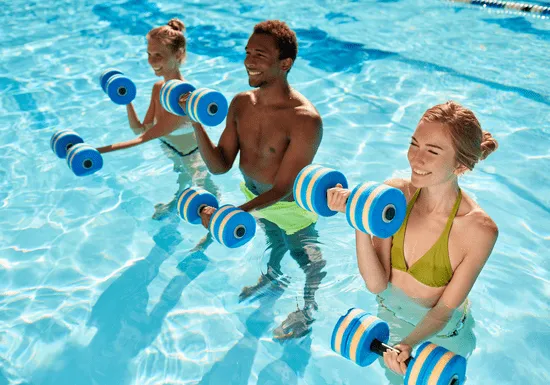
At first, your own body weight and the resistance of the water are completely enough. Later you can add noodles, water dumbbells, gloves, water shoes or a deep-water belt. They don’t automatically make the workout better, but they let you fine-tune the training load more precisely.
If your goal is recovery, choose a calmer pace and more control. If your goal is to get in better shape, use shorter breaks, faster movements and more core work. In either case, it’s worth listening to the instructor, not to your neighbor’s pace.
Aqua fitness for weight loss, strength and mobility
When it comes to weight loss, water training helps mainly through consistency. If a workout doesn’t wreck your joints and doesn’t cause fear, it’s much easier to show up even in the darkness of November or after a long workday.
Energy expenditure depends on the pace, the water depth, the exercises and the person’s own effort. Deep-water running can be surprisingly hard. On the other hand, a calm class in shallower water can be a good start for someone who hasn’t trained in years.
In terms of muscle strength, water aerobics doesn’t always replace heavy strength training, especially if the goal is a lot of muscle mass. But it develops endurance, balance and core control. For many people, it’s exactly the missing link that helps them move better on dry land.
Water is a rewarding environment for mobility. Hip circles, knee lifts, wide arm movements and rotations often feel more natural in a pool than in a gym. The body dares to try more.
What to check before your first class?
The first choice is the type of class. Water aerobics in shallow water suits a beginner well. Deep-water training usually demands more core control, although a buoyancy belt helps you stay afloat. If you’re unsure, ask the pool’s or club’s administrator beforehand which class suits beginners.
The second thing is equipment. You’ll need swimwear, a towel and comfortable flip-flops. In some pools it’s a good idea to wear water shoes, especially if the floor is slippery or the soles of your feet are sensitive. Swimming skills come in handy, but many classes take place in chest-deep water.
Third, take recovery into account. In the water, people don’t always feel how hard they’re actually working. Drink water, eat something sensible afterwards and don’t plan two hard workouts back to back on your first day.
Honestly, the hardest part is often not the exercise but getting there. In Estonia, in winter that means not rushing outside with wet hair, and in summer simply finding the time. But once a rhythm develops, water training is one of the easier habits to keep.
FAQ: aqua fitness
Is aqua fitness suitable for a complete beginner?
Yes, especially a class in shallow water. Start at a calm pace and tell the instructor if you have joint, back or balance problems.
Does water training help with weight loss?
It does, if you train regularly and your nutrition supports the goal. A big plus is that water makes movement more comfortable for many bodies.
Do I need to be a good swimmer?
Not always. Many classes take place in shallow water. Deep-water training usually uses a buoyancy belt, but confidence in the water matters more there.
Author: Margit Lipstuhl
Come and train! ArtGym