
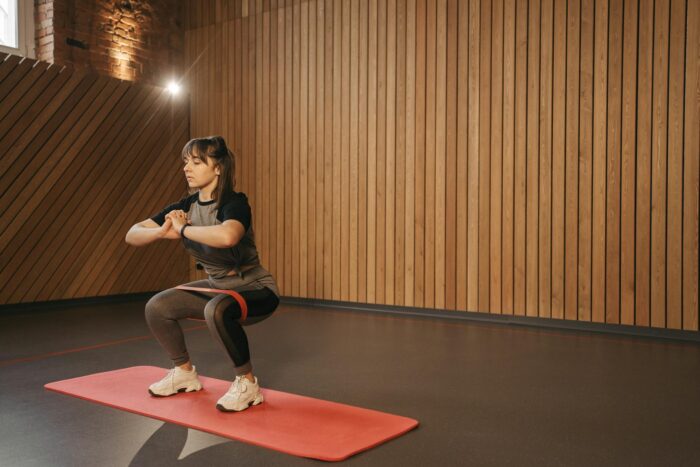
Knees past your toes in a squat
I have to admit that when teaching people to squat, I’m a keen advocate of the cue “try not to let your knees go too far past your toes.”
In this article, I’ll share my own thoughts on squats, toes and knees. Letting your knees go past your toes isn’t always a clear-cut mistake.
Although squatting in practice is certainly nowhere near as clear-cut as the theory we’re taught, I believe I’ll continue to use the half-truth “try not to let your knees go past your toes as you squat down” when introducing basic squat technique. Why? Because, among all the important aspects of squat technique, this particular point is a very useful place to start teaching the movement. I learned to squat by following this “knees must not go past toes” rule myself. And while I did learn to squat with this technical detail in mind, I soon developed mixed feelings about it. Right from the start, I felt that if I drove hard through my heels and kept my knees from going past my toes, I could squat considerably less, both in terms of weight and the length of a set. I felt I was working almost entirely through my hip extensors and posterior chain, but that this meant I was using only 2/3 of my available strength. Yet when I initiated the squat by pushing my hips firmly back, then allowed my knees to travel a little past my toes as needed on the descent and pushed up with most of the pressure through the balls of my feet, I felt much stronger coming out of the bottom. I also had conflicting thoughts when watching Olympic weightlifters, who are always held up as examples of excellent squat technique. Olympic weightlifters do indeed perform deep squats with beautiful technique. Even then, I remember wondering why the theory and practice didn’t match at all. “Don’t let your knees go past your toes,” we’re told, yet the squats presented as the gold standard of good technique do anything but follow that rule.
But back to why I still believe it’s worth starting to teach squat technique with this partly inaccurate rule. If you watch how most people squat on their first few attempts, that is exactly what they do: push their knees well past their toes. But that’s not all. As a coach and instructor, I honestly find some people’s squats painful to watch, even when they’re doing bodyweight squats. They drop down so fast and with such a “crash,” knees past their toes and heels off the floor, that you can actually hear their knee joints crunching, then bounce violently back up from the bottom. It’s painful to watch! Obviously, one issue is the speed of the squat and the bounce, which have little to do with the knees going past the toes. The other reason why virtually every beginner’s knees “shoot” so far past their toes and their heels lift off the floor is that they don’t know how to use their hip extensors and posterior chain (hamstrings, glutes and lower back) at all in the complex movement that is a squat. This places a dangerously high load on the knee joints, creating a risk of injury. In my view, this gap in beginners’ technical skills alone makes it necessary to start learning squat technique with the understanding that the descent should begin by moving the hips back, and that forward knee travel past the toes should be limited as much as possible.
I believe the first step should be learning to engage the posterior chain in the squat. From there, the approach should depend on the specific situation. Each person’s biomechanics come into play: whether they are quadriceps-dominant or dominant through the hip-extending posterior chain. Height is a major factor, as are torso length, overall leg length, mobility in the joints involved in the squat, and so on. With all these considerations in mind, you can, of course, begin allowing your knees to go past your toes according to your individual circumstances. Speaking of height, tall lifters actually cannot even reach a thighs-parallel position without their knees going past their toes. If a very tall person tries to squat by sitting back with their shins almost vertical, they will simply fall over, because it is impossible to maintain balance that way.
I can squat using either technique: relying almost entirely on the posterior chain, or with the bar high on my upper back and my knees going noticeably past my toes. The second version feels more natural and stronger. However, I can’t deny that when I spend an extended period squatting with unrestricted knee travel, freely allowing my knees to go past my toes, they eventually begin to crunch slightly and cause discomfort. Previously, when I squatted with a deliberate emphasis on the posterior chain, I never experienced knee pain, nor was there even the slightest crunching in my knee joints during squats.
There are many factors to consider when deciding whether, and how far, your knees should go past your toes. First, of course, we need to consider whether and how we can maintain balance. Second, although the hip joints always bear a proportionally greater load during squats, squatting with a forceful emphasis solely on the hips is neither sensible nor healthy. Squatting predominantly through the knee joints isn’t particularly healthy either. We should also bear in mind that, although the hips always take a proportionally greater load than the knees during squats, we should aim to distribute that load sensibly between these two main load-bearing joints according to individual characteristics. Nor can we overlook the fact that, for many people, the knee joints are a relatively weak point, both from birth and in terms of their anatomy, while the large hip joint at the center of the body is anatomically and biomechanically capable of bearing a greater load than the knee joints.
So, put simply, my position is that we should first learn to feel and use the hip joints and hip extensors during the squat. Then, guided largely by individual characteristics, we can consider whether and how far the knees should go past the toes, and how feasible, necessary and justified this is. And I say this without any irony: allowing the knees to go past the toes can often be justified, required and very much necessary given the way our bodies are built. However, with a complete beginner, we should be cautious about recommending, teaching and emphasizing this movement of the knees past the toes during the squat!
Author: Janar Rückenberg
Source:Turg.Fitness.ee
Come work out! ArtGym




