
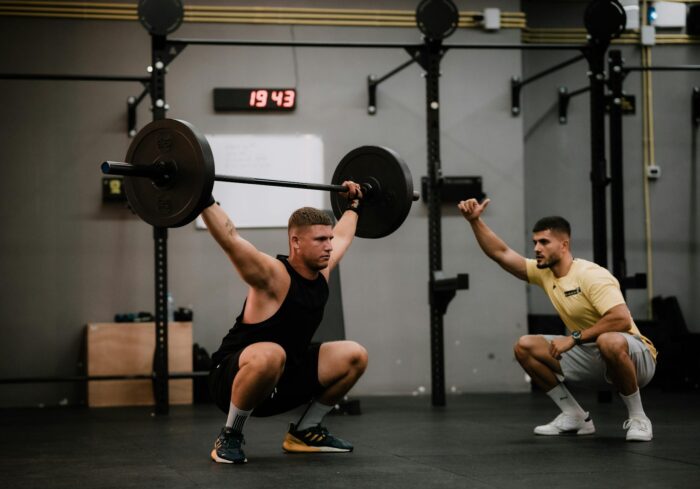
Try finding a strong squatter who hasn’t struggled with lower back pain from squatting at least once in their career. I had a period too when I had to forget about squatting altogether for several months — I couldn’t do them anymore without back pain. In my case, the culprit was too much sitting. Maybe that’s your problem too, so think about it.
Today I’m free of lower back pain, and at 75 kg I squat 182.5 kg so far, with no equipment at all. Drawing on my own experience and that of the people I coach, I’ll lay out the five most common reasons a squat can make your lower back sore — and what to do about them.
Why lower back pain happens when squatting
Nine times out of ten, the problem isn’t the squat itself but the technique. Lower back pain when squatting usually means the load is too far from your body’s center of gravity, you don’t have enough mobility, your body isn’t braced tightly enough, or your glutes aren’t engaging. Let’s go through them one by one.
Bar too high on your back — the first cause of lower back pain when squatting
If the bar sits high on your traps, close to your neck, don’t try to sit back on the way down the way you would with a low bar position. That loads your lower back heavily. A high bar sits far from your body’s center of gravity, and if you push your butt back, the weight pushes your body forward. To stay upright you have to strain your lower back — and that’s exactly where the pain comes from.
Two solutions: either squat with the bar high and keep your torso as upright as possible, or lower the bar (more onto your back) and consciously sit back, butt back. I have nothing against high-bar squats in classic weightlifting, but if you’re doing 5 x 5 or another powerlifting program, I generally recommend a low bar position. That way the weight is closer to your center of gravity, your body doesn’t tip forward as much, and the posterior chain and glutes do more of the work.
Depth and mobility
With a low bar position, going to maximum depth isn’t even possible — your lower back would round at the bottom. An “ass to grass” squat is only possible with a high bar position at all, and even then your hip mobility has to be very good to keep your torso upright.
The reality is that most squatters lack the hip mobility needed for a deep squat. The reason is usually too much sitting. That’s why I recommend that most recreational lifters use a lower bar position and squat only slightly below parallel. It’s gentler on both your lower back and your knees, and with this technique you also move heavier weights.
Tension in your body: the third and fourth causes of lower back pain when squatting
If you’re not squatting too deep but your lower back still rounds at the bottom, it’s probably a tension issue. Your body — especially at the bottom — has to be under control the whole time.
- Push yourself back from the hips and keep your lower back tight throughout.
- Feel and tense your hip flexor muscles — the sprinter’s muscle between the quadriceps and the abdomen. It’s the same muscle whose shortening makes your lower back sore. Tensing it automatically pulls your lower back straight.
- Watch your upper body: chest up, shoulders back. With a slouched upper back, you can’t keep your lower back under controlled tension.
If your hips are stiff from sitting, this position won’t feel natural at first. Regularly stretching your hip flexors helps.
The fourth mistake is not using your glutes. People who sit a lot tend to squat with too arched a lower back — that’s just as bad as a rounded back at the bottom. To keep your body from over-arching, use your glutes consciously:
- As you descend, push your knees out, with your feet at least shoulder-width apart. This stretches the hip extensors — the glutes and the hamstrings.
- Try to grip the floor with your feet; this automatically pushes your knees out.
- As you come up, lock out every squat — drive your hips forward hard while squeezing your glutes.
Breathing and your abs
The fifth cause is breathing. Never squat with your stomach sucked in or in a “vacuum.” Some coaches recommend it, but that’s wrong — this technique can even cause a hernia.
Before the squat, take a proper breath and fill your abdominal cavity with it. At the bottom, push your abs out. This creates pressure in the abdominal cavity that supports your lower back like an internal airbag.
One way to learn to feel this is with a belt. Put the belt on 1 – 2 notches looser than usual. Pull air into your belly and, as you go down, push your belly against the belt. You’ll feel right away whether your breathing is supporting your body or not.
FAQ about lower back pain when squatting
Is squatting bad for your lower back?
No. If your lower back is a concern when squatting, the problem is almost always the technique, not the exercise itself. Film yourself from the side, review the video and correct it.
Should I stop squatting if my lower back hurts?
In the short term, yes, until you find the mistake. I had to take a break of several months back then. But in the long run, the solution isn’t avoiding the exercise but improving your technique and mobility.
Is a high or low bar position better?
It depends on your goal. In powerlifting-style programs (5 x 5 and the like), a low position works better and spares your lower back. In classic weightlifting, the high position has its place, but it requires good hip mobility.
Author: Janar Rückenberg (translation)
Source:Turg.Fitness.ee
Come and train! ArtGym




