
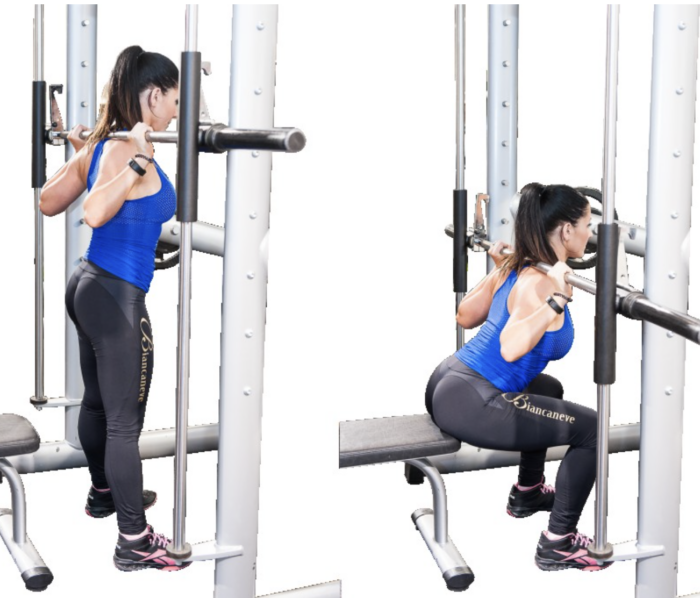
Box squat: technique, strength and depth
The box squat is a simple exercise, but only if you do it correctly. It teaches you to sit your hips back, maintain consistent depth and start every repetition with strong tension rather than letting your knees drift forward.
Why do box squats help improve technique?
Box squatting is more than just “squatting onto a chair.” The idea is that every repetition finishes at the same depth and starts from a controlled position. With the box at the right height, you can immediately tell whether you are squatting too high or reaching sufficient depth.
The original point is blunt but clear: if you box squat correctly, it should not damage your spine. You do not drop onto a 30 40 cm box with a thud, rock back and forth on it or try to prove anything with 300 400 kg. The box is a tool, not a rest stop.
The Westside school used box squats extensively because of the recovery benefits. The early Westside followers box squatted as often as three times a week. That may be too much for many people, but it illustrates why the exercise caught on: your nervous system can train for speed without the training load in the full squat having to be close to maximum every time.
The original account also mentions the NBA’s Utah Jazz and coach Greg Shepherd, who used box squats because they allowed for quick recovery. The same logic applies to powerlifters: if you have an important competition coming up, you can do much of your preparation with box squats, without knee wraps or a squat suit.
Box squats and engaging the right muscles
A well-executed box squat works your hips, glutes, lower back and hamstrings. Your shins should stay as perpendicular to the floor as possible. If your knees travel too far forward, you lose part of the exercise’s purpose because you are not learning to generate strength from your hips.
Box height determines which areas you train more. If your hip muscles or pelvic girdle are weak, use a box that puts you below parallel and squat with a wide stance. If your lower back is weak, also use a box that puts you below parallel, but squat with a narrower stance. If your quadriceps need work, use a box that lets you squat to exactly parallel.
If your sticking point is a couple of inches above parallel, choose a box that puts you a couple of inches above parallel. According to the original account, more accomplished squatters also used boxes that put them below parallel to drive out of the bottom, or “the hole,” more powerfully. The simple truth is that different box heights help address different weaknesses.
The examples were impressive. Two lifters at the club did box squats with 230 kg for 8 x 2 during their competition preparation, using a box that put them about an inch below parallel, and both squatted 318 kg in competition. One weighed 110 kg at the competition, the other 123.5 kg. That same 123.5 kg lifter had squatted only 210 kg at his previous competition.
How do you box squat correctly?
Set up as you would for a regular squat. Brace your abs, breathe in and keep your torso solid. As you descend, push your butt back first. Only then begin bending your knees to lower yourself. Think of sitting down on a toilet with control rather than falling onto the box.
Do not let your body relax while sitting on the box. Only your hip flexors may briefly release tension; your back, abs and upper back must stay braced and ready. This brief pause is the point of the exercise. Then drive up explosively, as if starting the movement from a dead stop.
Remember the sequence: butt back, then down onto the box. Sit fully onto the box rather than briefly touching it and bouncing back up. If you only “tap” the box, you miss the part that teaches starting speed and how to maintain tension.
Your hamstrings take on a substantial training load here. Many people forget that the hamstrings are also hip extensors. Some strong squatters have large quadriceps, others less so, but all good squatters have well-developed hamstrings, especially where they meet the glutes.
Box squats in your training program
The original recommendation was to box squat at 65 82%. This is a percentage of your box squat maximum, not your full squat personal best. You should change box heights every 3 4 weeks.
The typical training volume was 8 12 sets of two, with 1 minute of rest between sets. When you reach 82 percent, do 6 sets in the workout. After box squatting at 82 percent, you can attempt a new full squat personal best.
This is not an easy workout. Doing 8 10 sets of two can add 50 100 kg to your regular squat in a short time, but only if your technique stays sound. Sets of two repetitions work well because the first repetition is always the most important. If you do 12 sets, you get 12 first repetitions on your box squat day.
Box squats can also help your deadlift. Jerry Obradovich (+ 120 kg), mentioned in the original account, added 23 kg to his deadlift in three months, going from 305 kg to 328 kg. Chuck Vogelpohl deadlifted once in 8 weeks and still pulled 360 kg. To train his back, he used a 30 cm box, a wide stance, hyperextensions and bent-over rows, plus the deadlift itself every 8 weeks.
Common mistakes to avoid
Don’t choose a box at random. A box that is too high teaches you to do a partial squat, while one that is too low can compromise your position. If depth is your goal, start at a height where you can keep your back strong and your knees under control.
Don’t turn the box squat into an ego lift. If you land with a thud, collapse onto the box or relax as you sit, the weight is too heavy. Quality comes first. Marv Phillips, Larry Kidney, Roger Estep, Matt Dimel and George Fern used box squats as an assistance exercise, not a gimmick. As early as 1970, George Fern squatted 380 kg wearing ordinary shorts. The original article also mentioned 20 lifters who had squatted over 318 kg.
Box squat videos added by the translator: http://www.youtube.com/watch?v=Ue_GrU4mhqc and http://www.youtube.com/watchv=t156u5VuBTw&feature=related.
Article source: “Box Squatting Louie Simmons”.
Box squat: FAQ
Are box squats suitable for beginners?
Yes, provided you use a moderate weight and controlled technique. For beginners, the box provides useful feedback: every repetition reaches the same depth.
Should you sit fully on the box?
Yes. Sit down with control, keep your core braced and stand up after a pause. Don’t bounce off the box.
Can box squats replace regular squats?
They can complement regular squats for a period or temporarily replace them, particularly in the lead-up to a competition. In the long term, the choice depends on your goal.
Translated by: Janar Rückenberg
Come train with us! ArtGym




