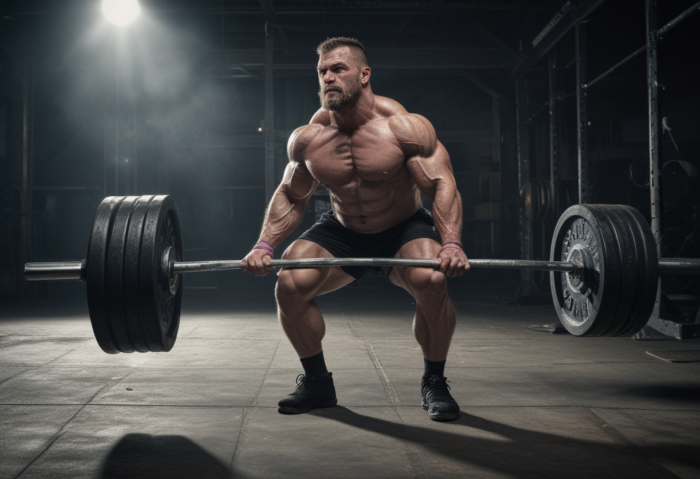
Powerlifters and muscle building
Powerlifters are a good example of why big muscle mass isn’t built just by pumping up in front of the mirror. If you want to grow, you need to treat the squat, deadlift, press, eating and recovery as one whole.
Translator’s note: the original text was sharp, at times even controversial. I’m keeping its direct tone, but putting the ideas into a clearer form so that they’re genuinely useful.
Why do powerlifters so often grow big?
It’s easy to slice your training too thin in the gym. One day a bit of chest, the next a bit of shoulders, then arms separately, then yet another machine that promises to “sketch out” the muscle more precisely. On paper, the plan looks smart. In the gym, though, it may not challenge your body hard enough.
The original article puts it much more harshly: a great many plans in bodybuilding magazines don’t suit the average lifter. They may work if you have exceptional genetics or use substances that an ordinary lifter should stay away from. Otherwise, what’s often left is just a large number of exercises and little real progress.
The author’s background was in strength sport. As an example, they cited their own results: a bench press of 270 kg, a squat of 365 kg and a deadlift of 320 kg at a body weight of 123 kg. These numbers aren’t there to show off but to provide context: this is coming from someone who has seen heavy training up close.
A simple truth: powerlifters often grow because their training forces the body to adapt. Squats, deadlifts, presses, rows and heavy core work don’t let you coast along comfortably. When the weight goes up and your technique holds, the body has to respond.
Powerlifters build the foundation with compound exercises
If your plan consists mainly of single isolation movements, the muscle may fill up nicely for a short while. That feels good. But the feeling isn’t the same as progress. A “pump” doesn’t prove that the muscle received a better growth signal than it would from a heavy, controlled compound exercise.
Compound exercises are the central theme here: the squat, the deadlift, the clean, barbell bent-over rows, standing and bench presses, pull-ups, barbell biceps curls, dips, weighted ab exercises and core exercises such as back extensions and good mornings.
The original idea was very specific: these exercises should make up 95-100% of what you do in the gym. In today’s terms, I’d put it this way: if your goal is strength and muscle mass, most of your energy should go into movements where, over time, you can lift more weight, do more repetitions or show better control.
That doesn’t mean every isolation exercise is always bad. But if you have to choose between doing one more light machine set or improving your squat, deadlift and press, most of the work should go to the latter.
Squats and deadlifts aren’t extras
Many lifters put too much emphasis on the upper body. If your plan has the upper body 3-4 times a week and the lower body only 1 time, the balance is off. The key to getting big often lies exactly where the work is most uncomfortable: in the squat and the deadlift.
The squat should be deep and controlled. The original article stresses that you should squat below parallel, not do quarter squats and call it heavy leg training. If your mobility or technique doesn’t allow it, you need to fix those rather than cheat the exercise.
How do powerlifters split their training?
One body part a week is too infrequent for many people. If a muscle or a main lift gets a proper stimulus only 1 time a week, progress is often slow. Powerlifters think more in terms of movements than of individual muscles.
Practical splits could be, for example, upper body and lower body, presses and pulls, or 3 full-body workouts a week. This approach gives your body the chance to progress 2 or 3 times a week, rather than just once and then a long wait.
But this is where a limit comes into play. If every workout ends in total destruction, you can’t repeat the same movement a few days later. That’s why it’s important to train hard, but not always to the point of failure. The two things aren’t the same.
The example from the original text is a good one: take 5-10 kg less than your squat 5-rep max and do 5 x 5 with it. The first sets may not crush you, but the end gets hard. After that, there’s no need to head to the leg press and do endless sets to failure. If the volume is sensible, you can recover in as little as three days.
The same logic applies to set schemes. The pyramid of 10, 8, 6, 4, 2 may seem classic, but it’s often simpler and more effective to do 5 x 5 or 4 x 8-10 with the same weight. This takes taming your ego, because your working sets don’t start right away with the biggest stack of plates.
Practical principles for muscle mass
First: do less empty work and more real work. Glenn Pendlay’s idea was spot-on here: many lifters use too many exercises at once, take a bit from one plan and a bit from another, and end up with a muddle. Often it would help to cut out half of the unnecessary exercises and put in half again as much effort on what’s left.
Second: don’t make your reps artificially weird. Ultra-slow reps and drawn-out negative training can work in some situations, but they often just reduce the total amount of work you do. Do your reps under control. Don’t bounce the weight, but don’t turn every rep into a drawn-out performance either.
Third: don’t judge the quality of a workout by muscle soreness alone. DOMS, or delayed onset muscle soreness, doesn’t automatically mean the workout was better. It means there is a lot of microtrauma in the muscle and the body is signaling it. You can be sore after a stupid workout too.
Fourth: your core muscles don’t necessarily need a ball or an unstable surface. Heavy deadlifts, standing presses, squats, barbell rows, carrying suitcases, carrying stones, tire flips, back extensions and weighted ab work all make your core work very hard. Honestly, harder than many “balance exercises” do.
Fifth: a good gym doesn’t have to be shiny. A pool, tanning beds and air conditioning don’t make a gym strong. A good gym has lifting platforms, barbells, dumbbells, enough weights, magnesium and room to actually lift. In the original text this point was number 15, and its logic still holds.
When it comes to building mass, you can’t get around eating either. The original text criticized lifters who are afraid to eat, try to grow and stay very lean at the same time, and spend thousands of kroons a month on miracle supplements. If your strength numbers aren’t moving and your body weight isn’t going up, the problem may not be a new secret program. Sometimes the problem is on your plate.
That doesn’t mean the powerlifters’ repertoire is 100% ideal for someone training for bodybuilding. It isn’t. A bodybuilder sometimes needs more muscle-specific work, a better feel for the muscle and careful form. But heavy progressive training, proper eating and respect for the basic exercises are lessons you shouldn’t turn your nose up at.
The original article’s harsh comparison went like this: for every successful bodybuilder with a good physique, there are about 20 failed bodybuilders who chase only the pump, are afraid to eat and don’t understand periodization. That’s blunt wording, but the point is simple. If you add 50 kg to your squat max, chances are your whole body will change too.
FAQ: powerlifters and muscle mass
Does a powerlifters’ program suit a bodybuilder?
Partly, yes. A bodybuilder doesn’t have to train exactly like a competing powerlifter, but squats, deadlifts, presses, rows and clear progression help build muscle mass.
Do you always have to train to failure?
No. It’s often better to leave 1 or 2 reps in reserve, so that recovery stays under control and you can train the same movement with good quality again a few days later.
Do the pump and muscle soreness show a good workout?
They can be side effects of training, but they aren’t reliable measures. Better measures are technique, progress in weights, rep quality, recovery and long-term consistency.
Powerlifters take on getting big Justin Hurley
Translator’s note: a divisive article. For me it contains some very good, thought-provoking points, but I can’t agree with everything. In real life, one single correct methodology isn’t that simple.
Translated by: Janar Rückenberg
Source: Turg.Fitness.ee
Come and train! ArtGym