
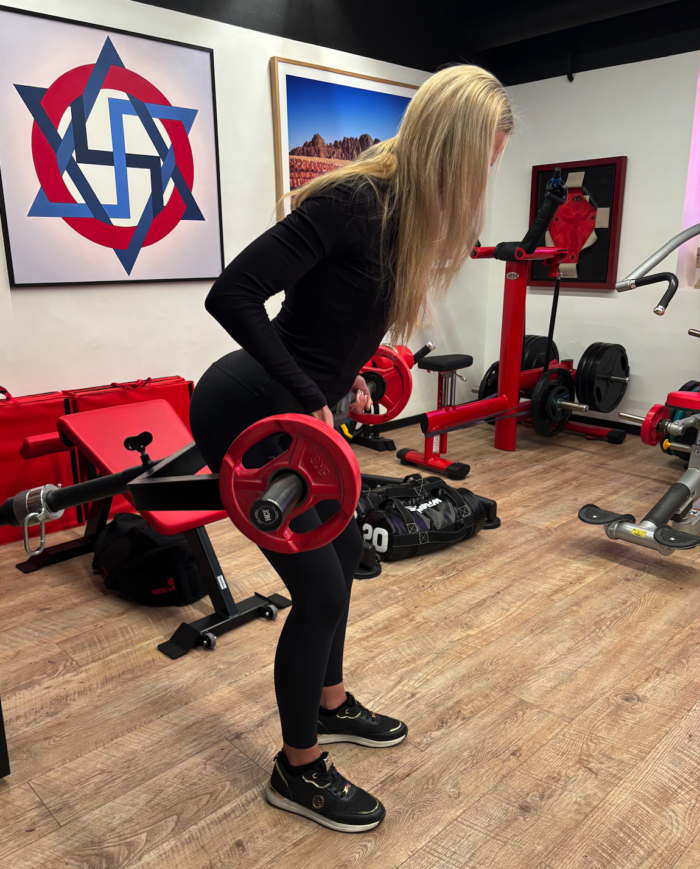
In short:
- Women’s testosterone levels are 15–20 times lower than men’s, so regular strength training does not lead to significant muscle mass gain.
- Early strength gains come mainly from neural adaptation, not from muscle growth.
- Strength training strengthens bones, speeds up metabolism and improves body composition without adding visual bulk.
- The ACSM recommends strength training for women at least 2–3 times a week to cover all muscle groups.
Women and strength training — this topic still raises a lot of questions and unfounded fears. The most common myth, that weights turn a woman’s body masculine and muscle-bound, is clearly refuted by science. In this article we explain why hormonal reality makes such a scenario almost impossible and what benefits strength training actually brings for women.
How do women and strength training interact at the hormonal level?
Hormonal chemistry explains everything. Men have roughly 15–20 times more testosterone in their blood than women (Vingren et al., 2010). Testosterone is the main anabolic hormone that triggers muscle protein synthesis and promotes significant muscle mass gain. A woman’s body does produce testosterone, but in such small amounts that massive muscle growth is physiologically almost impossible with a normal training load.
Estrogen dominates in a woman’s body; it helps protect muscles from post-exercise damage and supports recovery, but does not promote a significant increase in muscle mass (Enns & Tiidus, 2010). You can find more on the fundamental differences between how women and men train here: Women and strength training, or how female and male trainees differ.
Why is women’s muscle mass growth more limited — what does the science say?
Muscle size depends primarily on a muscle’s cross-sectional area. Studies confirm that women respond to strength training with strength gains similar to men’s, but the increase in muscle tissue volume is considerably more modest in women (Hubal et al., 2005). This means a woman can become significantly stronger without her body visibly getting bigger.
Early strength gains come mainly from neural adaptation — the brain learns to recruit muscles more efficiently, rather than muscle cells growing. Women and strength training: part I explains exactly how this neural adaptation works and why it is especially beneficial for women.
Worth knowing: professional female bodybuilders with significant muscle mass train for hours a day, follow extremely specific nutrition regimens and often use pharmacological support — this is far removed from regular strength training at the gym.
What real benefits does strength training bring for women?
Strength training offers women several evidence-based benefits that matter far more than any worry about muscle mass:
Bone density: Progressive strength training is one of the most effective ways to maintain and increase bone mass, which is especially important during the decline in estrogen levels (Layne & Nelson, 1999). For women over 40 this is an especially critical aspect, as the risk of osteoporosis rises significantly after menopause.
Metabolism: Muscle tissue is metabolically active — more muscle mass means burning more calories even at rest (Kraemer & Ratamess, 2004).
Body composition: Strength training reduces fat mass and increases muscle mass, making the body more toned and stronger without adding visual bulk (West & Phillips, 2012).
General health: The World Health Organization recommends muscle-strengthening exercises for adults at least two times a week, because they reduce the risk of chronic diseases and improve quality of life.
If you dive into the Strength training and women article, you’ll find additional practical tips on how to fit strength training into your everyday lifestyle.
How to start strength training safely and effectively?
The ACSM (American College of Sports Medicine) recommends the following for beginners:
- Train 2–3 times a week, covering all major muscle groups
- Choose a weight you can lift for 8–12 repetitions with correct form
- Increase the training load gradually by 5–10% per week (progressive overload)
- Let muscle groups rest for 48 hours before the next session
For beginners, it is advisable to do the first workouts under a coach’s guidance, to learn proper technique and avoid injuries. Good technique is the foundation of more effective and safer training — and ensures that you get stronger where you need it.
References
- Vingren JL, Kraemer WJ, Ratamess NA, Anderson JM, Volek JS, Maresh CM. (2010). Testosterone physiology in resistance exercise and training: the up-stream regulatory elements. Sports Med. PMID: 21058750
- Enns DL, Tiidus PM. (2010). The influence of estrogen on skeletal muscle: sex matters. Sports Med. PMID: 20433212
- Hubal MJ, Gordish-Dressman H, Thompson PD, et al. (2005). Variability in muscle size and strength gain after unilateral resistance training. Med Sci Sports Exerc. PMID: 15947721
- West DW, Phillips SM. (2012). Associations of exercise-induced hormone profiles and gains in strength and hypertrophy in a large cohort after weight training. Eur J Appl Physiol. PMID: 21993743
- Layne JE, Nelson ME. (1999). The effects of progressive resistance training on bone density: a review. Med Sci Sports Exerc. PMID: 9927006
- Kraemer WJ, Ratamess NA. (2004). Fundamentals of resistance training: progression and exercise prescription. Med Sci Sports Exerc. PMID: 15076779
Frequently asked questions
Does strength training make a woman’s body muscular and big?
No. Women’s testosterone levels are 15–20 times lower than men’s, which means massive muscle growth is not physiologically possible with regular strength training. The result of training is a more toned and stronger body, not a bulkier one.
How many times a week should a woman do strength training?
The ACSM recommends 2–3 times a week, covering all major muscle groups. There should be at least a 48-hour rest period between muscle group sessions to allow recovery.
Is strength training beneficial for women over 40?
Yes, especially so. Strength training helps maintain and increase bone density, which reduces the risk of osteoporosis after menopause. It also supports the preservation of muscle mass and a healthier metabolism in older age.
Does strength training help with weight loss?
Strength training increases muscle mass, which speeds up metabolism and raises the number of calories burned at rest. Combined with balanced nutrition, it is an effective method for improving body composition.
Where should you start if you have never done strength training before?
Start with 2 workouts a week, using your own body weight or lighter weights. First learn the basic movements: squat, deadlift, pressing movements. It is advisable to do your first sessions under a coach’s guidance to learn proper technique.
Come and train! ArtGym




