
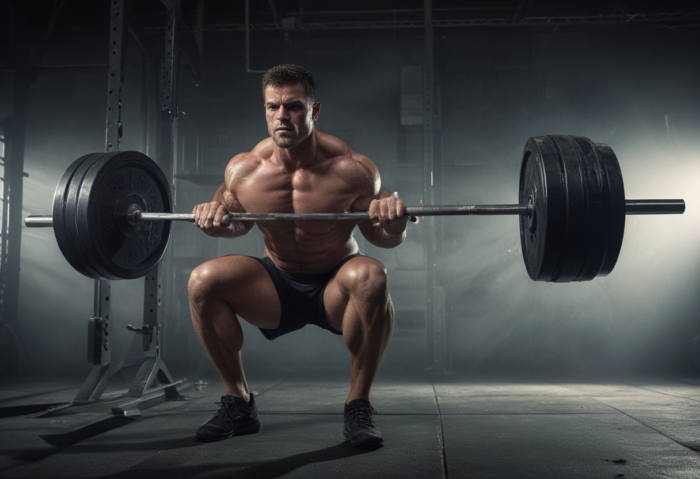
Big strong legs
Here is how to train so that your legs have both strength and endurance while also being massive. Countless training programs and routines promising big, strong legs have appeared in magazines over the years. Some of them are good and some are bad, but in general the secret to steady progress in any muscle is that we must not let our muscles adapt to the training. To achieve that, you need to change up and mix your workouts fairly often, but doing so without a plan or system is a waste of time too.
If you set up your training plans correctly, you move forward a little with every workout. A good example is the way powerlifters have trained for decades. They start a training cycle with light weights and long sets. For the first couple of weeks they do sets of ten or even eight. Over the next two weeks the weights go up and they do five sets of five reps. In the following weeks the intensity is raised further and the rep count drops, and that is how powerlifters work up to a new personal record by competition time: a 1-rep max in the competition lift. If the goal is to increase your records in the competition lifts, this approach works well. The goal of powerlifters is simply the greatest possible strength.
In bodybuilding, where the aim is legs that are big in mass, the weights don’t need to be maximal. Far more important are how long the muscles are kept under direct tension and the training volume. When tension and volume are adequate, that is what makes the legs grow. It is common for a bodybuilder to pick 4 different exercises per muscle group in a workout and do each exercise for 4–5 sets of 8–12 reps. This approach certainly won’t produce the strength numbers that the powerlifting approach does, but it guarantees good mass and proportions.
When it comes to endurance, triathletes have exceptional endurance, especially in their legs. They swim, run and cycle. Their workouts last for hours and are high-intensity. Big strong legs are exactly what they don’t have. Their legs aren’t hugely massive, and they can’t lift unprecedented weights either. But they train precisely so that they can carry their bodies as fast as possible and as far as possible. Great strength isn’t necessary for them, and a lot of mass would work against their goals too.
All three of the disciplines above have something in common. Each has its own specific, very particular goal. To be the best in your discipline, you have to train for that goal and in line with it.
Big strong legs: the purpose of the training
I (the author of this article) have competed in bodybuilding, powerlifting and strongman. But not only that: I have also competed in various athletics events and other popular recreational sports, although my most successful athletic career has been in strongman. The point of everything above is that competing in strongman, and training for its events, actually demands the leg qualities of all three: those of a bodybuilder, a powerlifter and a triathlete. A strongman’s legs have to be massive, strong and enduring.
This applies to the legs more than to any other body part. And it doesn’t apply only to strongman. It applies to every sport that demands strength, speed and endurance from the legs: football, rugby, baseball, sprinting and so on.
So, strength, mass and endurance. For a strongman competitor, developing all of them together means you can’t focus on pure strength alone. You can’t spend cycle after cycle focusing only on mass at the expense of strength, or the other way round. Nor does strongman training mean you should swim, run and cycle for hours. In that case, big strength numbers and mass are out of the question.
I believe I have found a solution, which I would call a big strong legs program, and which lets you develop strength, mass and leg endurance at roughly the same time. Of course, you also need to practice the various competition events in addition, but mainly for the sake of technique.
This so-called big-legs approach means that for the legs, specifically the front of the thigh, you do only squats, once a week. For the first two training weeks, squat 10 x 10, with 1–2 minutes of rest between sets. 10 x 10 is actually known as German Volume Training, and it is brutal, especially with an exercise like the squat and with rest intervals like these. Since strength is needed as well, stay with the 10 x 10 scheme for the first two weeks. This kind of rep and set scheme is excellent for training leg endurance, and the approach also stimulates muscle mass growth. Be aware and prepared that for quite a few days after such a workout you will feel drained and tired.
In the second week, when it’s 10 x 10 again, you should be ready and able to add more weight to the barbell, and although this 10 x 10 will still put you through the wringer, you won’t be as drained afterwards.
I won’t go into nutrition in detail, but if you want real benefit from this program, it’s obvious that you need to eat quality food and get adequate amounts of protein.
The next weeks of the big legs program go under the banner of 8 x 8. That means you squat 8 sets of 8 reps for the next two weeks. This rep count is also very favorable for muscle mass growth: the set is long enough, the weights go up as well, and the number of sets (the training volume) is large enough too. As with 10 x 10, increase the weight in the second week of 8 x 8.
Weeks 5 and 6 get heavier still, and over these two weeks you take a clear step from mass training toward strength training. For the next two weeks you squat 5 x 5. Because the weights keep climbing over these weeks, it is vital that you keep your technique correct. Make sure your back stays straight or arched during the squat, and as you descend, sit back and down rather than letting your knees travel far forward past your toes.
Be sure to do a few warm-up sets before you start the serious working sets. If you’re not a big fan of the lifting belt, this is the point in the program where you might want to consider one. Just as in the second weeks of 10 x 10 and 8 x 8, you should add weight in the second week of 5 x 5.
The seventh and eighth weeks of the program are already pure strength training. Both weeks you train 3 x 3: three sets of three reps. The weights are now obviously heavy. Before you tackle the working sets, of course, do a proper warm-up and ramp up in pyramid fashion. Since the weight is heavy, focus and prepare properly for every set.
After these last two weeks, the 8-week cycle for increasing leg mass, strength and endurance is complete.
If you are using this cycle to prepare for a powerlifting competition, add one more week in which you do 3 x1 (three sets of singles), then take a 7–10 day break, and you should be peaking for the competition. If you are not preparing for a competition specifically, you can start over with 10 x 10 again. You should be considerably stronger for the second cycle.
Okay, good luck, and start saving up for the new pants you’ll have to buy for your thick legs!!!
From the translator: so, in summary, the cycle looks like this:
Week 1 – 10 x 10
Week 2 – 10 x 10
Week 3 – 8 x 8
Week 4 – 8 x 8
Week 5 – 5 x 5
Week 6 – 5 x 5
Week 7 – 3 x 3
Week 8 – 3 x 3
To me, it looks just like typical powerlifters’ periodization :))!!!
Translated by: Janar Rückenberg
Come and work out! ArtGym




