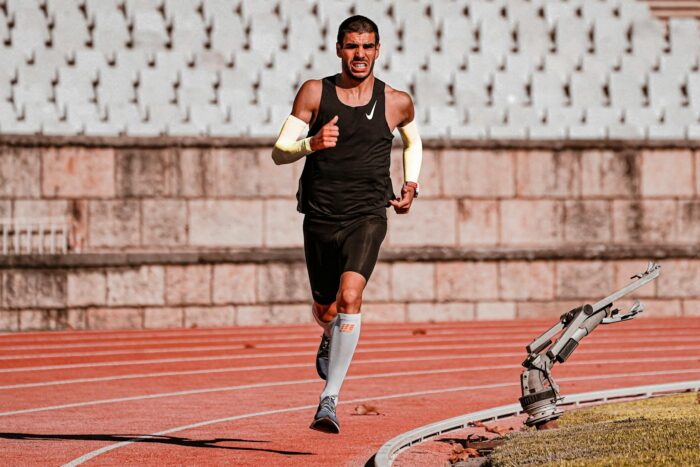
Strength training to build speed on the track
Strength training can help a sprinter, but only if it genuinely supports speed. In this article we look at why acceleration and top speed call for slightly different approaches, and which exercises suit each one best.
Why does strength training matter for speed?
Let me get straight to the point. Accelerating and running at top speed are not the same thing. From the outside both just look like fast running, but the body works differently in each phase.
During acceleration, especially over the first 10 – 20 meters of a sprint, the body leans strongly forward. The stride is shorter, the foot stays on the ground a little longer, and the athlete has to drive forcefully forward. The quadriceps, glutes and upper-body muscles do a lot of the work here.
At top speed the picture changes. The body is more upright, the stride more rhythmic and ground contact shorter. Now the hamstrings, glutes and hip flexors become especially important, including the iliopsoas, which is sometimes called the sprinter’s muscle.
That leads to a simple truth: if the different phases of a sprint use the muscles slightly differently, you can’t cover everything in the gym with a single approach. Strength training has to serve a goal, not just tire you out.
How does strength training develop speed?
Coaches generally agree that the gym has a place in developing speed. The problem starts when strength training becomes too generic. If the goal is a better sprint, the exercise has to help the athlete move faster and more powerfully.
That means two things. First, choose exercises that load the muscles you actually need for running. Second, the set and repetition scheme has to suit speed development. Running at top speed requires fast force production, not just a long muscle burn.
That’s why it makes little sense to build a sprinter’s main work around bench press 3 x 20. A scheme like that may build pressing endurance, but it doesn’t teach the body to produce the explosive strength a sprint demands. On top of that, the upper body plays a smaller role in top-speed running than the hips and the back of the thigh do.
Honestly, this is a good example of why the term strength training can be misleading. There is a big difference between one strength training program and another. One can make an athlete faster; another may simply look good in the gym.
Exercises for developing acceleration
For acceleration, choose exercises in which the athlete has to produce force forward and upward, making strong use of the legs, hips and trunk.
- Squat
- Clean from the floor
- Push press
- Sled sprints, moderate load
- Uphill sprints, moderate load
Exercises for top speed
At top speed, hip extension, hamstring work and a stable stride are especially important. This is where exercises come in that teach the body to hold on to strength even when ground contact is very brief.
- Romanian deadlift
- Good mornings
- Bounding for distance
- Single-leg squats
- Lunges
All of these exercises should be done in a range of 1 – 6 repetitions. The number of sets per exercise should be 3 – 5 sets. The exact volume depends on training experience, technique and how much running is done in the same period.
Strength training and practical choices in your program
So what actually happens when a sprinter does hard strength sessions but picks the wrong exercises? They may well get stronger, but not necessarily faster. This matters most in events where speed depends on the precise timing of the movement.
When planning your program, first ask: which movement do I want to improve? If the goal is a better start, look at acceleration. If the goal is to hold a higher speed in the middle of the race, look at top speed. The two aren’t completely separate, but the emphasis is different.
A good program doesn’t have to be complicated. Squats, deadlifts, cleans and good mornings can deliver a great deal when they’re done with correct technique and in the right volume. Technique sessions, of course, need to stay in the program. The gym doesn’t replace running technique.
It’s also important that strength training doesn’t eat up your freshness. If your legs are heavy all the time, your sprint can’t be sharp. Developing speed requires a ready nervous system, good technique and enough recovery.
Translator’s note: the takeaway is that strength training is a very broad concept. For a sprinter or skier, it does not always make sense to place a heavy emphasis on training the biceps or pushing hard to improve pressing strength. When preparing for other sports, strength training must remain functional.
FAQ: strength training and speed
Does strength training automatically make a sprinter faster?
No. Strength training helps when the exercises, repetitions and training load are appropriate for developing speed. If the program is haphazard, the result may simply be greater fatigue.
Do acceleration and top speed require the same exercises?
To some extent, yes, but not entirely. Forward-directed force and a stronger push-off play a greater role in acceleration. At top speed, coordination between the hips, hamstrings and stride rhythm is important.
Can gym workouts replace technique training?
No. Gym workouts provide a foundation of strength and explosive power, but you need to master running technique on the track. Moving fast requires both.
Translated by:Janar Rückenberg
Source:Turg.Fitness.ee
Come and train! ArtGym