Triceps and a strong bench press
At the end of the bench press, the triceps is the muscle that decides whether the bar locks out or stalls halfway. Here Ryan Kennelly talks directly and practically about how he trains the lockout, shoulders, legs and accessory exercises to make his press move better.
Why do triceps matter in the bench press?
Powerlifters call the second, final phase of the press the lock, or lockout. This is exactly where the triceps have to work hard. Once the chest and shoulders have got the bar moving, the lift has to be finished. If the triceps are weak, your result gets stuck too.
According to Kennelly, the main muscles in the press are the shoulders, the pectoral muscle, the latissimus dorsi (lats) and the triceps. When you lower the weight, the upper back, or lats, does a lot of the work. In the bottom phase, the shoulders and pectoral muscle come into play more strongly. The triceps finish the lift, especially when the bar has to be pressed into lockout.
The simple truth: a good press is not only about the pectoral muscle. The presser has to learn to use the whole body, from the upper back all the way down to the legs.
How do triceps get stronger in a powerlifter’s training?
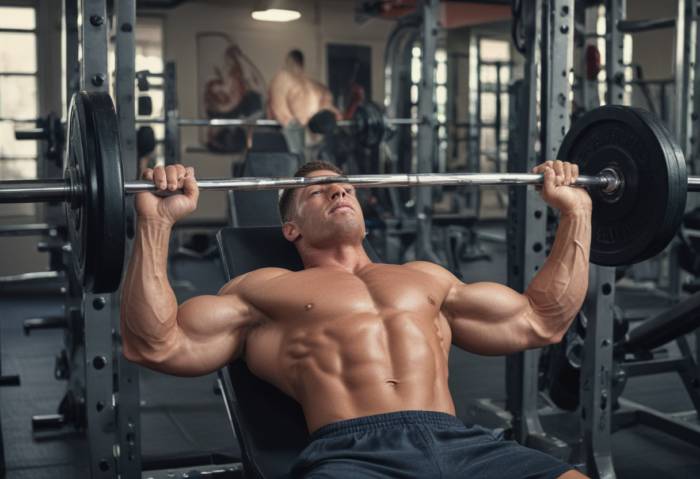
Kennelly’s favorites for the triceps are the close-grip bench press and presses from the power rack safety pins, also known as rack lockouts. In his words, both add a lot of strength to the triceps and shoulders. He uses a close grip for both exercises and does sets of five.
In regular training he mostly doesn’t go to failure. His usual choice is heavy work in triples: the weight has to be challenging but under control. Before competitions the picture changes a little. Usually four weeks before a meet, he also does a set or two to failure on the main pressing exercise, because it helps him get ready for the competition mentally and physically.
Kennelly uses the decline press in the period between competitions, when a meet is more than 8–10 weeks away. The incline press stays in permanently as accessory work. There, too, he uses a close grip and heavy sets of three. In his view, it works well for the triceps.
For him, the power rack is the main tool for training the lockout. When pressing from the safety pins, he doesn’t start lower than 20 cm from lockout. He usually sets the pins 10 cm and 20 cm from lockout. The set volume is 3–5 sets, with five repetitions in each set.
Training mistakes that keep your press stuck
Kennelly points out three typical mistakes: overtraining, undertraining and trying for records too often. In his view, training the press more than twice a week is already overtraining. Training the press less than once a week, on the other hand, is undertraining.
A powerlifter shouldn’t go to maximal weights every week. Kennelly recommends reaching a maximal result only 3–4 times a year. The rest of the time should go to submaximal weights, technical work and preparation for the periods when the weights really get big.
For the shoulders, he likes plate raises, standing dumbbell lateral raises and barbell upright rows. He usually does these for 4 sets in the 6–8 repetition range. It isn’t a fancy-sounding program, just clear accessory work that supports the press.
Triceps, legs and the practical side of lockout
Kennelly agrees with the idea that a strong squat and strong legs help the press too. He trains legs once a week. The main exercise is the squat, where he tries to go below parallel every time. One week he does 5 x 5, the next week 5 x 8, and he keeps alternating these rhythms.
After the squat comes the leg press. There he usually does very heavy sets of 5 x 10. Why is this related to the bench press? Your legs help keep the body tight at the start of the lift and get the bar moving. If you’re in doubt, try pressing your current record with your feet off the floor. You’ll feel the difference immediately.
When it comes to the triceps, Kennelly doesn’t talk only about the visible “horseshoe” part. He stresses the area around the elbow: the muscles, ligaments and tendons that help lock out big weights. A bodybuilder is often looking for mass and shape, while a powerlifter also has to care about how the triceps attach to the elbow and tolerate the training load.
For this he recommends lying dumbbell extensions, on the floor or on a bench, with your palms facing toward your head. Don’t let your elbow joints drift outward, and don’t drop the dumbbells down. Perform the movement under control. If the exercise is new to you, start with a light weight and longer sets. As your technique and feel improve, you can increase the weight.
FAQ
Should you always go to failure in the bench press?
No. Kennelly mostly does heavy triples, where the weight is heavy but controllable. He uses going to failure more in the run-up to a competition.
Why use a close grip?
A close grip makes the triceps work more. That makes it a good accessory exercise when the goal is a better lockout.
Which federations does Ryan Kennelly compete in?
The original names the WPO (World Powerlifting Organization), WAB (World Association of Benchpressers), APF (The American Powerlifting Federation) and APA (American Powerlifting Association).
Translated by: Janar Rückenberg
Come and train! ArtGym