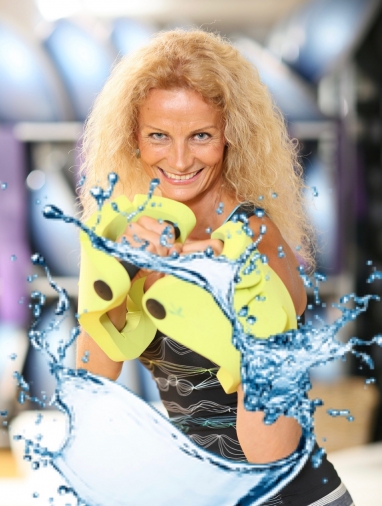
Water aerobics is one of the gentlest yet most effective ways to train. Water offers up to twelve times more resistance than air, supports your body weight and keeps your heart rate modest. The result is a strong workout without wearing out your joints — suitable for beginners, people who are recovering and advanced exercisers alike.
Why water aerobics works
In water, your body moves against resistance from every direction at once — forward, back, sideways, up. In regular aerobics the effort comes mainly from gravity; in water you add water resistance, which rises in exact proportion to how fast you move. A slow step is easy, while a sharp push turns into a serious high-intensity exercise.
This means two things. First, you choose the training load yourself — the same exercise suits a woman who is already in good shape just as well as a runner looking for a recovery class. Second, your heart rate stays lower in water than on land at the same effort, because water cools the body and supports circulation. You can train for longer without running out of steam.
Your joints will thank you. Your back, knees, hips and ankles — all the spots that take a hit when you run or jump — work cushioned by buoyancy. That’s why physiotherapists often recommend water aerobics to people for whom training on land is painful.
What water aerobics does for your body
If you go to class regularly, two times a week, you can expect to notice the following within a couple of months:
- Better posture and less back pain — water trains the deep muscles naturally, without you having to target them separately.
- Stronger endurance. Your breathlessness threshold rises and your everyday pace gets easier.
- Slow but steady weight loss. Your heart rate doesn’t spike, energy expenditure stays even and your appetite doesn’t start screaming after class.
- Better balance and coordination — it shows outside the pool, for example on slippery winter roads or on stairs.
- Less stress. Water is calming in itself; a good class is as relaxing as it is demanding.
The plain truth: nobody becomes a new person in a single class. But six weeks of a routine of two sessions a week makes a difference you can feel when you reach the top of the stairs and see when you look in the mirror.
Who water aerobics suits
The short answer — almost everyone. The longer answer:
- Beginners who have never worked out before. The training load is gentle, progress is steady and there’s no embarrassment, because you can’t see anyone under the water anyway.
- People with joint pain, excess weight or back problems — water takes the load of your body weight off you.
- Postpartum recovery (after your doctor’s green light) — water aerobics is one of the gentlest ways to get back in shape.
- Athletes on active recovery days. A light class in the pool helps clear muscle fatigue after a strength or running workout.
- Older adults. Buoyancy supports, resistance builds, and your joints don’t suffer.
Who might it suit less? A severe chlorine allergy, an open skin infection, or an acute ear infection or pneumonia are clear limitations. If you’re in doubt, ask your doctor first.
Your first water aerobics class — what to bring
The equipment is minimal:
- swimsuit and swimming cap (mandatory in many Estonian pools)
- shower gel, shampoo and a towel
- a bottle of water — in the water it’s easy to forget that your body is still losing fluid
- ear protectors, if your ears are sensitive to chlorine
- buoys, hand weights or an aqua jogging belt are usually available on site — ask your instructor
As for eating — don’t come on a full stomach. One light meal two hours before class is best. After class, have protein and carbohydrates within a couple of hours so that recovery can take place. If you go to a morning class, porridge or yogurt porridge works well; before an evening class, a piece of fruit and a few almonds are enough.
The intensity of your first class may be lower. That’s normal — your body is learning to read water resistance. From the second or third class you’ll feel your movements getting smoother and you can raise the training load.
Frequently asked questions
Is the class suitable for non-swimmers?
Yes. Most classes take place in shallow water where your feet reach the bottom. Some exercises are done in deeper water with an aqua jogging belt or buoys, but even then you don’t need to know how to swim — the equipment keeps you afloat.
How often should you go?
Two sessions a week is a good balance — your body has time to recover, yet your fitness keeps progressing. One session a week keeps your fitness where it is; three sessions give faster results, especially if the goal is weight loss.
Does water aerobics help with weight loss?
It does, if training goes together with moderate eating. A class burns between 300–500 kcal, depending on intensity and body weight. The biggest effect is actually indirect — better sleep, less stress and the energy to be more active at other times too.
Come and train! ArtGym