A tension-free, pain-free back every day
Your back often gives you a warning before real pain arrives. Your shoulders creep up to your ears, your lower back stiffens and sitting for longer becomes a chore. The good news: a lot can be done with calm movement, breathing and a sensible training load.
Why does your back get tense?
Back pain doesn’t always come from one big mistake. Often it builds up from small things: a day at the computer, your head bent down over your phone, a drive in the car, too little sleep and constant rushing. Your body doesn’t realize you’re just having a busy week. It reads the signal like this: hold on, tighten up, protect.
Honestly, the back is quite patient. It puts up with a lot. But when the same position repeats day after day, the muscles start to tire. Some areas become weak, others do too much work. Then a single sharp bend or a heavy grocery bag is enough, and you feel something tweak.
Stress plays a big role too. When your jaw is clenched, your breathing is shallow and your shoulders are up all day, your back can’t stay relaxed. That’s why looking after your back isn’t only about exercises on the mat. It also means breaks, calmer breathing and the ability to notice when your body is already screaming.
How do you get your back moving again?
Start simple. A sore back doesn’t need a barbell right away, heavy rows or a heroic stretch. It needs a sense of safety. The best first step is slow movement where you can breathe and check in on what’s happening in your body.
MediYoga and other gentler forms of yoga suit many people precisely because they don’t force the body to compete. The exercises are soft, breathing takes a central place and movement follows each person’s own limits. If the original seminar talked about a tension-free and pain-free back, that idea still holds: the back needs strength, but also the ability to relax.
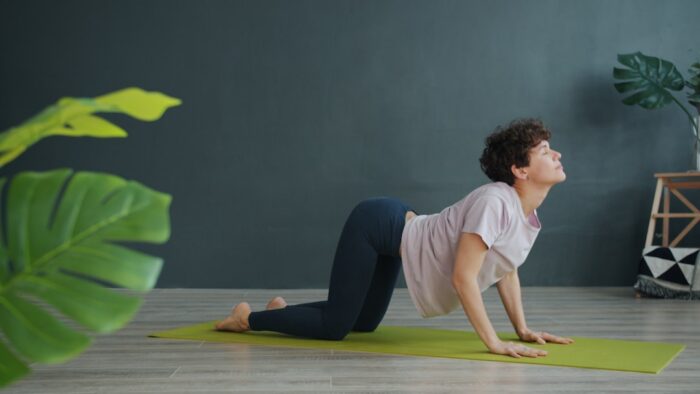
One simple routine could look like this: a couple of minutes of calm belly breathing, then gentle torso rotations, the cat-cow movement on all fours and finally opening up the hips and chest. Do everything slowly. If the pain turns sharp, reduce the range of motion or stop the exercise.
So what actually happens? Your nervous system realizes that movement is not a threat. The muscles let go a little. Blood flows better. And you regain the feeling that your back isn’t the enemy but a part of your body you can train smartly.
Practical techniques for a tension-free day
If you work at a desk, don’t look for the perfect sitting position. It doesn’t exist. A better idea is to change position often. Sit, stand, walk, occasionally rest one foot on a low step. Movement is better for your back than five hours of perfectly straight posture.
Set yourself a small rule: after every hour, stand up for two minutes. Do a few shoulder rolls and a few hip bends, walk to the kitchen for some water. That isn’t a workout, but it breaks a rigid pattern. In winter, when it’s dark and slippery in Estonia, movement easily drops off. That’s when these small breaks matter most.
In the gym, choose exercises that teach your body to work as a whole. Light deadlifts, hip thrusts, core exercises and pulling movements help your back more than endless stretching. If you’re a beginner, ask a coach to check your technique.
A simple truth: your back loves regularity. Not one big Sunday rescue operation, but small acts of care almost every day. Five minutes in the morning and ten minutes in the evening can do more than the occasional bout of overtraining.
FAQ: your back and everyday movement
Can you train with a sore back?
If the pain is mild and movement makes you feel better, calm training may be fine. If you have sharp pain, numbness, pain radiating down the leg, or after an injury, it’s worth asking a doctor or physiotherapist for advice first.
Is yoga suitable for every back?
It isn’t automatically suitable for everyone. Calm yoga can help improve mobility and breathing, but the exercises must match your condition. Don’t push yourself into a position where the pain increases.
How quickly does your back get better?
Sometimes the body eases within a couple of days, sometimes it takes weeks. The most important thing is consistency: move a little, sleep enough and reduce the load that winds the tension back up.
Author: Kai Ilp
Come and work out! ArtGym