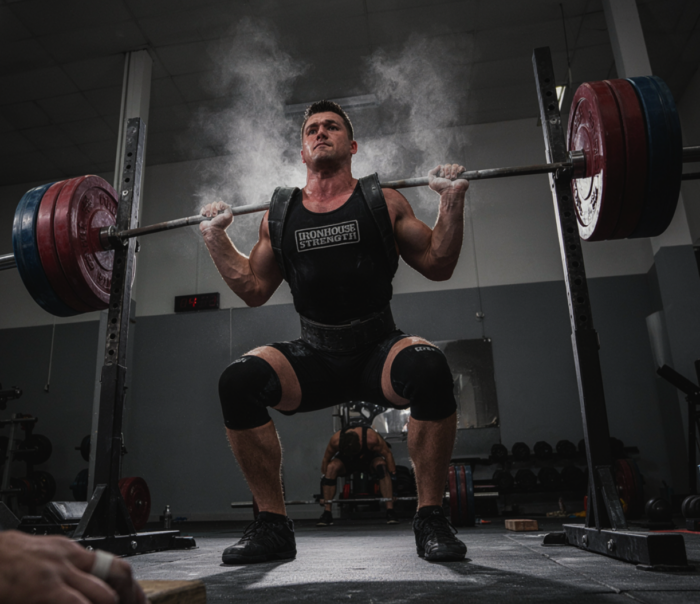
Safety bar: why it’s worth squatting with one
A safety bar doesn’t look as ordinary in the gym as a straight squat barbell, but for squatting it can be a very sensible choice. If your shoulders are stiff, your lower back is sending warning signals or your technique needs honest feedback, this bar is worth a try.
The safety bar and why it matters
A squat with a standard barbell demands quite a lot from the shoulders. Your arms have to go behind you, your chest has to stay up and the bar has to sit securely on your upper back. If your shoulder joints are stiff or an old injury gets in the way, that position quickly becomes uncomfortable.
The safety bar, or safety squat bar, solves part of this problem with a simple design. The handles sit further forward, so your hands don’t have to hold the bar behind your shoulders. That makes squatting gentler on the shoulders, especially when the standard barbell position pulls on your wrists, elbows or shoulders.
That doesn’t mean the safety bar is an easier bar. Quite the opposite. Because your hands hold handles out in front rather than the bar itself, the bar sits slightly less stable on your upper back. A lifter notices immediately when the torso collapses, the weight shifts onto one leg or technique starts to slip at the end of a set.
Honestly, that’s a pretty useful feeling. With a standard barbell you can sometimes hide a small error. The safety bar hands it right back to you.
How the safety bar changes squat technique
The safety bar forces you to keep your chest up and your upper body more upright. That changes how the squat feels. Your hips still move back, but you can’t keep folding forward with your upper body indefinitely, because the bar immediately starts to take on a life of its own.
The more upright you squat, the less load falls on the lower back. The main work shifts more to the quadriceps and glute muscles. That’s exactly why the safety bar suits people who want to train their legs but don’t want to pay too high a price in the lower back on every set.
Charles Poliquin put it aptly: “If you have lower back problems, the safety bar is your good friend when squatting.” That idea holds up pretty well in the gym. Not because the safety bar would cure anything, but because it pushes you into a cleaner position.
A simple truth: if the weight pulls you forward, you have to brace your trunk harder. If the weight drifts to the side, you have to get your leg work and torso working together better. If you tend to lean more on one shoulder or one leg, the safety bar shows it quickly.
In some ways, a safety bar squat resembles a mix of a front squat and a deadlift. You have to stay upright, but at the same time keep your hips and back under firm control. That makes the exercise a good helper for improving your regular squat too.
What to do with the safety bar and how to get started
The safety bar doesn’t have to be just an exercise you do for variety. It can be used in several ways, especially when the goal is to learn to squat better and keep the training load on the legs.
- Squat with the safety bar calmly and focus on keeping the bar from moving from side to side.
- Keep your chest up and make sure you don’t fold forward at the end of a set.
- Send your butt back from the hip joint, but don’t lose your upright position.
- Use the safety bar for lunges, because the feel is different from a standard barbell or dumbbells.
- Try front squats with the safety bar if getting the bar onto your shoulders doesn’t cause too much hassle.
- After a period of training with the safety bar, go back to the standard barbell and see how your squat feels.
With front squats, don’t rush the weights. At first, do sets of 6-12 reps, feel the range of motion and play with your technique. In this phase the goal isn’t to prove how much you can lift. The goal is to understand how the bar affects your body position.
You’ll probably also notice that the weights you can use with the safety bar drop compared with a standard barbell. That’s normal. The more upright position, the greater technical demand and keeping your balance all take their share. Your ego may take a small hit, but your squat becomes more honest.
The safety bar in practical training
So what actually happens when you add the safety bar to your program? Most of the time you get a new angle on the same basic movement. Your legs work hard, your lower back doesn’t have to carry all the work alone and your technique signals sooner when something falls apart.
A good idea is to use the safety bar in blocks. For example, run a program or two with it and learn to control depth, torso position and weight distribution better. Then go back to the standard barbell. In many cases the regular squat feels more solid afterwards, because your body has learned a cleaner movement.
At the same time, the safety bar shouldn’t be seen as a complete replacement for the regular squat. The barbell back squat is still an important exercise if your shoulders and body allow it. The safety bar is rather a strong alternative and accessory exercise that helps bring weak spots to light.
If you only have one barbell available, use the one that suits your body and your goal. If a safety bar is on hand, use it deliberately. Start lighter, let your technique do the talking and don’t treat the instability as a mistake. That is precisely one of this bar’s biggest strengths.
FAQ
Is the safety bar suitable for beginners?
Yes, as long as the weight is sensible and your technique is under control. For a beginner it can even show clearly whether the body tips forward or to one side during the squat.
Does the safety bar reduce the training load on the lower back?
A more upright body position can reduce the training load on the lower back. It doesn’t make the exercise easy by default, but it helps keep more of the work in the legs and glutes.
Does the safety bar replace the regular squat?
It doesn’t have to. It’s a very good alternative and accessory exercise, but the squat with a standard barbell remains the main exercise for many lifters.
Author: Janar Rückenberg
Come and train! ArtGym