Rest periods in strength training: how long should you rest?
Rest periods between sets are one of the most underrated variables in strength training. When one of my clients asks how many minutes to wait between sets, I can’t give a single number — the answer depends on the load, the effort and which working set you’re currently on. Below are four practical ideas that will help you find the right rhythm for yourself.
Why rest periods decide the fate of your next set
The point of resting after a set is simple: recover enough that the next planned working set succeeds at the same weight and rep count. Everything else is detail.
Say you’re squatting 5×5 and rest two minutes after the first set of five, but the second set of five falls short — then the rest was simply too short. The previous set is always the yardstick for the next one. You don’t have to guess the first rest in advance; just pay attention to what the second set tells you.
Take accumulated fatigue into account too. If the previous working set barely got done, with great effort, after a short rest, give yourself more time before the next set. The cost of hard effort doesn’t wear off on its own — you have to write it into the rest explicitly.
First sets vs. last sets: rest naturally gets longer
There’s no point padding your rest periods to fill some prescribed time. But it’s just as wrong to rush so much that the following working sets fall apart. In practice it goes like this: after the warm-up sets, the rests gradually get longer, because the load gets heavier and each set takes more out of your nervous system.
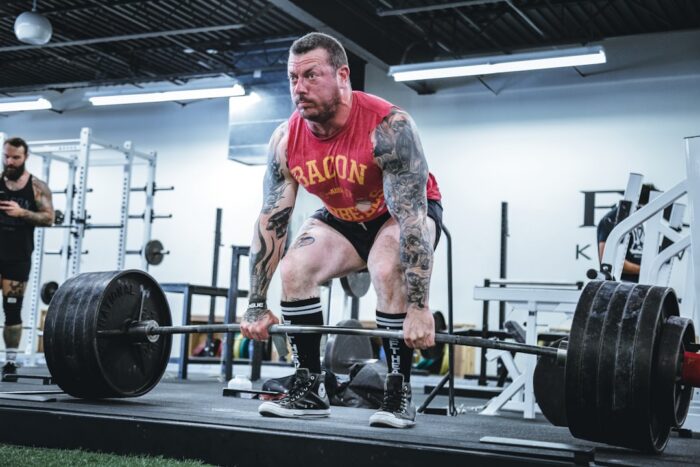
Take the deadlift as an example. The workout looks like this: 130 kg × 8, 150 kg × 8, 170 kg × 6, then 200 kg × 3 for five sets. Between the warm-up sets, 2.5–3 minutes is enough. For the working sets, the picture might look like this:
- 200 kg × 3 — rest 3 minutes
- 200 kg × 3 — rest 3 min 30 s
- 200 kg × 3 — rest 3 min 30 s
- 200 kg × 3 — rest 4 minutes
- 200 kg × 3 — last set
The difference isn’t big, but it’s there. Longer rests in the heavier sets aren’t laziness — they’re part of the plan.
Weight on the bar and rest periods go hand in hand
The more weight on the bar, the longer the rests you need. The deadlifter in the previous example managed 5×3 with 200 kg using 3–4-minute rests. If your heavy 5×3 deadlift is around 240–250 kg, you’ll wait more like 5–7 minutes between sets. Sometimes even longer.
This is exactly why a top-level powerlifter’s workout takes so long: most of the minutes go to the heavy working sets of the main lifts and the rests between them. Accessory exercises come at the end and go much faster, because the rests are shorter too.
Sets taken to failure need separate treatment
One rule is clear: a set done with maximal voluntary effort (10/10 on the scale) requires a much longer rest than a set where you stopped 3 reps short of your limit (about 7/10).
In practice this means that if you program a “top set + back-off” workout where one set really goes to the last rep, give yourself time after it. Not three minutes like before — more like five to seven. Otherwise the fatigue from the maximal set carries over into the following back-off sets, and they fall apart more easily than expected.
FAQ on rest periods
Does a longer rest make training less effective?
From the standpoint of strength and muscle mass — no. If the goal is to lift more weight, a longer rest is better, because the next set goes properly. Shorter rests suit goals like metabolic stress or conditioning work better.
How do I know the rest was long enough?
A simple metric: did the next set go to plan? If yes, the rest was at least sufficient. If reps fell short or your technique broke down — the rest was too short. A stopwatch is a good guide, but the numbers from your sets are the final proof.
Should you time your rests by the clock?
For beginners and intermediate lifters I recommend it — a phone stopwatch is enough. Without a clock, rests tend to stretch or shrink at random depending on how busy the gym is. Advanced lifters already have a better feel for their body and can improvise more.
To be continued…
Author: Janar Rückenberg
Come and train! ArtGym