Movement training and the mind-muscle connection
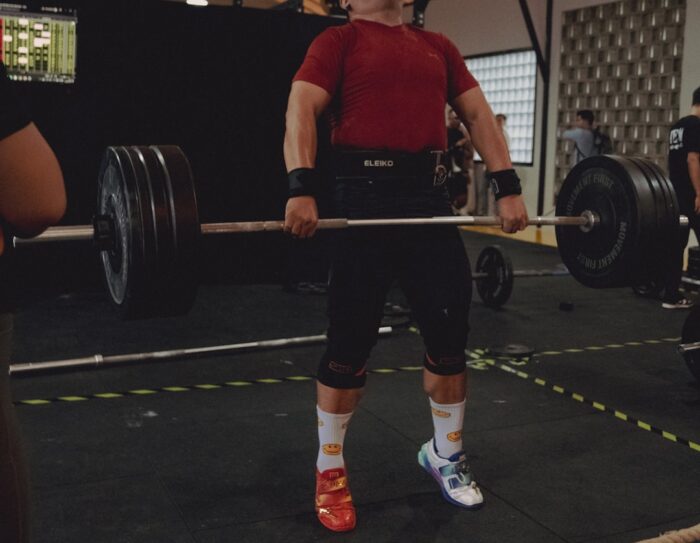
Movement training isn’t just a powerlifter’s concern. When the weight gets heavy, feeling an individual muscle often fades away and one simple task remains: perform the lift cleanly, powerfully and all the way through.
The question isn’t whether to train muscles or movements. A better question is: when does it make sense to look for the mind-muscle connection, and when should you trust the movement pattern of the exercise?
Why does movement training matter at all?
In the gym you often hear that a bodybuilder has to feel the muscle. That’s a sound idea, especially when the goal is muscle mass, body proportions and better control over the exercise. But it doesn’t mean that your full attention has to be on one specific muscle in every set.
Take a heavy squat, for example. With a light or moderate weight, you can think about your quads, your glutes or how your knees are moving. But when a set truly reaches its limit in terms of weight and effort, the picture changes. Your body no longer asks whether you can feel one particular muscle. It wants to know whether you can stand up with the squat.
Honestly, I’ve felt the same myself. Up to a certain set length, you can still keep the muscle in focus. From some point on, especially as the weight climbs and the reps drop, your attention shifts to the whole movement. At that point you’re no longer training only the mind-muscle connection. You’re training the movement.
Where is the line between movements and muscles?
The line isn’t the same for everyone. It depends on the exercise, your technique, your experience and how close to failure the set is taken. A four-rep squat near your max doesn’t usually feel like a calm search for the muscle. The same goes for 5-6 reps, if the set is really done with strong mental effort.
This is where intensity comes in, meaning the weight as a percentage of your 1RM. The higher the percentage, the more your body has to use the entire movement chain. In the basic lifts this is especially clear. Presses, squats, deadlifts and pull-ups aren’t isolation work for a single muscle. They’re team efforts.
When it comes to muscle growth, people often talk about two directions: sarcoplasmic and myofibrillar hypertrophy. Broadly speaking, the 8-15 rep range and 60-80% intensity are associated more with sarcoplasmic work. The 2-8 rep range and 80-95% intensity are associated more with the myofibrillar side.
That’s no reason to lock everything into a table. It’s more of a practical reminder: if you want different stimuli for muscle growth, you need to use different rep ranges and different weights. Some sets give you a better mind-muscle connection. Others teach you how to perform a heavy lift.
What did a study on the bench press show?
One study looked at muscle activity in the bench press at 50% and at 80%. When lifters were asked at 50% to focus on the chest, chest muscle activity increased by an average of 22%. Activity in the front delts and triceps stayed unchanged.
The same was tried with the triceps. When lifters focused on the triceps during the press, triceps activity increased by 26%. Chest muscle activity even decreased. But at 80% the picture was no longer as clear: with the heavier weight, the front delts inevitably came in strongly, and focusing on one muscle no longer guided the movement in the same way.
Reference: http://www.ncbi.nlm.nih.gov/pubmed/22076100
Movement training in practice
A simple truth: the heavier and shorter the set, the more you need to think about execution. If you’re doing sets of 15 with a moderate weight, the mind-muscle connection can be very good. If you’re doing a heavy set of six pull-ups, the question changes. Should you do a set of six with an overhand grip and 20 kg, feeling your lats, or a set of six with a locked grip and 35 kg, focusing on the movement?
The answer depends on your goal. If the goal is to feel a specific muscle better, choose a weight you can truly control it with. If the goal is strength and a strong myofibrillar stimulus, a heavy lift isn’t the enemy. It’s a tool.
Even a bodybuilder can’t escape movement training. If the plan is, say, a set of six to failure at 85% of 1RM, it isn’t realistic to expect the whole set to stay on a fine-tuned feeling in one muscle. The same goes for the 80-85% range. Heavy weight demands the whole movement.
For a basic exercise, the combination of “a set taken to failure with maximal effort in the 1-8 repetition range + 80-100% intensity” usually means training the movement. A squat with those parameters isn’t a meditative exercise in feeling your quads. It’s a heavy squat.
What movement training doesn’t mean
It doesn’t mean the mind-muscle connection is pointless. Quite the opposite. In longer sets, accessory exercises and when learning technique, feeling the muscle is very valuable. It helps you tell whether the exercise is hitting the right spot or whether the load is shifting to where you don’t want it.
A practical split could look something like this: 1/3 of a bodybuilder’s training volume can go to work focused more on the movement and 2/3 to the mind-muscle connection. For a powerlifter, the ratio may be the other way around. This isn’t a rule, just food for thought.
If you want to load a particular muscle more, you can also do it through your choice of movement. For example, front squat vs back squat, or bench press with a medium grip vs a wide grip. You don’t always have to mentally “chase” the muscle. Sometimes the right exercise variation sets the training load in the right place on its own.
FAQ: movement training
Is the mind-muscle connection necessary for muscle growth?
It’s useful, but it isn’t the only route to muscle growth. In heavier compound exercises, good movement and sufficient training load can give a very strong stimulus even if you can’t clearly feel one muscle on its own.
When should you focus more on the movement?
When the set is heavy, the reps are few and the exercise requires the whole body to work together. This applies especially to the squat, deadlift, press and pull-up.
Should a bodybuilder do heavy, short sets?
Yes, if they fit into your program and your technique holds up. For maximum muscle hypertrophy, it makes sense to use both longer sets with a focus on the mind-muscle connection and heavier sets that focus on the movement.
Discussion and differing views on this topic are certainly welcome.
Author: Janar Rückenberg
Come and train! ArtGym