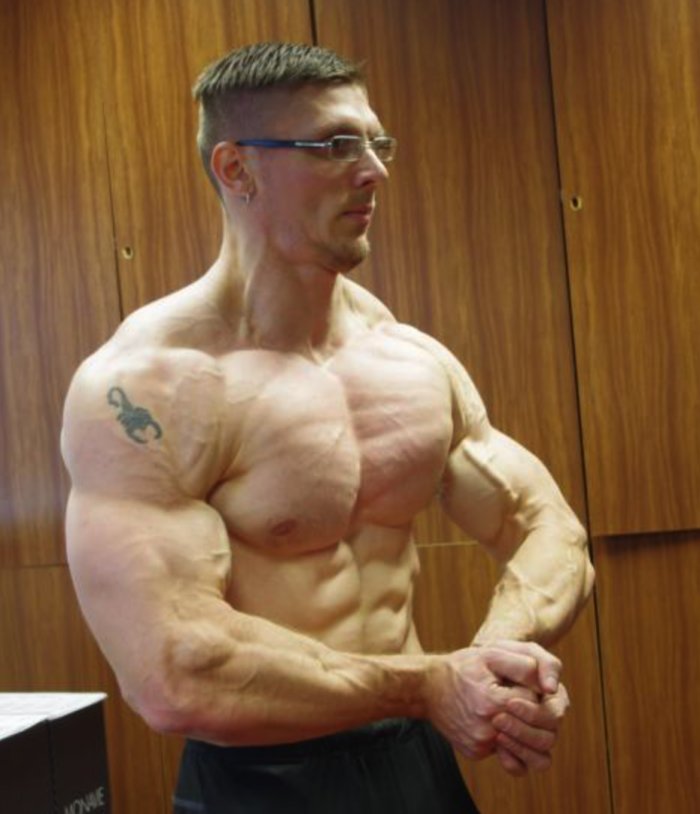
Summer 2013 and Janar Rückenberg’s training plan
In practically every competition season, my thoughts have started drifting to post-contest plans 2 – 3 weeks before the final show. It’s amazing how, in the subconscious buried under a mind still crushed by the ongoing diet, the first seeds of the next season’s training plans begin to sprout. How to carry on after the contest in the new preparation phase, what to prioritize, what to bring up, which splits to follow, how to progress, which systems to try, or simply how to move forward at all.
A hardened, fanatical gym rat knows exactly what I’m talking about. On one hand, you’re still on the final stretch of a hard journey, tired, fed up and drained; on the other, you’re already gathering your thoughts on how to get even better. That’s always oddly refreshing, exciting and motivating.
A new beginning and new plans are like the light at the end of a hard road and a tunnel. And seeing the light after a “crushing, long-lasting darkness” is always both strength-giving and hope-inspiring.
In today’s piece, I intend to give a brief overview of how I’ve organized my training since the spring season. I’m doing it as a standalone article because I believe quite a few trainees can take away valuable information on how to bring change and variety into their own training. On Bloq, long and thorough posts packed with valuable information usually sink into oblivion, ungratefully fast.
So, even before the European Championships in Moldova, quite a few thoughts were spinning in my head about how I might continue after the last contest. The first question I tackled was what to bring up and what to put more emphasis on. The answers to these questions were decisive when putting together the upcoming split.
Summer 2013: 1. Priorities
Of course, I’d like to improve everything. Mass and refinement would come in handy everywhere. The priorities this summer, in 2013, are still the back and legs. In addition, I want to pay more attention to the shoulders and biceps. It’s clear that when there are this many muscles/body parts among the priorities, a split spread over just one week can’t satisfy all the wishes. From 1 June 2013, I decided to try a split spread over two weeks, which would let me keep a stronger focus on the back and legs while also working properly on the shoulders and biceps. The split turned out like this:
Monday – LATS, BICEPS
Tuesday – LEGS, ABS
Wednesday – CHEST, SHOULDERS, TRICEPS
Thursday – REST
Friday – LATS, TRAPS, ABS
Saturday – SHOULDERS, BICEPS
Sunday – REST
Monday – LEGS, ABS
Tuesday – REST
Wednesday – BENCH PRESS, LATS, BICEPS
Thursday – LEGS, ABS
Friday – REST
Saturday – SHOULDERS, TRAPS, TRICEPS
Sunday – REST
The split worked very well and I used it until 21 July, when I was forced to modify the plan a little. The reason was that I felt I couldn’t recover from five training sessions a week. The priorities stayed the same, but I arranged the split so that both weeks have 4 workouts. I’ve been training the chest, triceps, abs and calves at a maintenance level only.
The split from 22 July looks like this:
Monday – LATS, BICEPS
Tuesday – LEGS, ABS
Wednesday – REST
Thursday – BENCH PRESS, LATS, TRAPS
Friday – SHOULDERS, TRICEPS, ABS
Saturday – REST
Sunday – REST
Monday – LEGS, ABS
Tuesday – BENCH PRESS, LATS, BICEPS
Wednesday – REST
Thursday – LEGS, ABS
Friday – SHOULDERS, TRAPS, TRICEPS
Saturday – REST
Sunday – REST
2. Progression
One of the most important questions is always: how do you progress? I’ve approached the shoulders and biceps more freely and creatively, but still working up in weight over time across the different exercises. For the legs and back, the system exercises are still the squat and the pull-up. Leg day starts with the squat system, followed by other exercises. Back day starts with either close underhand-grip pull-ups or wide overhand-grip pull-ups. The first of these pull-up variations is also a relatively new exercise in my plans. I still prefer wave periodization, and I combine it with alternating between two different pull-up variations. I wave the training load, volume and set lengths for the squat as well, and it works.
Squat (legs):
8 x 8: 110 kg; 120 kg; 130 kg; 140 kg; 150 kg;
10 x 4: 130 kg; 140 kg; 150 kg; 160 kg; 170 kg;
6 x 6: 120 kg; 130 kg; 140 kg; 150 kg; 160 kg;
Pull-ups (back):
Close underhand-grip pull-ups: 4 x 8 (4 – 5 x 8)
Wide overhand-grip pull-ups: 8 x 4 (8 x 3 – 5)
Close underhand-grip pull-ups: 6 x 6 (5 – 6 x 6)
Wide overhand-grip pull-ups: 4 x 8 (4 – 5 x 8)
Close underhand-grip pull-ups: 8 x 4 (8 x 3 – 5)
Wide overhand-grip pull-ups: 6 x 6 (5 – 6 x 6)
3. Rep ranges
For the squat, I’ve decided to follow progress by alternating between sets of four, six and eight reps. Sets for the accessory exercises naturally come in all lengths, even up to 50 reps.
I actually use sets of the same lengths for pull-ups as the back’s system exercise too. The only difference is that every other workout I do close underhand-grip pull-ups first, then wide overhand-grip pull-ups. This approach works quite well.
4. New exercises
After the competitions, it was clear that further progress would require something completely new. The priorities are set, and so are the split, progression and repetitions, but it’s obvious that going forward I also need freshness in the form of new exercises. The well-known basic exercises are the cornerstone of progress and will always remain the foundation, but if year after year we use only the same movements, we end up holding our own progress back. In the summer of 2013, the relatively new exercises in my programs are the following:
a. One-arm bent-over row with the end of the barbell. The barbell moves between your two legs. A fantastic exercise, and I keep wondering how I never tried this lat row variation before. It’s an excellent position for balance, and it doesn’t twist the lower back. The lat goes into a proper deep stretch. I feel the lat very well, and my back doesn’t take a beating. Compared with the classic basic lat movement, this row version is completely new to me and works extremely well.
Incidentally, I grip the bar itself, not the part where the plates go on. That’s more comfortable, and the feel and range of motion are better still.
b. Weighted close underhand-grip pull-ups. A well-known exercise, but over my career I’ve hardly done it at all, since I lacked the means. Although the biceps is clearly working too, I’m gradually learning to do this pull mainly with the lats. It’s a good exercise, and as I progress and the weights go up, I’m confident it will add to my back development. I now also have the option of doing this exercise not on a straight bar but on a bar set at a slight angle. It doesn’t twist the wrists. On a straight pull-up bar I generally don’t recommend this exercise, since it gets hard on the wrists and elbow joints.
c. Dumbbell hammer curls for the biceps. Another well-known movement, but once again I’ve shamelessly neglected this exercise myself. It loads the brachialis and the outer head of the biceps heavily, making the upper arm – the biceps – look denser and squarer from the front. That’s exactly what I’m after in biceps development. I do this exercise standing, alternating arms, seated on an incline bench and on the Scott bench.
d. Barbell bench press with chains, close/medium grip. I’ve done this exercise before, but quite a while ago. In addition to the chains, the barbell also carries weight in the form of plates. Right now I’m working up with 6 x 6 and am at 105 kg (+ 12 kg of chains). I try to work in a focused way, mainly with the triceps.
e. Straight-arm cable pulldown (for the lats, with a ball handle). A superb exercise. It’s the ball handle that gives an unprecedentedly good feel for the lat. You can see this exercise in the clip below at 2 : 10, and I do it both kneeling and standing. It’s an exercise that deserves a try, and finding the feel for it.
So these are the changes in the gym this year, 2013, that are most worth highlighting. If even one trainee has taken at least one new idea (an approach, an exercise, etc.) from this article and put it to use in their own training, then the piece has already served its purpose…
Author: Janar Rückenberg
Come and train! ArtGym